
Huntr Blog
The Ultimate Job Search Guide (2026): What Actually Works
November 09, 2026
Hi, I'm Sam. I lead career strategy at Huntr, where I was the first hire in 2021. I built this guide from 1,000+ free calls with job seekers and data on about 2 million applications. It's all on this one page. Jump to the part you need, or read it top to bottom.
As seen in Forbes, Business Insider, The Wall Street Journal, The Seattle Times, Salon, HubSpot, The Job Hopper, ZDNET, CIO, and the U.S. Chamber of Commerce.
Used by career centers. Yale, UCLA, UChicago, Carnegie Mellon, Georgetown, Michigan, and 40+ other schools link to Huntr's tools and research. Our research has been cited by Quartz, Crain's Chicago Business, Forbes Japan, Coursera, The Business Journals, and many more.
"Even if you have a well-crafted resume, Sam can help point out the minor details or missing elements which take it from very good to great."
Technical project manager, in a public LinkedIn recommendation, June 2026
Let's connect on LinkedIn. Or add me on Happenstance to browse my connections and find people I might be able to refer you to.
Where are you starting from?
Pick the one that sounds most like you. Each one points you to the 2 or 3 parts of this guide that fit your search.
⚡ I need a job now
Aim for the title you just had, and apply where interview rates are highest.
Read Plan your search and Where to find jobs.
📦 I just got laid off
Don't sign yet. Negotiate severance, file for unemployment, and map your people.
Read If you were just laid off, then Plan your search.
🌟 I'm going for my dream job
Run a reach search next to your main one, and lean on referrals.
Read Networking and referrals and Tailor your resume and use AI.
🎓 I'm looking for my first job
Lead with projects, internships, and proof you can do the work.
Read Write your resume and Career changes, gaps, ageism, and first jobs.
🧭 I'm changing careers
Keep your industry or your job title, and change the other.
Read Career changes, gaps, ageism, and first jobs, our career changer research, and our career change resume examples.
🧓 I'm worried about ageism
Ageism is real, but in our data 20+ years of experience didn't hurt. Keep the experience you have.
Read Career changes, gaps, ageism, and first jobs.
TL;DR: 6 things that matter most
- Apply on Google Jobs and company sites. Google Jobs had a 9.9% interview rate. LinkedIn had 3.6%.
- Tailor every resume. Tailored resumes got 1.85x the interview rate.
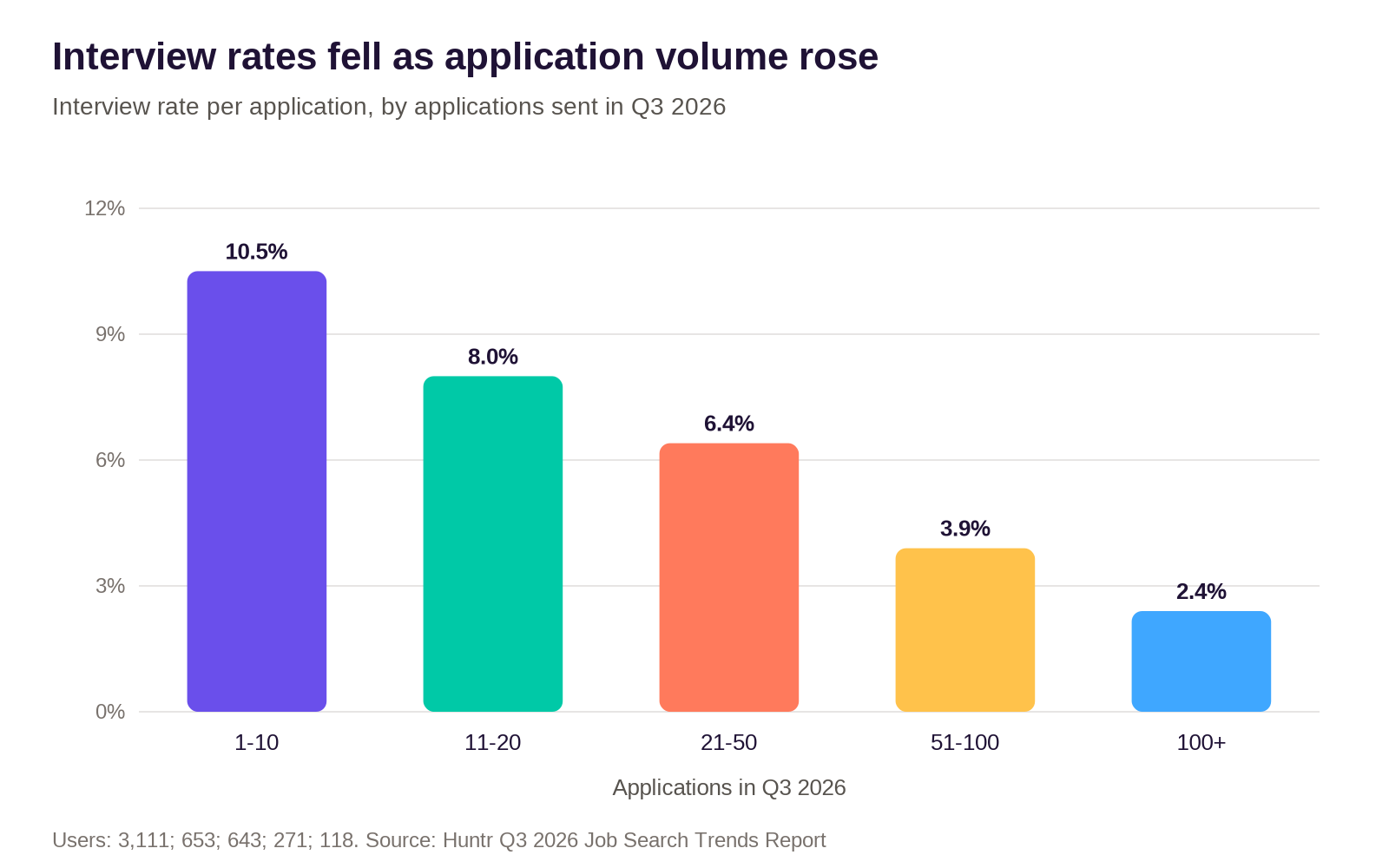
- Apply 10 to 20 a week, and match each one. People who sent 11 to 20 applications got interviews on 8.0% of them. People who sent 100+ got 2.4%.
- Ask for referrals, and keep applying. 40% of referred applicants reach an interview, against 3% of everyone else. But cold applicants still fill most jobs.
- A person reads your resume. Fast rejections come from knockout questions on the form.
- Plan for 3 to 4 months. The median time to a first offer was 102 days in Q3 2026.
What's in this guide
- Plan your search: your target, weekly pace, and tracking
- Where to find jobs: the best job sites and the hidden job market
- Networking and referrals: who to ask and what to say
- Write your resume: 7 fixes from 2,000+ resume reviews
- Tailor your resume and use AI: match each job, and check what AI writes
- Understand the ATS: what recruiters say gets you rejected
- Your LinkedIn profile: 8 ways to get found by recruiters
- Follow-ups and cover letters: messages people answer
- Prepare for interviews: stories, questions, AI interviews, and final rounds
- Job offers and negotiation: pay, terms, and how to ask for more
- Career changes, gaps, ageism, and first jobs: new fields, career breaks, ageism, and visas
- Advice by field: resume examples and tips for your field
- Get the right help: coaches, tools, mental health, and scams to avoid
- If you were just laid off: your first 4 weeks, week by week
- Frequently asked questions: short answers to common questions
- How I built this guide: where the numbers come from
Plan your search
"I have submitted 676 applications ... And of those 676 I have converted into six interviews."
Technical program manager, on a call with Sam
A written plan, by itself, raises your odds. In a randomized study in South Africa, job seekers who made a job search plan got 30% more job offers and were 26% more likely to be employed at follow-up, without spending more time searching (Abel, Burger, Carranza and Piraino, 2019).
Before you start: know your limits
Write these down before you send a single application:
- Income: how long can you go without a paycheck? Count how many months your savings will cover. In our Q3 2026 survey, 42% of job seekers could get by for less than 3 months without a job. Only 55% of US adults have 3 months saved (Federal Reserve, 2025).
- Location: where can you work, and would you move? If you would move, put the city you want at the top of your resume, not your home address. "Relocating to Denver, CO" tells the recruiter you're ready and keeps your address from screening you out.
- Work authorization: where can you legally work, and do you need sponsorship? This gets complex, and every case is different. Be upfront about your status, and look for employers that hire people with it.
- Schedule: which hours can you work, and how many can you spend searching each week? Plan on 15 to 30 minutes per application. At 10 to 20 a week, that's 2.5 to 10 hours a week, or 30 minutes to 2 hours a weekday.
- Caregiving: who else depends on your time?
Pick your path
Your limits decide which path you take. If you need income now, run both at once.
Path 1: You need a job soon
- Aim for the title you just had. That's the title you're most likely to get interviews for. Resumes whose title matched the posting had a 10.6x higher interview rate in Jobscan's study of 2.5 million applications.
- Look at onsite and hybrid jobs too. Remote-only applications had a 3.4% interview rate in Q3 2026, against 5.3% for both onsite and hybrid.
- Take interim work if you need it. Interim work does not erase your experience. Just laid off? Start with If you were just laid off.
Path 2: You have time to reach
- Aim higher or change fields if you have a job or savings to lean on.
- Change 1 thing at a time. Keep your industry and change your function, or keep your function and change your industry.
- Changing both takes stronger proof, such as a relevant project, internal assignment, or paid contract.
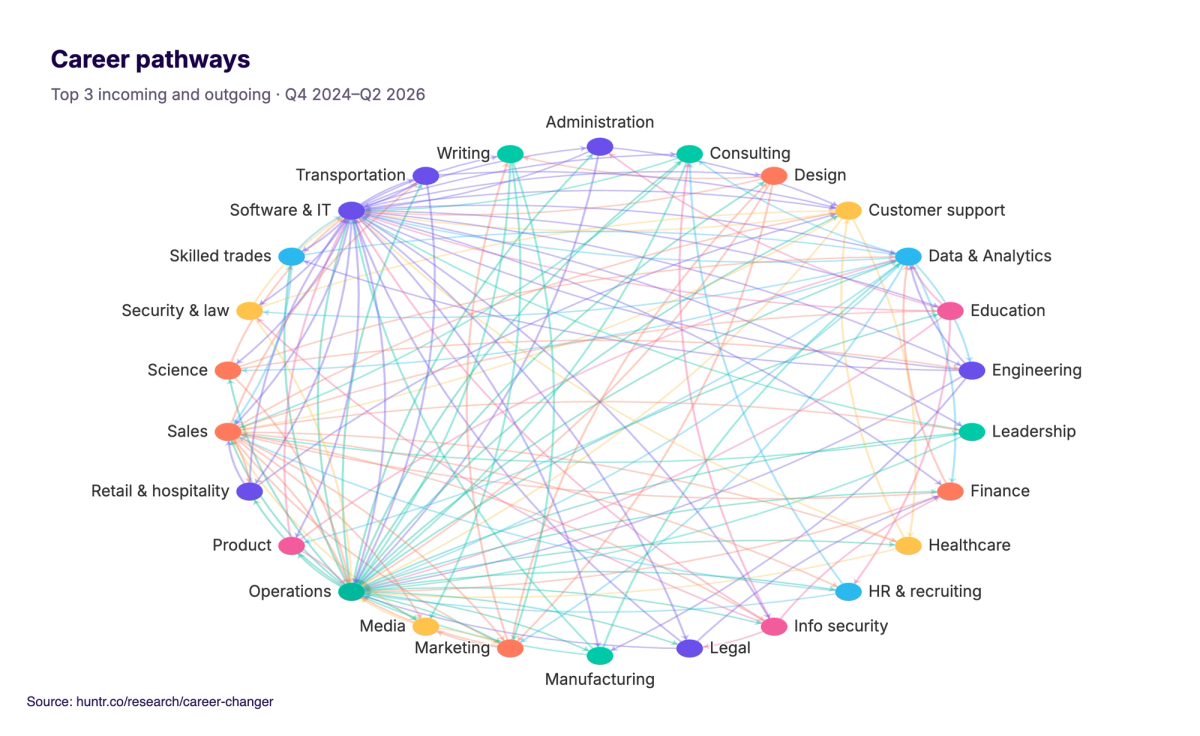
Changing careers? See where people from your field go
70.3% of 15,175 Huntr job seekers applied outside the field on their resume. In Operations, 82.9% did. The most common route was Software & IT to Data & Analytics, taken by 722 people. Our career changer research maps 26 fields. Pick yours to see the 3 fields its people apply to most, and how they wrote the switch in our career change resume examples.
Build your plan in 3 steps
Step 1. Choose one target role. Pick it from your path above, then add a few nearby titles that describe the same work. Read the duties in each post. A "customer success" job might center on adoption, renewals, support, or selling, and each calls for different evidence. You can change the target later.
Step 2. Tell your network, this week. Most people work through their network in the first 2 weeks of a search, so start early.
- Referrals work. Referred applicants reach an interview 40% of the time, against 3% for cold applicants.
- Acquaintances help most. In a LinkedIn experiment with 20 million people, moderately weak ties, people you share a few contacts with but don't know well, led to the most job moves.
- Reach past your usual circle. Raj Chetty's research found that friendships across income lines are among the strongest predictors of moving up the income ladder.
Step 3. Set your pace and start tracking. Use the data-backed plan below: 10 to 20 applications a week. Log every one in Huntr's free job tracker from day one, so you can see your interview rate.
If you have an hour today
- Define your target role. Pick the title closest to the one you have now, where you can find 10 to 20 openings a week. That is the fastest path to interviews.
- Save 3 job descriptions with the free Huntr Chrome extension. Use Huntr to pull out each posting's keywords, qualifications, and responsibilities, and see where the 3 overlap.
- Match your evidence to the overlap. Find your strongest proof for each shared requirement, and put it near the top of your resume and LinkedIn profile.
- Apply to 1 opening, find 1 contact, and log both in Huntr's free job tracker.
Going for a reach job?
If the title you want is one you haven't held, treat it as your reach search. Run it alongside your main search, lean on referrals, and lead your resume with proof you can do the work.
Where I would put the effort first
| Priority | Action | Reason |
| 1 | Confirm the role fits your experience and constraints | Matching your resume title to the job title lifted interview rates 10.6x in Jobscan's 2025 analysis. |
| 2 | Seek a relevant introduction or referral | 40% of referred applicants reach an interview, against 3% of cold applicants (Ashby). |
| 3 | Tailor your strongest truthful evidence | Tailored resumes had a 5.71% interview rate, against 3.09% untailored: 1.85x. |
| 4 | Find suitable openings early and apply promptly | One recruiter told me he had 6 roles open less than a week, each with 500+ applicants. Once 5 people are in the interview loop, recruiters stop reading. |
| 5 | Send a useful, specific follow-up | A marketing director sent 100+ applications in 3 months. Her one interview came from a direct note to a former coworker. |
| 6 | Make the resume readable and stop endlessly redesigning it | Across 94,338 applications, 2-column resumes hit 6.2% and single-column 5.7%, a gap that did not hold up. No layout wins. |
Work on all 6 at once. Referrals work, but they are rare, and cold applications still fill most jobs. In Ashby's data, 93.8% of applications came in cold, and cold applicants still made up 43% to 52% of hires, against about 18% for referrals. Ask for referrals early, and keep applying.
A data-backed weekly plan
This is the plan I give on most calls.
- Apply to 10 to 20 jobs a week. Most people who landed an offer sent about 50 applications or fewer first. At 10 to 20 a week, that's 3 to 5 weeks of steady work.
- Block 2.5 to 10 hours a week. At 15 to 30 minutes per application, that's 30 minutes to 2 hours a weekday.
- Aim for a 5% to 10% application-to-interview rate. Tailored resumes averaged 5.71% from October 2024 to June 2026, and people sending 11 to 20 applications hit 8.0% in Q3. The average LinkedIn application converts at about 3.6%.
- Expect about 1 interview a week. 10 to 20 applications at 5% to 10% works out to between 1 interview every 2 weeks and 2 a week.
- Ask for referrals in the first 2 weeks, and keep applying. See Networking and referrals.
- Plan for 3 to 4 months. The median time to a first offer was 102 days in Q3 2026. How fast you get there depends on how well you interview.
Senior or narrow searches may turn up far fewer suitable openings. If so, judge yourself by your interview rate.
When to change course
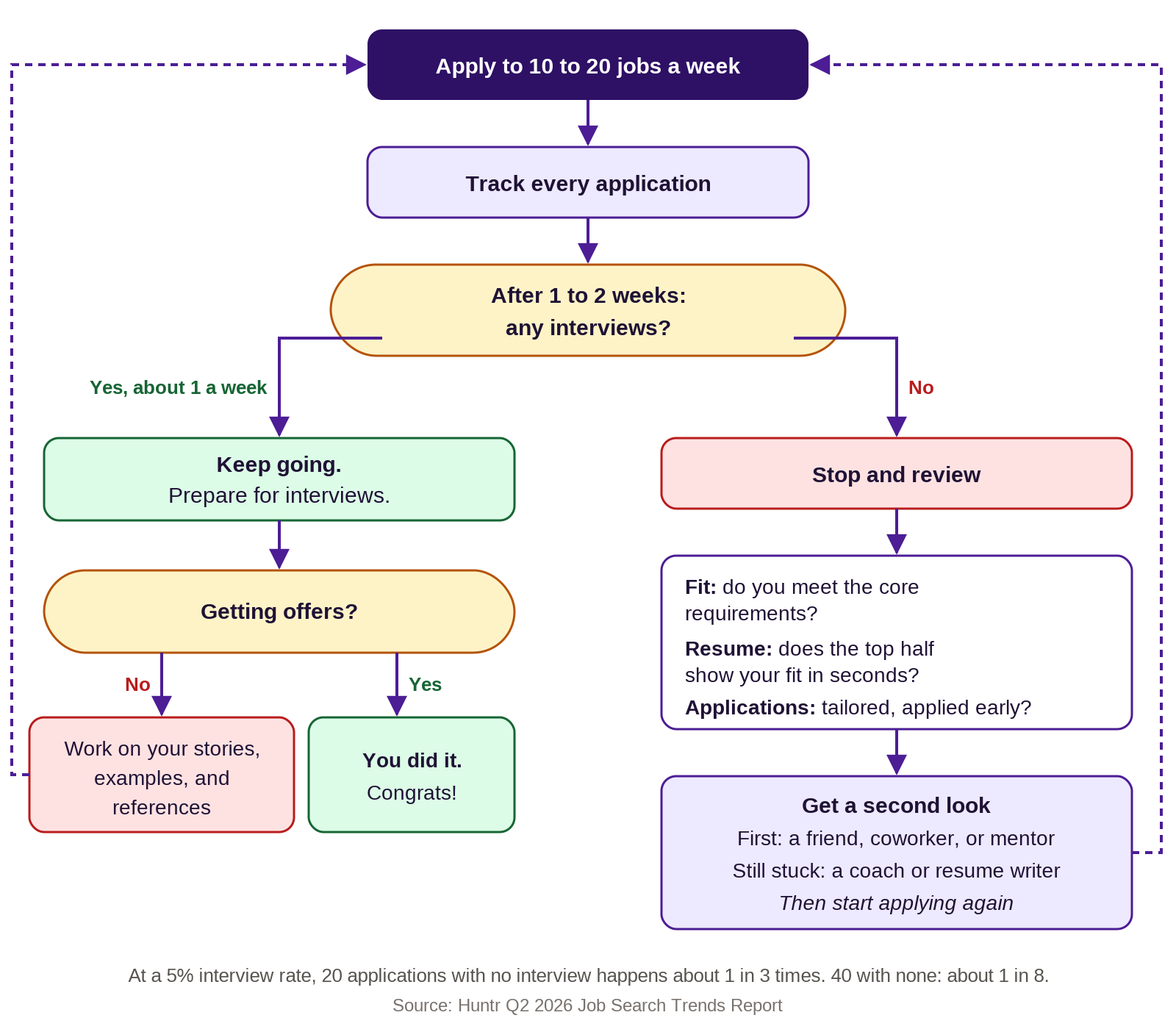
1 quiet week can be bad luck. At a 5% rate, 20 applications with no interview happens about 1 time in 3. At 40, it happens about 1 time in 8. So 1 quiet week is a reason to check, and 2 quiet weeks is a reason to change something: your fit for the job, your resume, or how you apply. Ask a friend, former coworker, or mentor to look at all 3. If you're still stuck after that, a career coach or resume writer is the next step.
Track everything
If you don't track your search, you can't tell what's working. Measure your interview rate. Business Insider summed up my approach this way: Wright "uses application-to-interview conversion rates to measure the success of each job search." Carnegie Mellon's career center points students to Huntr's tracker. A spreadsheet works just as well if you update it after every application.
Track the role, company, source, date, resume version, contact, next step, and outcome. Count each application once, even if it leads to 5 interview rounds.
Application-to-interview rate = applications that reached an interview ÷ applications submitted. 3 out of 50 is 6%. Only compare applications that have had the same time to hear back.
Where are you stuck?
After 1 to 2 quiet weeks, find your problem below. Each has its own common causes.
🔎 Not enough jobs?
Widen your titles and look past LinkedIn.
- Your target title is too narrow. Add nearby titles that describe the same work.
- Your filters are too tight. Remote-only applications had a 3.4% interview rate in Q3 2026, against 5.3% hybrid.
- You search one job board. See Where to find jobs and the Hidden Job Market list.
📉 Low interview rate?
Check your fit, your resume, and how you apply.
- You're missing a core requirement. Check credentials, experience, and work authorization. See Understand the ATS.
- Your resume doesn't show fit fast. See Write your resume.
- You send the same resume everywhere. See Tailor your resume and use AI.
- You apply late. Apply within the first few days a job is posted.
- You only apply cold. See Networking and referrals.
📞 Screenings but no interviews?
Tighten your story, pay range, and profile.
- Your story doesn't fit the role. Practice a short answer that ties your last job to this one. See Prepare for interviews.
- Your salary range doesn't match theirs. See Job offers and negotiation.
- Your LinkedIn doesn't match your resume. Recruiters check. See Your LinkedIn profile.
🤝 Interviews but no offers?
Deepen your stories and ask for feedback.
- Your stories lack depth. Prepare a few examples with clear results.
- You don't show your work. Bring a sample, portfolio, or short case study.
- Your references are weak or slow. Line up 2 or 3 who will answer quickly.
- You don't ask for feedback. Ask politely after each rejection. See Follow-ups and cover letters.
Job search numbers to keep in mind
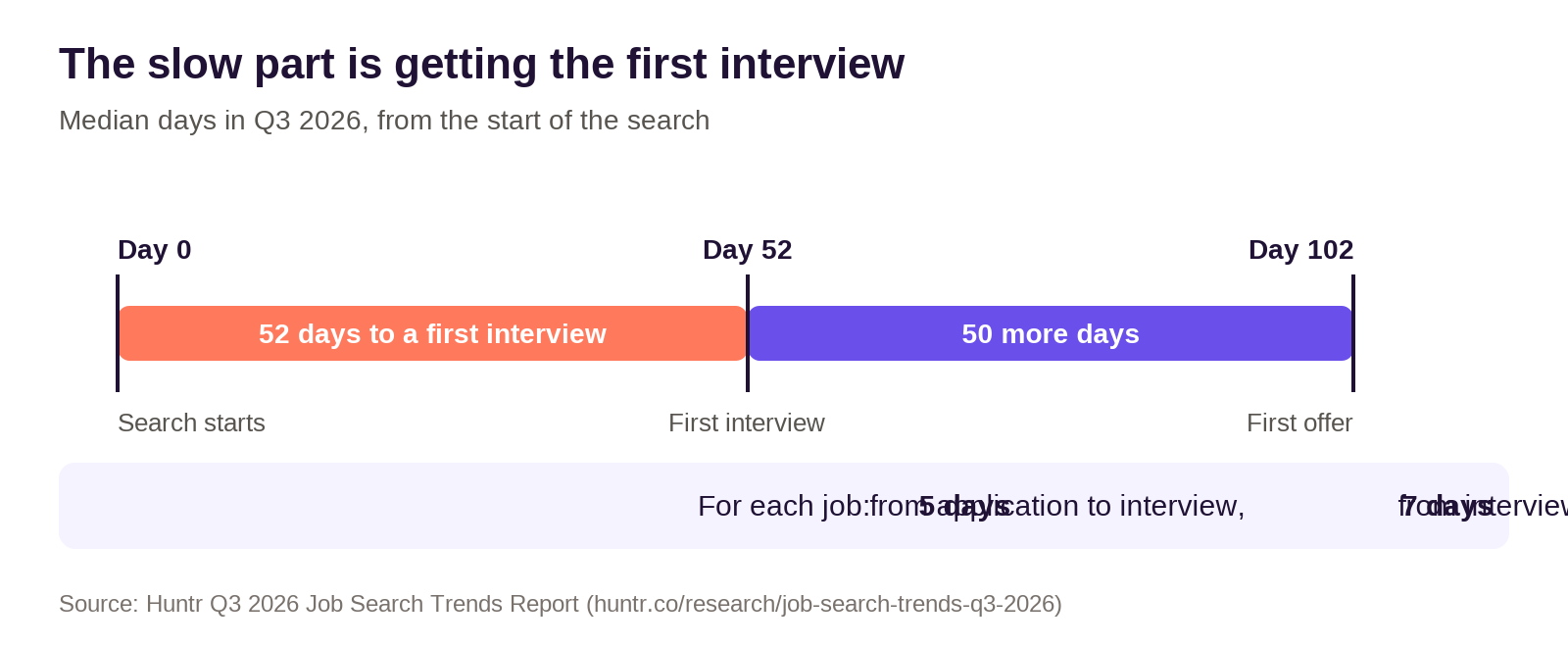
In Q3 2026, the median Huntr job seeker took 52 days to reach a first interview, 5 days from application to interview, 7 days from interview to offer, and 102 days to a first offer.
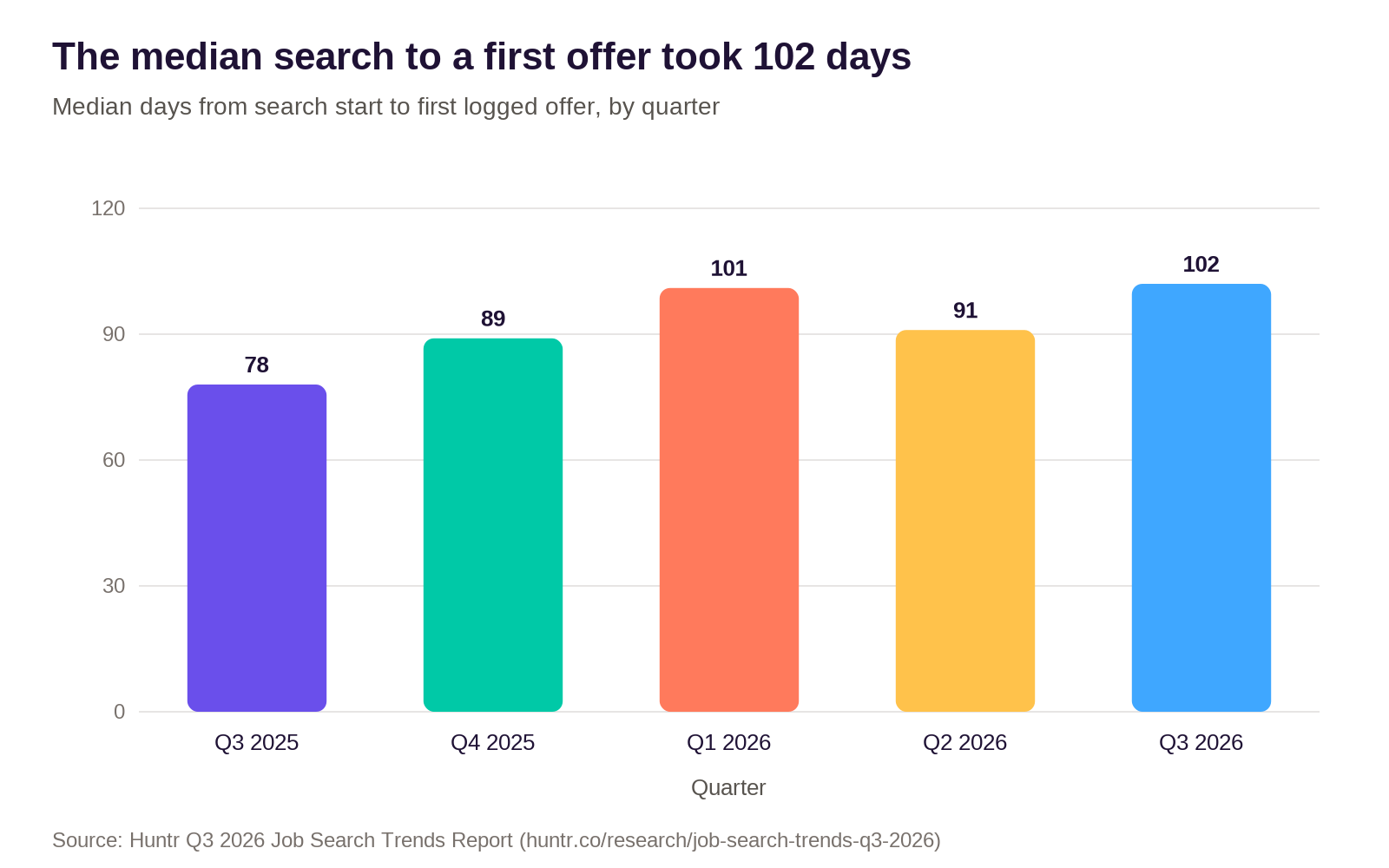
Plan for 3 to 4 months.
Search time rose in 3 of the last 4 quarters, from 78 days to 102.
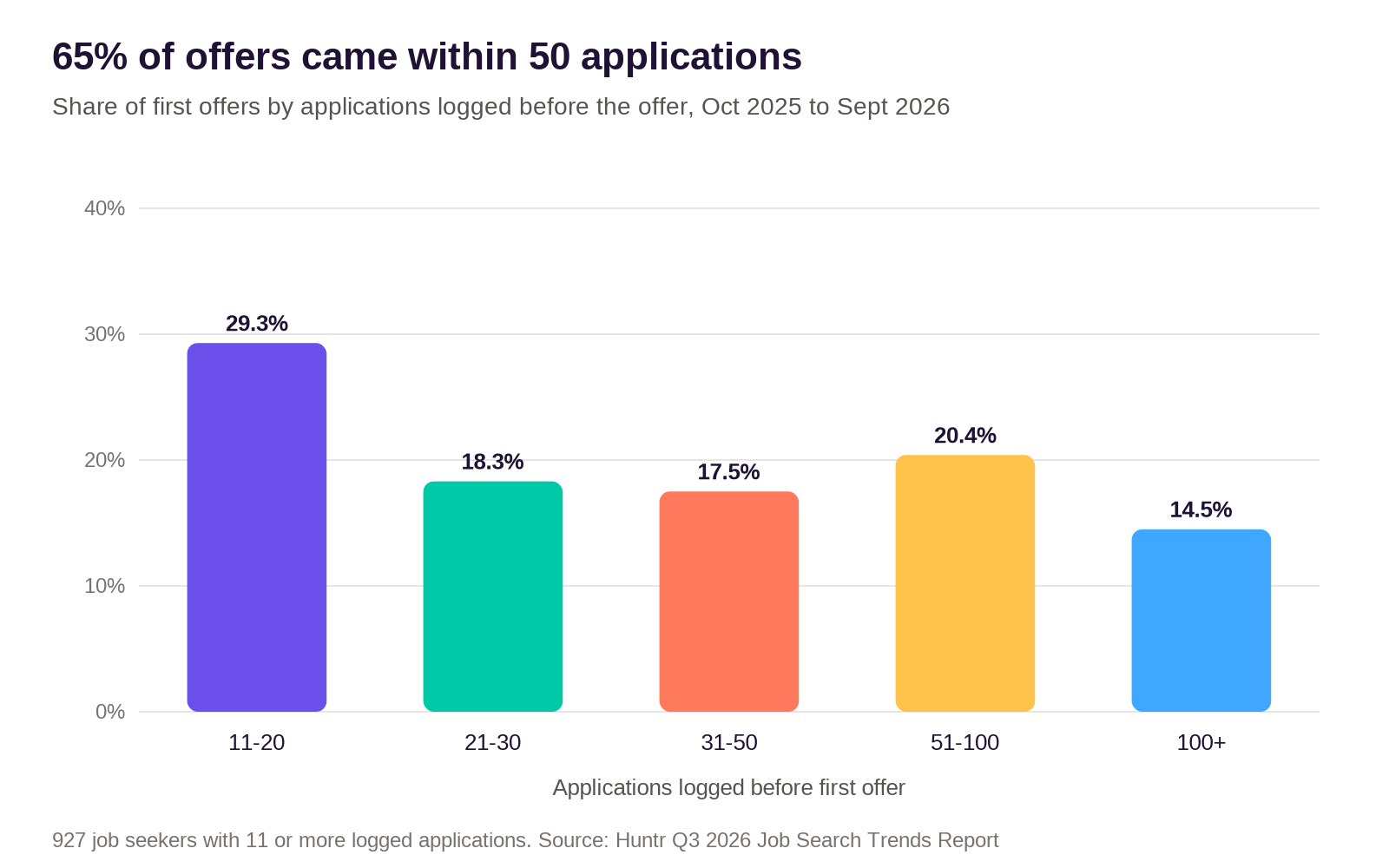
Most offers come within 50 applications. 65% of job seekers who landed an offer logged 50 or fewer applications first. If you pass 50 with nothing, change your approach. Sending more won't fix the problem.
More applications, lower rates. People who sent 11 to 20 applications got interviews on 8.0% of them. People who sent 100+ got 2.4%.
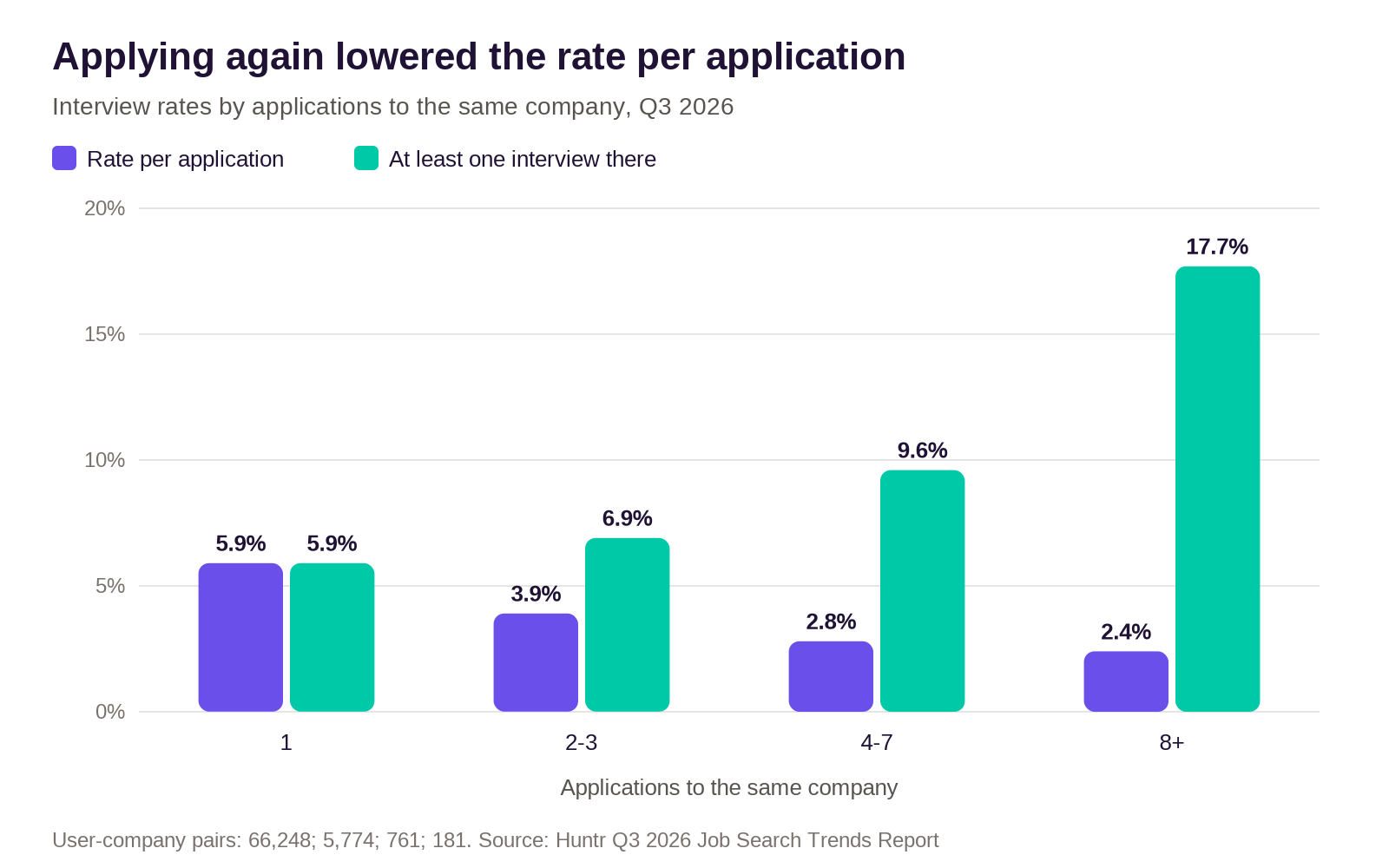
Don't keep applying to the same company. 1 application had a 5.9% interview rate. 8 or more had 2.4% each. Apply again only for a different role or team.
Your action items
- Write down your limits: income, location, work authorization, schedule, and caregiving.
- Pick one target job title.
- Block 2.5 to 10 hours a week for 10 to 20 applications.
- Set up Huntr's free job tracker and log every application from day one.
- Tell 5 people what you're looking for this week.
Further reading
- It Doesn't Matter That the Job Market Is Getting Better: the weekly pace I suggest on most calls.
- Q3 2026 Job Search Trends Report and Q2 2026: the data behind this section.
- The Job Hopper's review of our data: an outside look at our Q2 numbers.
- Huntr's contact tracker and job search metrics: log people and watch your rate.
Consult the experts. For a data-backed plan, follow Bogdan Zlatkov, who coaches mid-to-late-career professionals. For free job search strategy, read Hannah Morgan's Career Sherpa. More in the coaches I recommend.
Where to find jobs
"So I was mostly applying to, like, LinkedIn easy applies and stuff. So I was not getting any response."
Software engineer, on a free one-on-one Huntr job search support call
Where you apply changes your odds. Across Huntr applications from October 2025 to September 2026, jobs found on Google job search reached an interview 9.9% of the time, against 3.6% on LinkedIn. In Q3 2026, applications on employer career sites reached 6.0%.
Use multiple sources
Keep LinkedIn, but don't rely on it alone. Every week, search:
- Google job search. Google pulls jobs from across the web and sends you to the employer's own form.
- Niche job boards for your field or city. Fewer people apply to each job. Find niche job boards for your field.
- Company websites of employers you'd work for. Start with the Hidden Job Market list.
Interview rates vary by job site
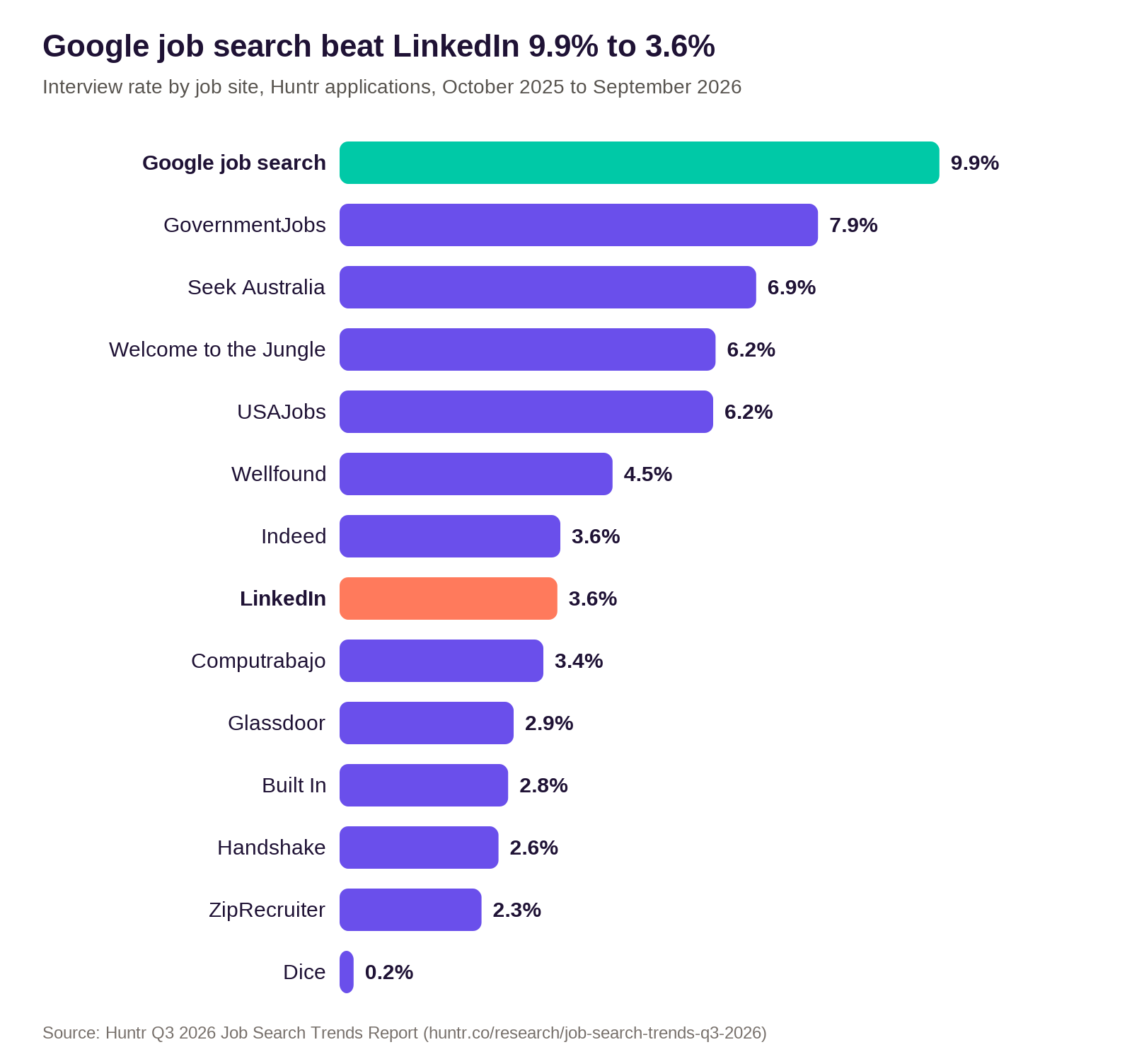
LinkedIn carried 175,416 of these applications, more than all the other sites in the chart combined. 6 sites beat it, and Indeed matched it. Here's why most LinkedIn applications go nowhere. GovernmentJobs had the second-highest rate, at 7.9%. If you'd work for a city, county, state, or the federal government, search GovernmentJobs and USAJobs. Students should check Handshake, and job seekers in Australia or New Zealand should check Seek.
Takeaway
Diversify beyond LinkedIn. Pick a few niche job boards, and apply on company websites.
Easy apply means hard to get an interview. If it takes you 10 seconds, it takes everyone else 10 seconds too, and you're 1 of hundreds. Many people tell me, "I'm going to hit the easy apply button on LinkedIn 200 times." We just don't see any evidence that's worth your time. In our 2025 survey, 72.5% of job seekers said Easy Apply got them 0 interviews. Send fewer, better applications that speak to the job.
Boston University's Questrom career blog reposted our job sites ranking for its students.
Start with Google job search
Google pulls postings from career pages and job boards, then often sends you to the employer's own form. Search "[job title] jobs" and open the jobs panel, or try a Boolean search:
"job title" AND ("location" OR "remote") AND ("careers" OR "jobs" OR "hiring")
More searches to try:
- "data analyst" "healthcare" "Chicago"
- "customer success manager" "renewals" "remote"
- site:boards.greenhouse.io "software engineer" "Seattle"
- site:jobs.lever.co "product designer"
Set an alert on your best search. See how to use Google job search, with a video.
Apply on the company's website
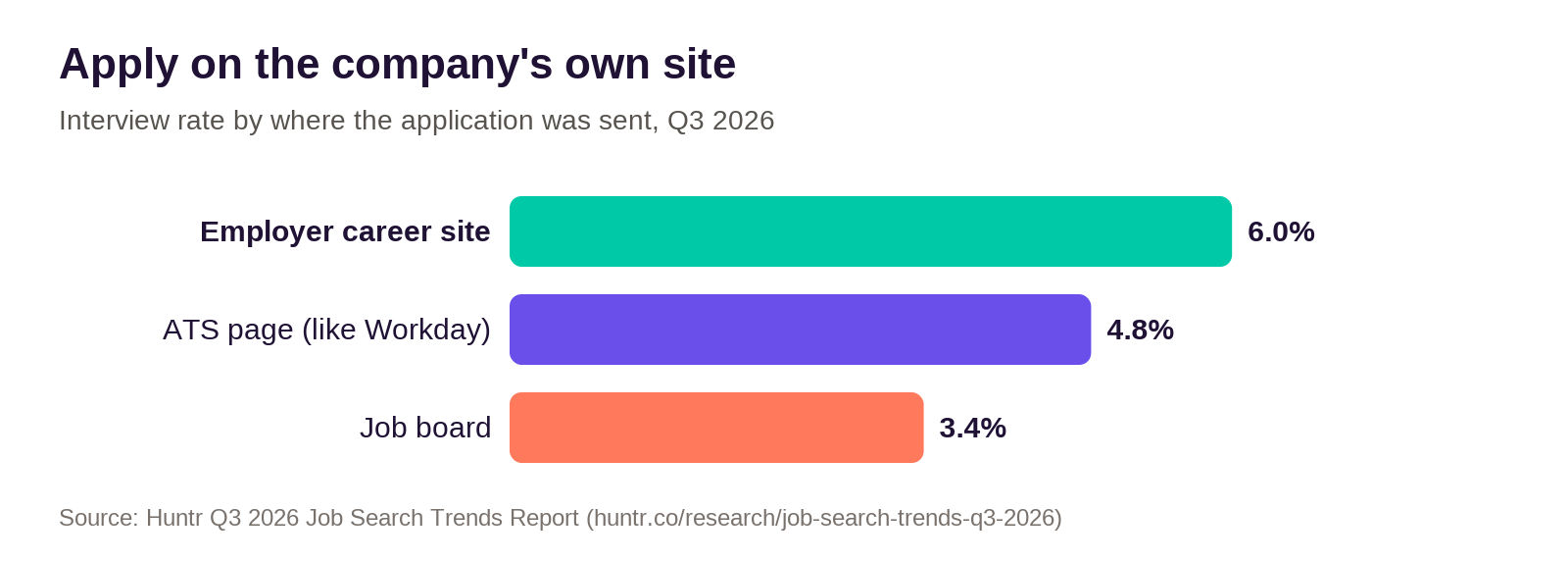
In Q3 2026, applications sent through employer career sites got interviews 6.0% of the time, against 4.8% through ATS pages and 3.4% through job boards. Find the job anywhere, then apply on the employer's own site. Huntr's autofill speeds up long forms.
Search the hidden job market
Many small employers never post on LinkedIn, so fewer people apply. In September 2026 I checked 1,800+ employers and found 263 that don't post there. Of 107 well-known employers, 98 do, so the gap sits with smaller firms. The free Hidden Job Market 2026 list has 263 employers that don't post on LinkedIn, 101 job boards and search tricks, and 163 networking groups.
385 people have asked me for it on LinkedIn since February. Filter by type, place, or remote status, and pick 10 to 20 employers a week. How to use the hidden job market.
Find jobs posted only on company hiring systems: search site:boards.greenhouse.io "your title", then swap in jobs.lever.co, jobs.ashbyhq.com, or apply.workable.com.
Apply within 24 hours
Set alerts and apply within a day of a posting going live. LinkedIn reports that applying within 10 minutes of an alert can raise your odds of hearing back up to 4 times. Recruiters stop looking once they have enough strong people.
"What I tell every hiring manager is get five people interviewing. If you have five folks interviewing, you're going to get a hire ... That's why applying early is key."
Ted Staeb, technical recruiter
See jobs from the last hour: on LinkedIn, filter for "Past 24 hours," then change f_TPR=r86400 to f_TPR=r3600 in the URL. The 1-hour trick.
Speed should not cost you quality. Keep a strong base resume ready so you can tailor it in minutes with Huntr's resume tailor. A good older opening is still worth applying to. And don't wait for the best month. September and October are the busiest months in our data, but interview rates stay fairly steady all year.
Looking for remote work?
Remote-only applications got interviews 3.4% of the time in Q3 2026, against 5.3% for both onsite and hybrid. Remote-only ranked last in every quarter of 2026.
- Confirm the allowed country, state, time zone, and travel. "Remote" does not always mean "from anywhere."
- Show how you communicate and deliver with a team you rarely see.
- Robin Ryan's Forbes guide to remote jobs includes my advice.
Your action items
- Every week, search Google job search, a few niche job boards, and company websites.
- Pick 10 to 20 employers from the Hidden Job Market list.
- Set alerts for your target title, and apply within 24 hours.
- Apply on the employer's own site when you can.
Further reading
- The best job boards: the full ranking of 25 sites.
- Job search sites guide: how to use each one.
- 101 job search sites: boards by field and region.
- The Job Hopper on the best time to search
Consult the experts. Alison Doyle's The Job Hopper newsletter tracks the job sites worth your time. Austin Belcak teaches how to land jobs without applying online. More in the coaches I recommend.
Networking and referrals
"The best ones, which is how I got my one and only internal interview, was I reached out directly to someone I work with briefly. Not even that closely. Five years ago. And then she sent my information directly to the hiring manager and hr."
Entertainment industry professional, on a free one-on-one Huntr job search support call
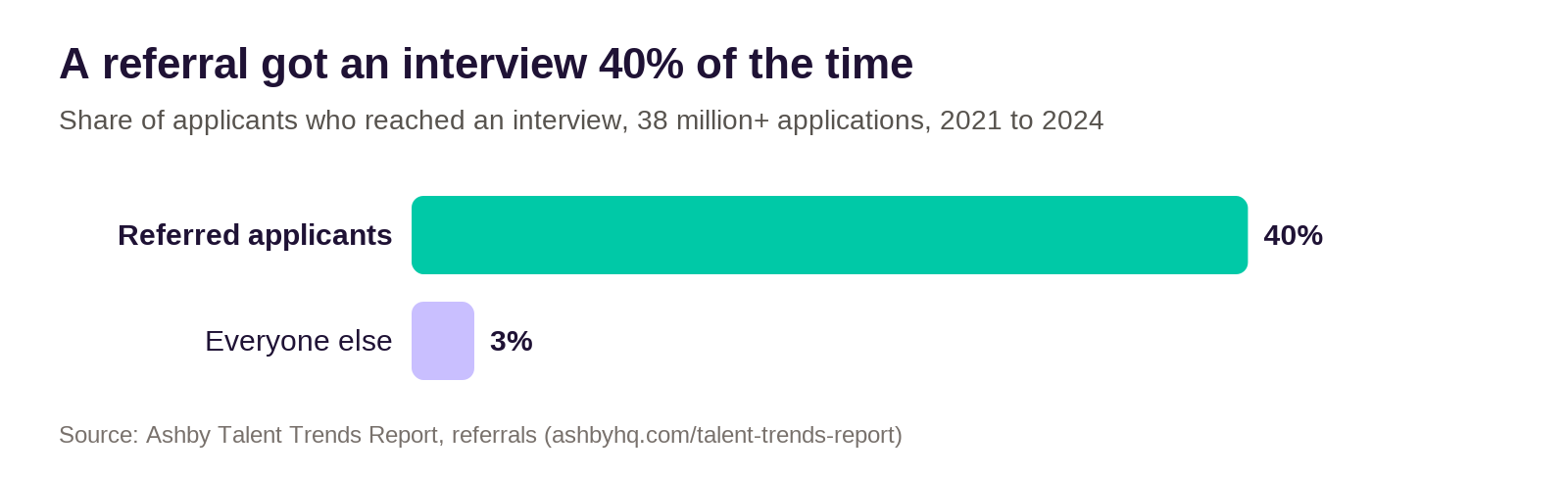
A referral gets you an interview 40% of the time. In Ashby's analysis of 38 million+ applications across 93,000 jobs from 2021 through 2024, 40% of referred applicants reached an interview, against 3% of everyone else. But referrals are rare. 93.8% of applications came in cold, and cold applicants still made up 43% to 52% of hires. So use referrals early and keep applying. Networks take years to build, and most people work through theirs in the first 2 weeks of a search.
Why it matters more now
1 recruiter with 28 years in the business has never found his own job any other way:
"Every job I've ever landed, eight different companies over my career since graduating college in 1992, all through networking."
Founder of a B2B sales recruiting firm
Employers are pickier now, which raises the value of someone who can vouch for you.
"Our companies are more selective ... So we are going from [is this] a good candidate, to [are we] confident that this is the right person for this role right now."
Freelance recruiter and career coach in Spain
2 kinds of networking
1. Always be networking
You do this all the time, whether or not you need a job. You don't ask for anything. You talk shop and build relationships that turn into referrals later.
2. Reach out about a specific job
When you apply, message someone at the company about that role. Make it about the job, and make it easy to say yes or no.
1. Always be networking
Hi [name], I saw you work in [industry or team]. I'm in [your field] and curious how [their company or field] handles [topic]. Want to chat for 15 minutes sometime?
Start with people who have some reason to know you: former colleagues and classmates, customers and vendors, alumni, and people in professional communities, like the 163 groups in our Hidden Job Market list.
Make relationships useful in both directions when you can. Share a lead, offer feedback, or introduce people who could help each other. You don't have to earn the right to ask for help by doing a favor first. My Authority Magazine interview goes deeper.
Acquaintances help most. Granovetter's work explains why acquaintances connect us to news outside our circle. Later LinkedIn experiments with 20 million+ people found that weaker ties led to more job moves.
Access isn't equal. We don't choose our family, and our schools, neighborhoods, and workplaces shape whom we meet. Chetty and colleagues found that both exposure across class lines and the way friendships form help explain unequal access to well-off networks. Federal Reserve research also links living near your parents with faster earnings recovery after a layoff for younger adults. I wrote more in A Rant on Referrals and Favoritism in Hiring.
2. Reach out about a specific job
Find the best person for this job. That depends on the company. At a 10-person startup, it might be the CEO. At a Fortune 500, it's the hiring manager, the recruiter, or someone on the team. Start with anyone named in the post. Then look for someone you know there, or someone they know. If you can't tell, make your best guess about who's closest to the role.
Hi [name], I just applied for [role] on your team. I'm excited about it because [specific reason]. In my last role, I [relevant result]. If you think there's a fit, I'd be grateful for a referral or a quick word with the hiring manager.
Attach the job link. Then follow up 3 days later. Most people skip this step.
- Expect few replies. In my experience, maybe 3 of every 100 messages get one.
- A message can still lead someone to look you up in the ATS and read your resume.
- Keep applying while you wait.
Referrals are tip 1 in my job search tips, ranked by impact. Need more contacts? I'm happy to help. See if anyone in my network fits on LinkedIn or Happenstance, and message me.
Your action items
- List 20 people who could refer you.
- Set up 2 or 3 industry chats this week.
- Each time you apply, find the best-connected person for that job and message them. Follow up 3 days later.
- Log every contact in Huntr's contact tracker.
Further reading
- A Rant on Referrals and Favoritism in Hiring: why referrals are the easiest way to fill a job and the hardest way to get one.
- Ashby's referral data
Consult the experts. Austin Belcak teaches how to land jobs through people instead of online applications. Luki Danukarjanto, a former Deloitte recruiting lead, coaches networking and soft skills. More in the coaches I recommend.
Write your resume
"I'm not super confident with the CV, so I just kind of wanted to like get a bit of a almost verification that I'm kind of on the right track with it."
Frontend developer, on a free one-on-one Huntr job search support call
Lead with your best.
Hiring managers have TikTok brains, the same as the rest of us, and recruiters decide in seconds. In the first sentence or 2 of your resume, put the most interesting, impressive thing you've done in your career that relates to this job. Numbers jump off the screen a lot louder than words.
"In those 12 to 15 seconds, you want to give them every reason to say yes ... and, like, as little questions in their mind, that would make them think that you're a no."
Gino Calavitta, go-to-market recruiter
The 7 fixes I make most, after reviewing 2,000+ resumes
- Cut the AI slop. Resumes that open with "results-driven" and "detail-oriented." Percentages with no context, and too many of them. Long dashes everywhere. Recruiters spot AI slop fast.
- Show the size, scope, and scale. How many people, how much money, how many customers. Without those numbers, a reader can't see the proof of your impact.
- Use the formula. "Did X, which led to Y result."
- Move your biggest win to the top. On 1 call, I found $310 million managed across 2 government funds, buried on page 2.
- Cut the text. Dense paragraphs are hard to read. Use short bullets. 2 pages is generally the best length, even if you are entry-level.
- Write numbers as numerals. "Led 3 teams," not "led three teams." A Microsoft recruiter taught me this one.
- Fill out your education. An Amazon recruiter told me she scrolls straight to the education section, so make sure it is filled out EVEN if you graduated a while ago.
What recruiters read first
Every recruiter reads in a different order. Put your proof in every section.
"I scroll to the bottom ... And then I scroll up from there to see progression ... I'm looking at companies and title and tenure."
Cameron Black, contract recruiter at a large manufacturer
"Look at your resume as a technical manual of accomplishment ... Give me numbers, percentages, dollar signs ... and don't make it a paragraph. The more paragraphy a resume is, the more likely we are to simply not read it."
Ted Staeb, technical recruiter at Microsoft
Header
Include your name, email, phone, city or region, LinkedIn, and a portfolio or GitHub link if it fits. Put them on the page itself, not in the header area of Word or Google Docs. Parsers often skip that area. See Understand the ATS.
Put the city where you want to work.
If you'll move, write that city: "Denver, CO" or "Relocating to Denver, CO." Answer location and start-date questions honestly when they come up.
Keep official job titles. If a title is obscure, add a short, true explanation: "Client Partner (account management and renewals)." Don't invent a title to match the posting.
Summary
Lead with the strongest relevant thing you've done. Aim for 2 to 3 clear lines that connect your experience to the work ahead.
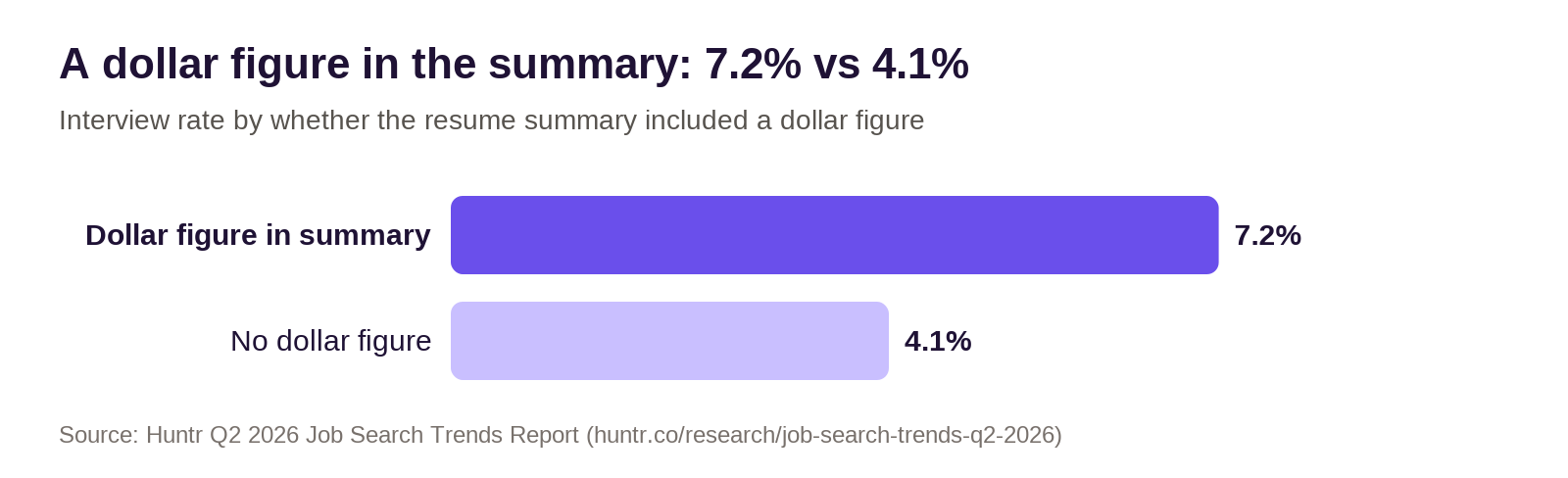
Put a dollar figure or another key number in your summary. Resumes whose summary included a dollar figure had a 7.24% interview rate, against 4.13% without one. Having a summary at all made no reliable difference in our format study. What goes in the summary does. Several recruiters told me they don't read the summary. So keep it short, with a number in it.
Weak
Results-driven, detail-oriented sales professional with a passion for building relationships.
Strong (fictional numbers)
Account executive who closed $4.2 million in new business over 3 years, selling workflow software to operations teams. Typical contract value: $60,000.
Changing careers? Your summary is the bridge. It's your best argument for why you're uniquely able to do this job: the work that carries over, the new skills you can show, and the role you want.
Experience
For unfamiliar employers, add 1 short line about the business or team: customers, product, team size, budget, or scale. Then write each bullet around what you did, what changed, and why it mattered. Order bullets by relevance to the target job.
Illustrative rewrites; fictional numbers:
| Weak | Clearer |
| Responsible for customer onboarding | Rebuilt onboarding for 80 small-business accounts, reducing median setup time from 12 days to 8 over 2 quarters. |
| Improved performance by 50% | Reduced median API response time from 400 ms to 200 ms for a service handling 2 million requests a day. |
| Worked with cross-functional teams | Coordinated engineering, support, and finance to replace a manual billing process used by 12 account managers. |
Write numbers as numerals.
"Led 3 teams," not "led three teams." "Cut costs 25%," not "cut costs by twenty-five percent." A recruiter skimming for 12 seconds sees numerals first. Use numerals in your summary, bullets, headline, and LinkedIn profile.
Separate your work from the team's. "Led the rollout" and "contributed to the rollout" are different claims. Give percentages a baseline or time period. If you lack reliable numbers, describe the scope, difficulty, or decision your work enabled. Don't invent a metric.
Career breaks
Resumes with a gap did about as well. In our data, resumes with no current role interviewed at about 5.65%, against 5.14% for resumes listing a current job. A short, factual line can help when it explains the timeline: "Career break for family caregiving" or "Planned career break; returned to work in March 2026." You don't owe an employer private medical details.
Skills
List skills you can use and discuss, in the employer's words when they describe your real experience. Put the most important skills in your bullets too.
Where to put your skills section: in a technical role, right after your summary, so the reader sees your tools first. In other roles, put the skills section at the end. The section is still worth having, because recruiters search the ATS by skill and your resume needs those words to show up. Don't aim for 20 or 30 skills, don't copy every term from the posting, and don't chase a perfect match score.
Read every line AI writes for you.
"I've seen resumes come in with, like, the prompt at the end of ChatGPT ... I've declined based off of that because I'm like, your attention to detail right there was very bad."
Cameron Black, contract recruiter at a large manufacturer. More in how to use AI for your resume.
Education, projects, and certifications
New or recent grad? Put education right after your summary. Fill it out with the most interesting, impressive things you did: honors, research, leadership, clubs, and projects.
Fill it out even if you graduated years ago. An Amazon recruiter told me education is the section she looks at most. Recruiters and hiring managers went to school too, and a shared school, club, or professor can start a human connection.
For projects, explain the problem, your part, the result, and where someone can see the work. Say whether a project was a personal demo or production work, and whether you did it alone. List required licenses and relevant certifications first. A course completion is not a professional certification. List the ones that matter for the role.
See resumes that landed interviews
Each example is built from real, anonymized Huntr resumes whose owners moved a job to the interview or offer stage. The companies named are real. Start here: 100+ real resumes that landed interviews
- Data: data analyst, financial analyst, data scientist
- Engineering and IT: software engineer, systems engineer, engineering, cybersecurity
- Programs and operations: program manager, program coordinator, project manager, operations manager
- Sales, marketing, and customers: account executive, sales development, marketing, customer success
- Changing careers: career change examples. More by field in Advice by field.
Your action items
- Put your most impressive win for this job in the first 2 lines.
- Put your target city in the header.
- Rewrite your summary in 2 to 3 lines with at least 1 dollar figure or key number.
- Fill out your education section.
- Rewrite your weakest 3 bullets with the formula above, and change every spelled-out number to a numeral.
- Ask someone to read the top half and name the role you want. If they can't, fix that first.
Further reading
- The Resume Is Dead and Other Job Search Nonsense: 40 years of claims that the resume is finished, and what our data says instead.
- Best resume format study: 94,338 applications.
Consult the experts. Robin Ryan has written thousands of resumes. Greg Langstaff spent 11 years as a hiring manager and makes the best short resume videos I know. Tayyaba Manaal writes resumes for middle managers and executives. More in the coaches I recommend.
Tailor your resume and use AI
"How should I tailor my resume, you know, to. Be a better fit here without lying."
Operations and program manager, describing what he asks ChatGPT, on a free one-on-one Huntr job search support call
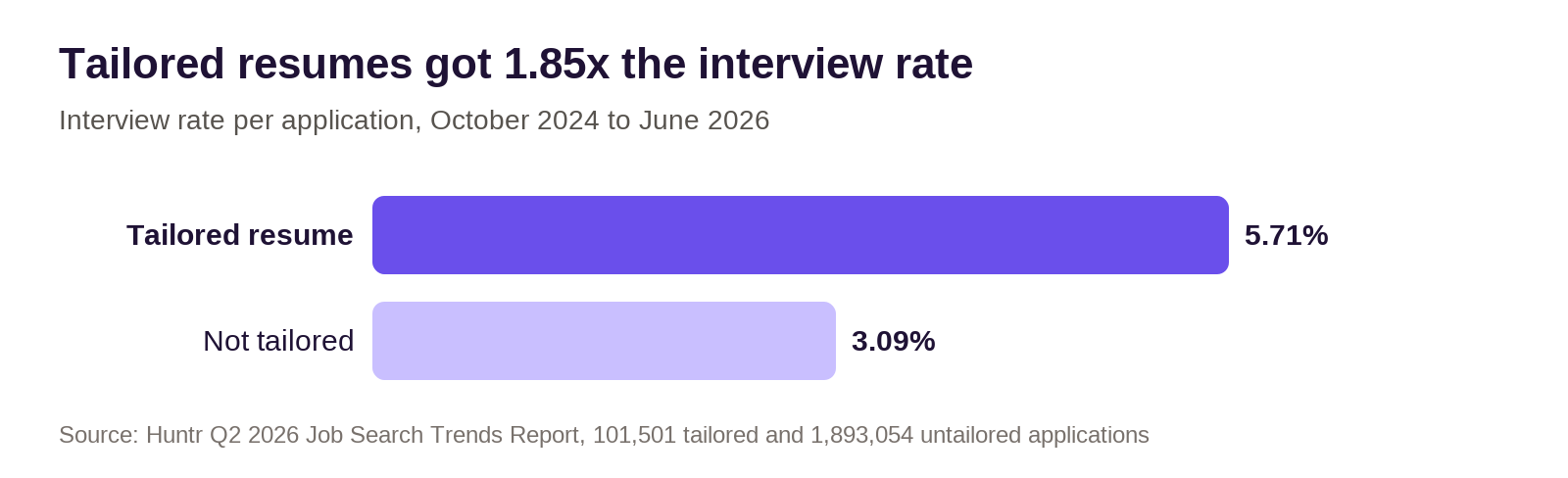
Tailored resumes got 1.85x the interview rate. From October 2024 through June 2026, applications with a Huntr-tailored resume had a 5.71% interview rate, against 3.09% without one, across 101,501 tailored and 1,893,054 untailored applications. Tailoring is the most consistent pattern in our data. The gap held in Q1 2026 and across 2025.
Tailoring means choosing the parts of your experience that matter for this job. The facts stay the same.
Match only the keywords you can claim
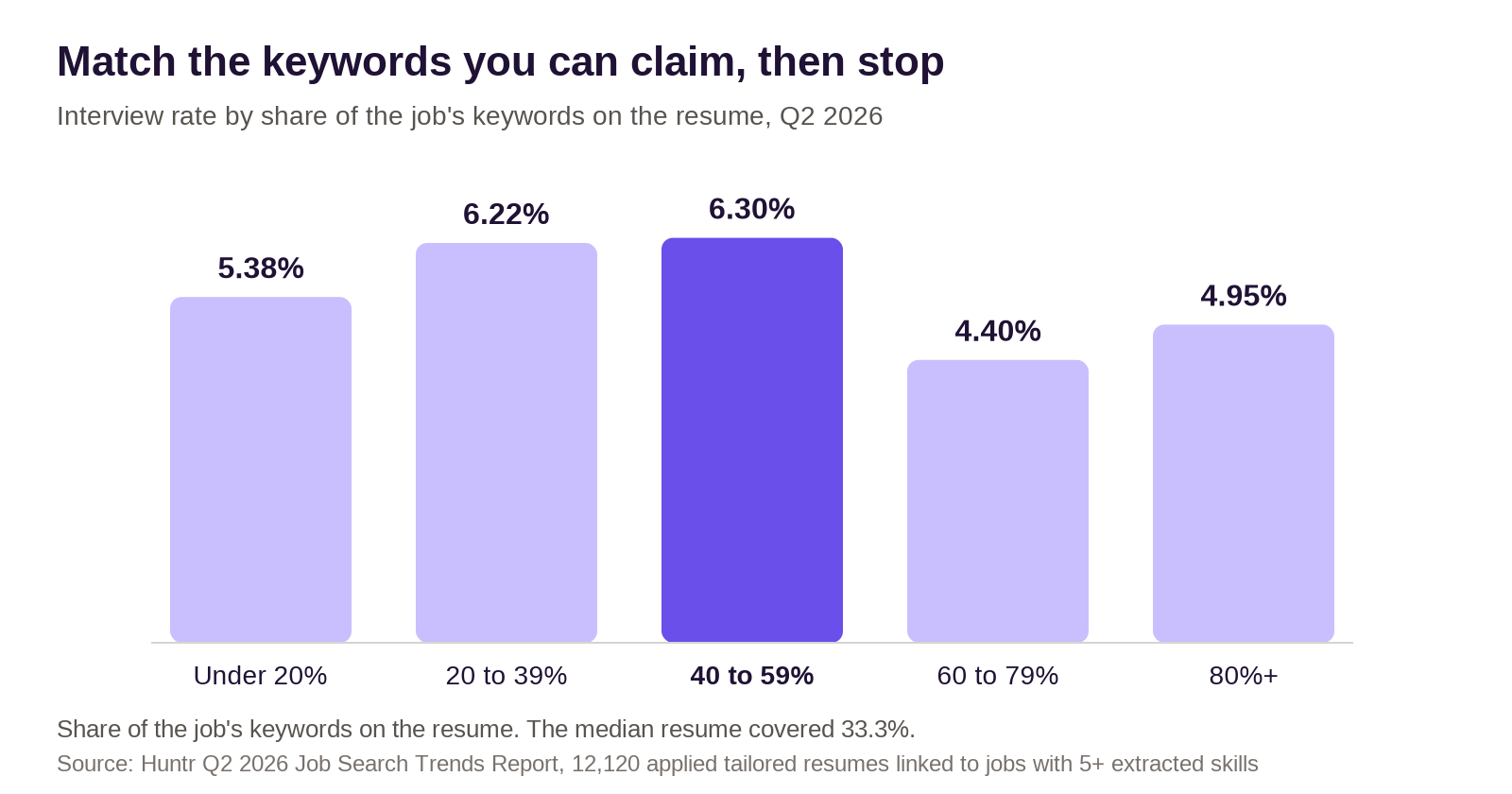
Across 12,120 Q2 resumes, covering 40% to 59% of a job's keywords had a 6.30% interview rate. Covering 60% to 79% had 4.40%. The median resume covered 33.3%. A high match score alone won't get you interviews:
"I use AI to scan my resume against job descriptions, modify wording as necessary and get high match scores - and still no response from LinkedIn jobs. Something is broken."
Executive job seeker, in a Huntr survey, March 2026
I walked through why a generic "ATS score" misleads people on the Land Your Next Job podcast.
How to tailor your resume in 5 steps
- Read the job description. Find the parts that matter most: the outcomes, duties, must-have qualifications, and abilities, not just the keywords. The free Huntr Chrome extension pulls these out for you.
- Rewrite your summary for this job. This is where tailoring matters most. Lead with the most interesting, impressive thing you've done that relates to this job. You can name the company. Show how you'll solve the problems the job description lays out. Huntr's resume tailor drafts your summary with you.
- Reorder your achievements. In each role, put the bullets that best connect to this job first. Do the same with your projects.
- Tailor your skills section. List the skills the job asks for, when you have them. If a skill is crucial to the job, prove it in your summary or an achievement bullet too. A line in your skills list is the weakest proof you can give.
- Check everything. Read every changed line against what you actually did. Use the job description's words only when they're accurate. Then save the version you sent, so you can prepare for the interview.
Keep a private master record of projects, wins, feedback, and metrics. What I tell job seekers: "An AI polished resume is only as good as the base resume that you're polishing." A good record gives AI better material and gives you a way to catch made-up claims. See using AI for your resume.
Tools that help
- Huntr's resume tailor rewrites your summary, bullets, and skills against a posting.
- The resume keyword scanner and job keyword finder show which terms a posting uses.
- Compare tools in our ranking of the best resume builders.
There's no such thing as an AI resume or a non-AI resume. There's a good resume and a bad resume. AI is like a hammer. You can use it to build a house, or you can hit yourself in the thumb. Overuse it, or use it in the wrong place, and it hurts you. Resumes stuffed past 60% of a job's keywords got fewer interviews. Use it in the right place, and it helps you create a great resume.
Check what AI writes
"You can tell when, like, those applications are completely AI generated and just copy and paste."
Gino Calavitta, go-to-market recruiter at Meshy
For We Tested 40+ AI Resume Builders, our team spent about 2 hours on each tool with real resumes. Some tools made things up. 1 added $12 million in revenue that wasn't in the source resume. Another changed 30 million views to 700,000. Huntr ranked first in that test (our full ranking of AI resume builders), so weigh my view with that in mind, and check every line any tool writes.
Some tools match words instead of meaning. If a job asks for "project management" and your resume says you "led cross-functional initiatives," some tools mark the skill as missing. A recruiter sees the match. Don't rewrite clear wording just to please a tool.
4 checks before you send
- Does your resume sound like you? Cut generic lines that hide your experience.
- Can you back up every fact and number in an interview? Watch for made-up metrics and overstated ownership.
- Did any chatbot instructions get pasted in?
- Is your resume getting interviews? If 50 tailored applications get none, stop and change your approach.
Protect confidential information
Don't put confidential employer information into a tool unless you're allowed to.
Try Huntr's resume tailor. Paste a job post and see which keywords, qualifications, and responsibilities your resume covers. Then tailor your summary, bullets, and skills to match, using only what you've done. Tailor your resume with Huntr.
Your action items
- Start a master record of your projects, wins, and metrics.
- Tailor 1 application using the 5 steps above.
- Aim for 40% to 59% keyword coverage, and work those keywords into your achievement bullets.
- Before you send, run the 4 checks above, and save the exact version you send.
Further reading
- Q2 2026 Job Search Trends Report: tailoring, keywords, and summaries.
- Real resume examples from job seekers who landed interviews
Consult the experts. Jeremy Schifeling, formerly of LinkedIn, wrote best-selling books on using AI in your career. More in the coaches I recommend.
Understand the ATS
"I apply for job and the recruiter comes to my linkedin page and then like an hour later I get the rejection email and I don't know where I'm going wrong in that area."
Financial analyst candidate, on a free one-on-one Huntr job search support call
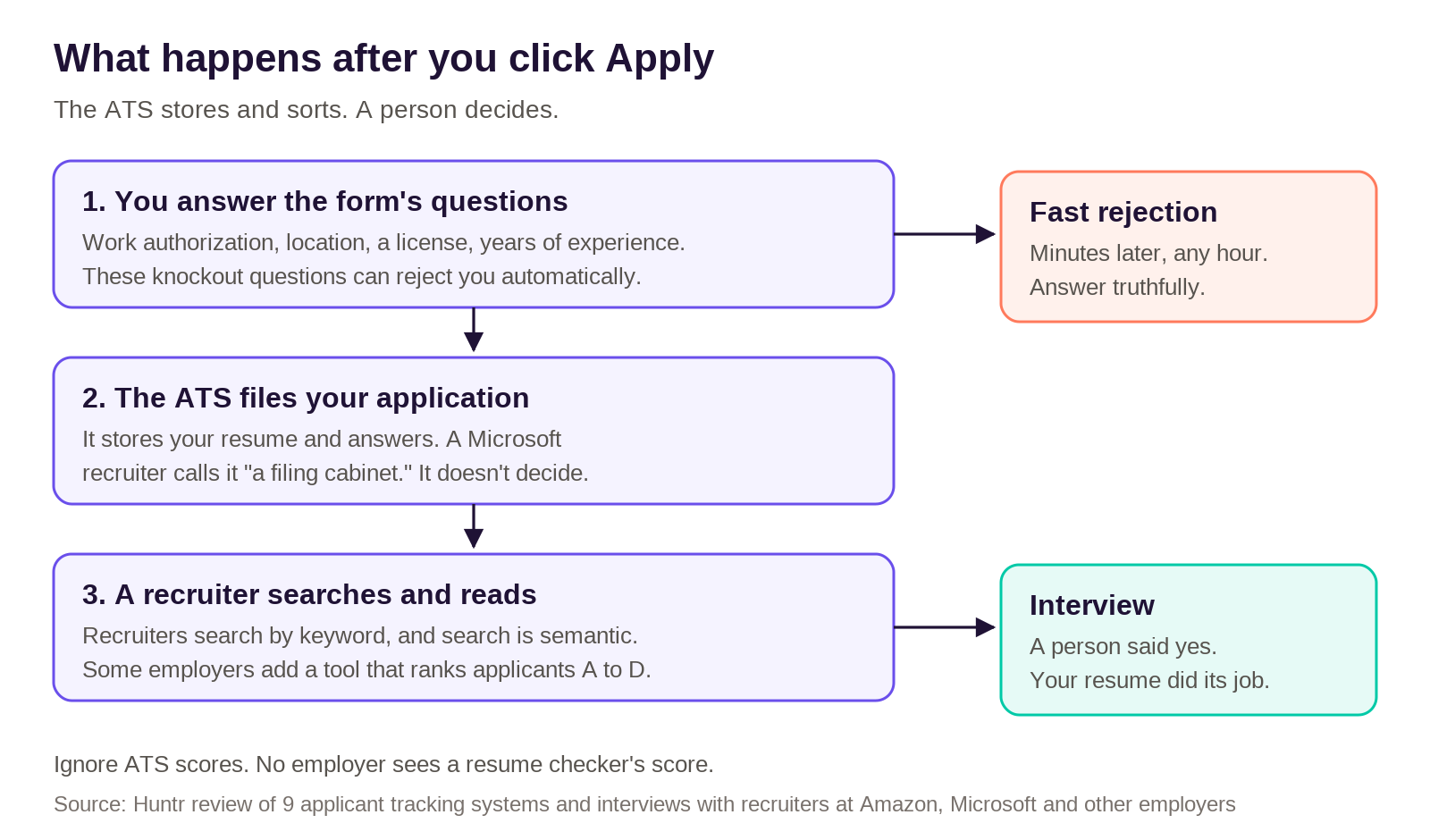
A person reads your resume. An applicant tracking system (ATS) stores your resume, runs the form you fill in, and lets recruiters search. An ATS doesn't reject resumes on its own. I reviewed 9 ATS platforms and asked recruiters with experience at Amazon and Microsoft. They all said the same thing. For the full investigation, see how applicant tracking systems actually work.
What recruiters told me
"An ATS is a filing cabinet. That's it ... It doesn't make decisions."
Ted Staeb, technical recruiter at Microsoft
"A person reads every single resume. There is no AI involved at all, period ... Every, every application is read by a person."
Kristen Fife, senior technical recruiter, on contract at Amazon
"I have never used AI in screening applications, so every application that comes to me ... there's a human eye on it."
Gino Calavitta, go-to-market recruiter at Meshy, an AI company
Recruiters can search the applicant pool by keyword. The search is smarter than most people think:
"We don't care what keywords you put in because platforms like Monster and Dice ... included semantic search long back, you know, five, six years ago."
Vikas Pathak, recruiter, formerly at 7-Eleven
A search for "software engineer" also finds "programmer" and "coder." Use the words the job post uses for skills you have, and stop there.
The real automatic filter: knockout questions
The questions on the form can reject you on their own. Work authorization, location, a license, or a minimum number of years are the usual ones. Greenhouse, for example, lets employers set rules that reject applicants based on those answers. So a rejection can arrive in minutes, at any hour.
"Does every employer make use of knockout questions? Yes, that is where I think a lot of people are getting frustrated is the knockout questions."
Kristen Fife, senior technical recruiter, on contract at Amazon
"If you get rejected in five minutes at 1:38am and Tuesday morning, like, of course you didn't look at my resume."
Ted Staeb, technical recruiter at Microsoft, describing how candidates read a fast rejection. He traces most fast rejections to knockout questions.
Answer every eligibility question truthfully. If you fall just short of a requirement, apply anyway. Recruiters look at near misses.
"I need six plus years of experience ... And Sam Wright has got five, five years and eight [months]. So that doesn't disqualify him ... We review, we fight with the hiring managers."
Vikas Pathak, recruiter, formerly at 7-Eleven
Some employers rank applicants
Workday sits behind about 1 in 5 job postings in our count, second only to Greenhouse. Some employers add a tool that sorts applicants. Workday's HiredScore grades candidates from A to D. You won't see your grade. When a recruiter has enough A candidates, the rest may never get read. A federal lawsuit, Mobley v. Workday, asks whether tools like these act as decision makers. In June 2026, the court let most of the claims go forward. It has not found that the tools discriminate. I wrote about the case in my open letter to Workday.
The parser causes trouble too. A recruiter I interviewed called Workday's parser "hands down the single worst parser I've ever used." Workday's parser can drop contact details from headers and scramble bullets.
What you can do
Put your name, email, and phone at the top of the page itself, not in the header area of Word or Google Docs. Parsers often skip that area. After you upload, read every field the form fills in, and fix what broke. Then apply early, before the recruiter has enough strong candidates.
Ignore ATS scores
No employer sees a resume checker's score. My ATS investigation reviewed 9 applicant tracking systems and found no shared score. The University of Michigan's Taubman College sends its students to our report on ATS. I went deeper on the Land Your Next Job podcast, in an episode called "ATS Score Is a Myth."
Format for a person
No layout wins. Our format study of 94,338 applications from 9,264 job seekers found no template, color, or column layout that won. 2-page resumes performed well for most candidates. Use clear headings, readable type, consistent dates, and text a reader can select. Follow the employer's requested file type. If the upload scrambles a field, fix it before you submit. More in resume format.
"People have been very concerned about having more than one page, and I'm like, two pages, please. Like that's fine."
Cameron Black, contract recruiter at a large manufacturer
Your action items
- Answer every knockout question truthfully.
- Apply when you're close on years of experience and the rest fits.
- Stop checking ATS scores.
- Export your resume, read it at normal size, and open every link.
- Move your contact details out of the Word or Google Docs header area and onto the page itself.
- Check the fields the application form fills in from your upload.
Further reading
- I Reviewed Every Major ATS on the Market. Not One of Them Rejects Your Resume.
- An Open Letter to Workday and All Applicant Tracking Systems
- Best resume format study
Consult the experts. Emily Christakis, a certified resume writer, digs into how applicant tracking systems really read your skills. More in the coaches I recommend.
Your LinkedIn profile
"I have worked on my LinkedIn profile multiple times. And people say it looks good, but in fact, I get a lot of people checking out my profile, but I'm not getting any traction."
Executive assistant, on a free one-on-one Huntr job search support call
Start with the experts. These 2 know LinkedIn profiles better than I do. Carrie Bryson trains people on LinkedIn and coaches mid- and senior-level professionals. Jeremy Schifeling used to work at LinkedIn and wrote best-selling books on LinkedIn and AI.
Use LinkedIn to get found, and apply on other sites
- Applying through LinkedIn rarely works. Applications sent through LinkedIn got interviews 3.6% of the time from October 2025 to September 2026, against 9.9% for jobs found on Google.
- Recruiters search LinkedIn by keyword every day. Your profile's job is to show up in those searches and make the recruiter want to talk to you.
1. Lead with a hook in your headline
Your headline sits under your name everywhere you appear: search results, comments, connection requests. Your headline is the first thing a recruiter reads. Most people spend it on their current job title alone.
The headline formula
Target job title | Your best number | 2 or 3 skills Example: Senior Product Manager | Grew B2B revenue 40% in 2 years | Pricing, Analytics, Roadmaps
Weak
Marketing Manager at Acme Corp Says where you work. Doesn't say what you're good at or what you want next.
Strong
Growth Marketing Manager | Cut cost per lead 35% across $2M in ad spend | Paid Search, SEO, HubSpot Names the job you want, proves you can do it, and holds the keywords recruiters search.
- Write "3 companies" instead of "three companies." Readers spot numerals first.
- Use the title of the job you're applying for, as long as your work backs it up. Don't claim a title or employer you haven't held.
- Pick the most impressive number from your work: money saved or made, people led, users served, time cut. The number shows the size of what you've done.
2. Make the first lines of your About section count
Most people never click "see more." Only the first 2 or 3 lines of your About section show before the cut. Put your best material there. As I told ZDNET, "we all have TikTok brains, eight-second attention spans."
- Open with the most interesting, impressive thing about you that ties to the job you want.
- Explain the problems you solve, and give 1 or 2 examples with numbers.
- End with what you're looking for, if you want that public.
Write in the first person, the way you'd talk at a networking event.
Weak
I am a results-driven professional with a passion for excellence and over 10 years of experience...
Strong
I've helped 3 SaaS companies double their pipeline in under 12 months. Here's how...
3. Use a photo that looks like you at your best
Pick a clear, recent photo where your face fills most of the frame and you look like someone people would want to work with. Keep the photo professional, but let it say something about you. A plain wall works. So does a setting that fits your field. Skip group shots, sunglasses, and photos cropped from a wedding.
4. Pin your best posts to Featured
The Featured section sits near the top of your profile. Pin a post that got strong engagement, your "open to work" post if you wrote one, and a project, portfolio piece, article, or talk that shows your work. Remove confidential details, and open each link while logged out to make sure it works.
5. Make your profile mirror your resume
A great resume makes a great LinkedIn profile.
Recruiters check both. Your titles, employers, and dates should match. A mismatch raises questions you don't want.
Your profile can carry more than your resume: extra context, more examples, and samples of your work. Give unfamiliar employers a one-line description. Fill out every section, including education, with degree, school, and dates. An empty section is a missed chance to show up in search. Start from Write your resume if you haven't built your resume yet.
6. Load your skills section with keywords
Keywords matter more on LinkedIn than on your resume.
Recruiters find people on LinkedIn by searching for skills and titles. In my experience, they search LinkedIn far more often than they search their own applicant tracking system. If a skill isn't on your profile, you won't come up.
Pull skills from the job posts you want. Add the hard skills and tools first, then the softer ones. Put the most important skills in your headline, About section, and job descriptions too, not only in the skills list.
7. Ask for recommendations
A few recommendations from people you've worked with tell a stranger that others vouch for you. If you don't have any, ask former managers, colleagues, and clients. Make the ask easy:
Hi [Name], I'm looking for my next [job title] role. Would you be willing to write me a short LinkedIn recommendation about our work on [project]? 2 or 3 sentences is plenty. I'm glad to write one for you too.
8. Grow your network
Aim for at least 500 connections. LinkedIn shows "500+" once you pass 500, and more connections means you show up in more searches. Connect with people when you meet them: at networking events, on calls, in classes, and at work. Add a short note saying where you met.
You don't need to post every day or build a big following to find work. A clear profile and steady connections are enough to start. See Networking and referrals for how to turn connections into conversations.
Protect your privacy.
If you upload a resume to your profile, remove your street address and anything else you don't want public. Check your contact and visibility settings so the right people can reach you.
Your action items
- Rewrite your headline: target title, best number, 2 or 3 skills.
- Rewrite the first 2 lines of your About section, and update your photo.
- Pin 1 to 3 items to Featured.
- Check that titles, employers, and dates match your resume, and fill out every section, including education.
- Add skills from 3 job posts you want.
- Ask 2 people for a recommendation, and connect with everyone you meet this week.
Further reading
- The best job boards of 2026: interview rates for 25 job sites, including LinkedIn
- Why most LinkedIn applications go nowhere
- My ZDNET interview on updating your LinkedIn profile
Follow-ups and cover letters
"You can't even communicate through the platform anymore. Like no one answers your messages."
Organizational change management professional, on a free one-on-one Huntr job search support call
A short note to the hiring manager beats a cover letter. After applying, find the hiring manager or the person closest to the role on LinkedIn, and send a short note. It takes about 10 minutes per role. It works. A marketing director I spoke with sent 100+ applications in 3 months. Her 1 interview came from a direct note to a former coworker.
The note
Hi [name], I applied for [role, job ID]. Your team's work on [specific problem] caught my attention. In my last role, I [relevant action and result]. I've included [brief work sample or link] because it shows how I approach that kind of problem. I'd welcome a conversation if that experience would be useful to the team.
Keep it short. Show that you understand the job. A good work sample can help. An unasked-for strategy deck is a lot of unpaid work for little return.
Who gets the note? The best-connected person you can find for this job. Check the post for a name first. See Networking and referrals for how to find the right person.
After an interview, the note is a second chance. Add a better answer, ask a clarifying question, or offer a follow-up. More on thank-you notes in Prepare for interviews.
The follow-up
Wait 3 days.
If you don't hear back in 3 days, follow up.
Follow up 2 times at most.
1 is forgettable. 3 is annoying.
Respect a no.
Honor a stated process or a request not to contact the team. Don't chase people across their personal accounts.
Track replies, conversations, and interviews separately. A friendly reply doesn't always lead to an opportunity, and silence doesn't tell you whether someone read your application. Use your own results to decide how much time follow-up deserves. You can also ask people in the role how the work is done and what good looks like. More outreach advice in our job search tips, ranked by impact.
Cover letters
Skip the cover letter unless the employer requires one.
A strong resume summary does the same job. I've seen no evidence that a cover letter raises interview rates.
If you must send a cover letter, write it yourself. Give 1 specific reason you want this job, 1 or 2 pieces of evidence, and a short close. Don't send AI slop. A recruiter can spot a generic letter in seconds.
Your action items
- After your next application, send 1 short note to the hiring manager.
- Set a reminder to follow up 3 days later, and follow up 2 times at most.
- Log replies in Huntr's contact tracker.
- Write a cover letter only when it's required.
Further reading
Consult the experts. Austin Belcak teaches outreach that gets answered. Hannah Morgan's Career Sherpa blog is full of free job search resources. More in the coaches I recommend.
Prepare for interviews
"I've had a handful of interviews and even gotten to like the bottom three and I wasn't chosen. And of course there's never any feedback that anyone can give you so you never really understand why."
Operations professional, on a free one-on-one Huntr job search support call
Interviews move fast once they start. In Q3 2026, the median gap was 5 days from application to interview and 7 days from interview to offer. Prepare before the first invitation arrives.
Before the interview
- Reread the posting and the exact resume you sent.
- Research the company's product, customers, recent news, and your interviewers' public work history.
- Prepare 3 questions you couldn't answer by skimming the website.
Build 5 stories with the STAR method
Have 5 stories ready: a strong result, a hard problem, a mistake, a disagreement, and something you learned. Tell each story with the STAR method:
- Situation: where you were
- Task: what you had to do
- Action: what you did
- Result: what changed, with a number
Include your part and the tradeoffs. Practice out loud until the answer sounds natural.
Questions to ask them
- What does success look like in the first 3 months?
- What makes the work hard right now?
- How does the team make decisions?
- What do the best people in this role do differently?
As I told HubSpot, "Ask questions about the best practices of people in the role currently." An interview is also your chance to find out whether this job works for you.
During the interview
Almost every hire has a personality part. You want them to feel good about talking to you and about hiring you. Spend a few minutes on small talk at the start instead of diving in. Stay curious and ask questions. Make the interviewer feel their questions are the best you've heard, and mean it. Talk to them the way a coworker would.
When you keep finishing second
"I'm consistently getting to the final round and I'm consistently getting second place."
Senior manager a year into a search for director roles, on a free one-on-one Huntr job search support call
If you keep reaching final rounds, your resume is working. Look at the conversation instead: how deep your examples go, the numbers in your stories, your answer to "why this role," and your references. Ask the recruiter for 1 piece of feedback. Many won't give it, but some will.
AI interviews
AI interviews are common now. In my October 2026 LinkedIn poll of 299 people, 56% had been asked to do an AI interview in the past 6 months, 21% dropped out, and 11% said they'd never do one. In a larger Greenhouse survey of 2,950 job seekers, 63% had been interviewed by AI, and nearly 4 in 10 US job seekers have walked away from a hiring process over one.
Do what others won't. Sites that are hard to use, like GovernmentJobs.com, make many people give up, so fewer apply. AI interviews work the same way. Every person who drops out is 1 less candidate. AI interviews are annoying, and whether to do them is your call, based on your values. But skipping one can cost you a real opportunity.
Prepare the same way. I've seen no evidence that you should prepare differently. Research the company, its problems, and every qualification and duty in the post. Use STAR and show how big your results were. Tie each answer back to this job. Expect less small talk.
Follow up with a human. An AI interview still ends with a person deciding. Most people who do AI interviews won't follow up. Find the hiring manager or recruiter and send a short note: thank them, add a point you missed, or ask a clarifying question.
Take-home assignments
Before you start, ask how long it should take, how it will be judged, and whether they will use the work. You can offer a smaller sample if the request is unreasonable or involves confidential material. Guard your time. My essay The Cost of an Interview covers the expensive promises sold to job seekers.
After the interview
"A thank you note shouldn't just say thank you. It should be the start of the conversation."
Sam Wright, on a free one-on-one Huntr job search support call
Your thank-you note is a second chance. In a guest lecture, I put it this way: "Almost nobody follows up after the interview with a thank you note and then addresses ... a better answer to the question that you were trying to describe." Use the note to:
- Give the clearer answer you wish you'd given.
- Share 1 thing you didn't get to say.
- Ask a question that came up after you hung up.
- Offer a follow-up, like a work sample or a short call.
I've seen a strong follow-up work from the hiring side. "Somebody just bombs the interview. They send me a really great follow-up email, and I said ... Let's give them another shot." Send your note to the hiring manager or recruiter. See Networking and referrals for how to find them.
Your action items
- Write 5 short stories using STAR, and practice your introduction out loud.
- Prepare 3 questions about the actual work.
- Line up 2 or 3 references who will answer quickly.
- After each interview, including AI interviews, send a note that adds 1 thing.
- After each final round, ask for 1 piece of feedback.
Further reading
- Phone interview tips and video interview tips
- Q3 2026 Job Search Trends Report: time to interview and offer.
Consult the experts. Luki Danukarjanto, a former Deloitte recruiting lead, coaches interviews and soft skills. Carrie Bryson coaches interviews for mid- and senior-level professionals. Teri Christine Akpovi brings 12+ years of hiring experience. More in the coaches I recommend.
Job offers and negotiation
"I've been applying to jobs ... way less than half of my ... total compensation that I was earning."
Financial services professional after a layoff, on a free one-on-one Huntr job search support call
Get every term in writing before you say yes.
Pay, benefits, the work, and every condition. A phone call is not an offer.
What to check in a job offer
- Pay: base salary or hourly rate, bonus and commission with targets and any conditions, and the payment schedule. Add these together to get total pay.
- Benefits and costs: health coverage, leave, retirement, commuting, equipment, and costs you'd pay yourself.
- The work: duties, manager, resources, how success is measured, hours, location, travel, and flexibility.
- Certainty: start date, background checks, approvals, and other conditions. Don't assume a phone call settles these.
- Your priorities: compare the offer with the limits you wrote at the start of your search. More money may not fix an impossible schedule. See Plan your search.
How to negotiate a job offer
Ask about unclear terms before you accept. If you negotiate, pick the changes that matter most and explain why. Don't bluff about other offers.
Thank you for the offer. I'm interested in the work, especially [specific responsibility]. Based on [relevant experience and the scope discussed], would you be able to move the base salary to [amount]? If the salary is fixed, I'd welcome a conversation about [1 meaningful alternative].
No script guarantees a raise. Your options depend on the employer, the role, the market, and your situation.
Keep searching until the offer is signed.
Don't stop applying while important terms are still open.
After you accept
Confirm next steps, thank the people who helped, and save the evidence of your work for next time. Template: how to accept a job offer.
Your action items
- Ask for the full offer in writing.
- Compare total pay: salary, bonus, and benefits.
- Check the offer against the limits you wrote down at the start.
- Pick 1 or 2 changes that matter most and ask for them.
- Keep applying until you sign.
Consult the experts. Courtney Warnsman coaches negotiation and career moves, with 20+ years of experience. More in the coaches I recommend.
Career changes, gaps, ageism, and first jobs
"It is a career shift. And I guess is this a terrible time to do a career shift is one of my questions."
Account manager moving into operations, on a free one-on-one Huntr job search support call
Most job seekers apply outside their field. 70.3% of 15,175 Huntr job seekers applied outside the field on their resume. Gaps hurt less than people fear: resumes with no current role interviewed at about 5.65%, against 5.14% for resumes listing a current job. And 20+ years of experience didn't lower interview rates.
If you're changing careers
Change 1 thing at a time.
Keep your industry and change your job, or keep your job and change your industry. Changing both takes stronger proof, like a project, an internal assignment, or a paid contract.
Write down where your old work and the new role overlap. Separate skills you already use from skills you're learning. Choose 1 project or work sample that proves the missing part. Before paying for a long course, look at current openings and talk with people who hire for the work. A certificate shows learning, but can't replace every experience requirement. See where people from your field apply in the interactive career change chart, and read our career change resume examples.
If you're returning after a break
| Gap length | Interview rate |
| Currently employed | 5.14% |
| Under 3 months | 6.55% |
| 3 to 6 months | 5.77% |
| 6 to 12 months | 4.59% (the only dip) |
| 1 to 2 years | 5.91% |
Across 54,007 applied tailored resumes, July 2025 to June 2026. Source: our Q2 2026 Job Search Trends Report
Make the timeline easy to follow and lead with relevant experience. Update the skills current openings ask for. A recent project, contract, hands-on course, or volunteer role gives you fresh evidence. Share personal details only as far as you choose.
If you're worried about ageism
"All people see is, oh, twenty five years, you're too old. You're done."
Job seeker with 25 years of experience, on a free one-on-one Huntr job search support call
Ageism is real.
I've met people who told me flat out stories of ageism, so I know it exists. Most weren't guessing. Someone said it to them. A technology executive told me a CIO said he was too old for the role. I just haven't seen much hard data on it, and I'd like to see more.
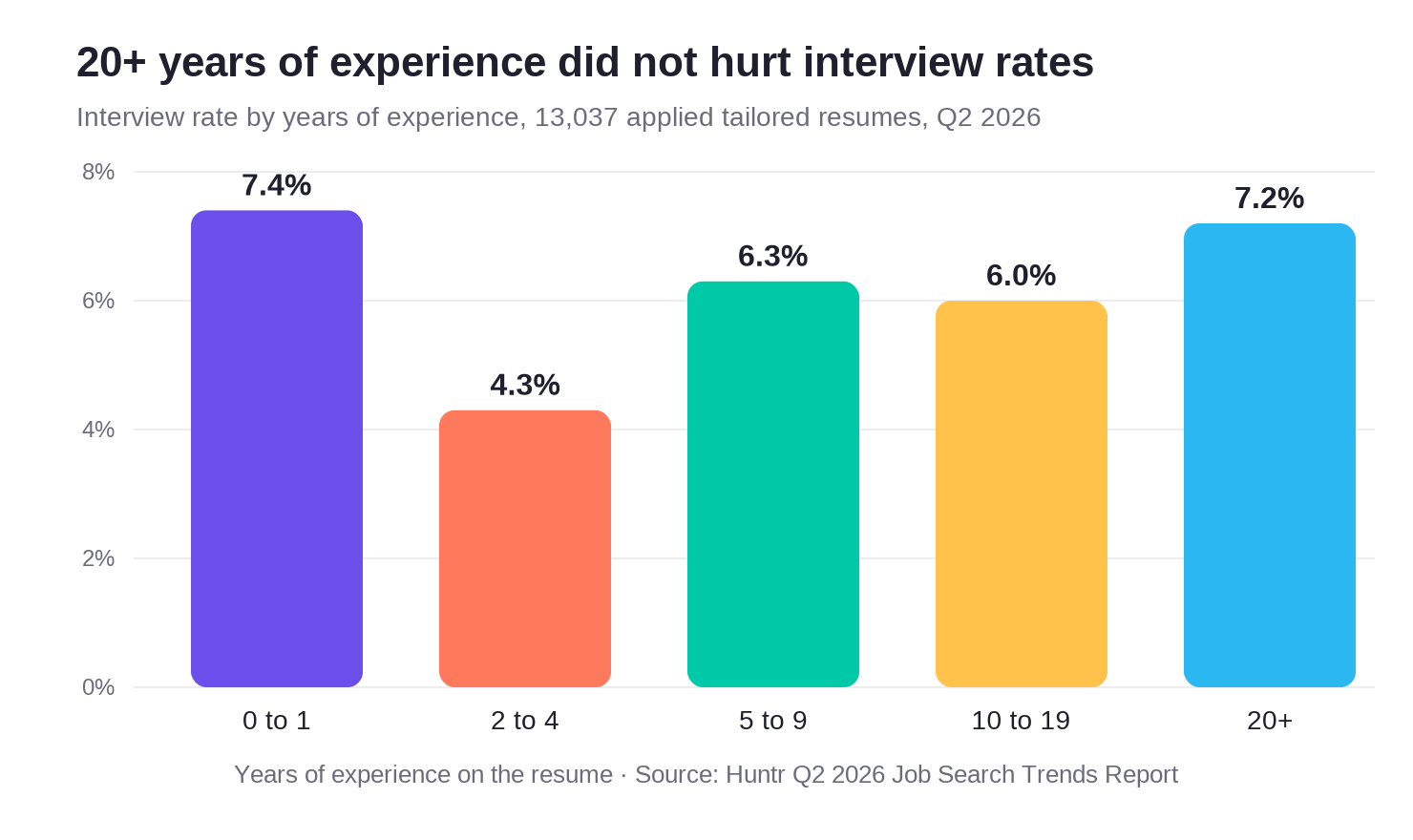
In our data, experience doesn't hurt you. Resumes with 20+ years of experience got interviews 7.2% of the time in Q2 2026, near the top rate. The group that struggled most had 2 to 4 years, at 4.3%. Many people I talk with say senior people have an easier time right now than mid-level people. In my calls, senior searches do run longer, with more interview rounds. But a slightly higher share of their applications turn into interviews.
Don't cut experience you have to look younger.
What I told one job seeker on a call: "One thing that pains me is when somebody has really great experience and they take it off of their resume because they're worried about ageism." Show all the work you've done that's relevant to this job. If you did this exact job 20 years ago, keep it. 2 pages gives you room.
What you can control:
- Lead with fit. Show the work that makes you the best person for this job: scope, team size, budget, and the decisions behind your results.
- Favor in-person and hybrid roles. Remote-only jobs had a 3.4% interview rate in Q3, against 5.3% for both onsite and hybrid.
- Aim at the companies you want. You can't fix someone else's bias. And a company that turns you down for an unfair reason may not be a place you'd want to work.
- Test, then change course. I always back what the data shows works. But if 30 to 40 tailored applications bring back less than the average, about 1 interview for every 20 applications, try something new. Hiding the oldest dates is 1 test. Keep the experience either way.
If you're a student or early in your career
Start before you graduate. As I wrote in The Seattle Times, recent graduates are stepping into "the worst job market for new entrants since 1988." Expect a longer search.
Use class projects, internships, campus jobs, volunteering, and paid work as evidence. Label them accurately. Explain the problem, what you did, and what someone can look at. Ask your career center about employer contacts, alumni, and recruiting calendars in your field.
When weighing an internship, ask about the work, supervision, feedback, pay, and what you'll learn. My advice to employers in the U.S. Chamber of Commerce's internship guide stresses structure and real responsibility. Those are good questions for you to ask too.
If you need work right now
Protect your income and your time. Consider temporary, contract, part-time, or nearby work while you keep up the longer search. Your experience still counts. Ask people you trust for specific help.
If you need a visa, or want to show you don't
"Majority of my screening calls end on the question of visa sponsorship because I'm on opt right now."
Financial analyst candidate, on a free one-on-one Huntr job search support call
Be honest and upfront about your status.
Answer knockout questions about work authorization truthfully. It saves their time and yours. And read how each job post words sponsorship before you apply. That wording is your best guide.
You don't need sponsorship?
Feel free to say so on your resume: "Authorized to work in the US; no sponsorship required." People add this for many reasons, like a degree from outside the US or worry that an employer will read their name and assume they need a visa. If you want the question out of the way, add the line.
You need sponsorship?
Getting sponsorship is much harder now than it was a few years ago, after the federal changes. Remote roles were already hard to land. I know people Amazon wants to hire who are struggling to get their visas. Your best move: show you're the most impressive, uniquely qualified person for this exact job.
If location or schedule limit you
Check limits early: location, hours, travel, accessibility, and the hiring process itself. Ask a recruiter about unclear requirements before doing a lot of unpaid work. Choose a pace you can keep up.
Your action items
- Find your field in the career change chart and note the 3 fields its people apply to most.
- Write down where your old work overlaps the new role, and choose 1 project that proves the missing skill.
- If you have a gap, write 1 short, factual line that explains it.
- If you're worried about ageism, check that you haven't cut relevant experience.
- If you're on a visa, read each post's sponsorship wording before you apply.
Further reading
- Career changer research: where people from 26 fields apply.
- The Job Hopper on resume gaps
Consult the experts. Changing careers: Courtney Warnsman has guided career changes for 20+ years, and Scott Anthony Barlow's Happen To Your Career helps you decide what you want first. Returning from a break: Heather Hagen Halldin writes resumes and LinkedIn profiles for people coming back to work. Students and new grads: Betsy Jewell coaches students and early-career professionals. More in the coaches I recommend.
Advice by field
"One of their pieces of feedback was. I wasn't able to quantify or, like, connect ... the data to the stories and, like, showing impact."
Customer success candidate coming from tax and accounting, after a final-round interview, on a free one-on-one Huntr job search support call
Look for the green "Reached the interview stage" label.
- Green examples come from real, anonymized Huntr resumes whose owners moved a job to the interview or offer stage. Names and some figures are changed. The companies that interviewed them are real.
- Purple examples are labeled illustrative. We built them from real job postings, and they make no interview claim.
Learn from the structure, then replace every line with your own. See how we build them in our resume examples methodology.
Pick your field
- Tech: software engineering, AI and machine learning, data, IT, cloud, and security, design
- Business: product, sales, marketing, customer success
- Operations: operations, program and project management, science and engineering
- People: HR, recruiting, and 100+ other roles
Software engineering
Show what you shipped, the part you owned, and its effect on users, reliability, speed, cost, or developer time. Put the relevant stack in context. Search for the work as well as the title: backend, platform, infrastructure, frontend, or developer tools. Link a focused, documented project where it backs up your claims.
Software engineer composite · Senior engineer composite · 30 software engineer examples · Full stack · Front end
Product
Show the customer problem, the decision you made, the tradeoff, and what happened after launch. Report product adoption on its own, apart from the company's total customer count. Bring a short case study that shows how you made a hard call.
Product manager composite · Senior product manager composite · 20 product manager examples
Sales
Give quota attainment with the quota, period, segment, deal size, and sales cycle. Label booked revenue, pipeline, and team revenue clearly. Target the motion you can explain: outbound, enterprise, channel, expansion, or inbound. A short, researched message to the sales leader shows the same judgment the role needs.
Account executive composite · Enterprise sales composite · 29 sales examples
Marketing
Show audience, channel, budget, and business result. Impressions matter when reach is the goal, but don't prove revenue. Match your evidence to demand generation, content, lifecycle, brand, or product marketing. Bring a campaign sample with your part and the result.
Data
Explain what decision, workflow, or product got better because of your analysis. Include data size where it matters, plus the quality checks and tools you used. Name the decisions your dashboards drove. George Washington University's data science program links to the data examples below.
Data analyst composite · Data engineer composite · Data scientist composite · 24 data analyst examples · Business analyst · Financial analyst
Science and engineering
Name the method, instrument, or process, the scale, and the result: yield, accuracy, cost, safety, or time saved. Make clear which work was yours and which was the lab's or plant's. Publications, patents, and validated processes count as evidence.
Systems engineer composite · Engineering examples
AI and machine learning
Show the task, baseline, how you measured it, and the tradeoff among quality, cost, speed, and risk. Say whether a system ran in production or only in a notebook. A small project with careful testing beats a list of model names.
Machine learning engineer composite · AI engineer examples. Read each example's evidence label.
Customer success and support
For success roles, show account scope, adoption, retention, renewals, or expansion. For support, show complexity, response or resolution time, quality, and what you improved. Match the resume to whether the employer needs account management, implementation, technical troubleshooting, or high-volume support.
Customer success manager composite · Technical support engineer composite · 46 customer service examples
Design
Make the portfolio easy to open. Show the user problem, limits, research, options, and your decisions. Explain what you owned and how you know the design helped. Tailor the first case study to the employer's product. Don't claim a conversion lift as yours alone when product, pricing, and engineering changed too.
Product designer composite · UX designer composite · 24 UX designer examples · Graphic designer
IT, cloud, and security
Show the environment you supported: users, systems, cloud spend, uptime, incidents, recovery, or risk reduced. Keep sensitive details private. Match required credentials accurately, and say whether the work was in a lab or in production.
Security engineer composite · Systems administrator composite
Operations
Make the work visible: process, volume, team, locations, budget, quality, and turnaround time. Give a before-and-after result with its cost or service effect. Logistics and business operations at a software company need different proof.
Operations manager composite · Chief of staff composite
Program and project management
Show scope, dependencies, risk, budget, timeline, and the benefit delivered. Pair each launch date with the business result. Say whether you ran a program of many projects or a single project.
Program manager composite · Project manager composite · Program coordinator examples · Career-change example
HR
State the workforce, locations, systems, and scope you owned. Show measurable gains in service, retention, onboarding, or process quality. Protect employee privacy.
Recruiting
Show role types, seniority, open roles you carried, sourcing channels, time to fill, and offer acceptance. Make clear which calls were yours and which were the hiring manager's. A short sourcing case study shows your approach without exposing candidates.
The HR collection has recruiter examples written for illustration, not built from real outcomes. Use them for structure.
Other fields
100+ roles in the collection. Browse the full index, or jump to legal counsel, consulting, executive assistant, and administrative assistant.
Your action items
- Open 3 examples for your target role.
- Note how the top third of each one shows fit.
- Copy the structure, not the words, into your resume.
Further reading
- 100+ real resumes that landed interviews
- Career changer research
- Q3 2026 Job Search Trends Report and Q2 2026
Consult the experts. Many coaches focus on a field or a career stage. Find yours in the coaches I recommend, sorted by what they help with.
Get the right help
"I've recently had two people contact me in the last week and told me, oh, your resume is all wrong. We need to redo it. It's not formatted for the ATS tracking system."
Rehabilitation counselor, on a free one-on-one Huntr job search support call
Start with people I trust. See the career coaches and resume writers I recommend below, sorted by what they help with. In the US, American Job Centers offer one-on-one counseling for free.
What good help costs
Sound career help usually costs a few hundred dollars, and $2,500 at most. That's what Robin Ryan, a career counselor with 30+ years of experience, told me. Some people pay far more:
- A C-suite job seeker told me she spent $9,000+ on 1 resume rewrite. I wrote about her in The Cost of an Interview: $9,000 for a Damn Resume.
- A "reverse recruiter" pitched a program that worked out to $1,600+ per guaranteed interview.
Red flags
Walk away from
- Guaranteed jobs
- Paying for access to an interview
- "Your resume failed the ATS" with no proof about the actual employer
- Pressure built around a score nobody explains
Ask before you hire
- What will you do, and what will I get?
- How do you know my field?
- How do revisions and cancellation work?
- Can I see a relevant, anonymized sample?
Verify the person and the opening through the company's official channels before sharing sensitive information. My reporting on expensive resume promises.
Choosing a tool
Whether you use a spreadsheet, a resume editor, or the Huntr browser extension, a good tool saves time, helps you make accurate edits, and lets you keep the result. Test any tool on 1 real application. Compare the output with your original facts. Check export options, recurring charges, and cancellation terms.
As I told Forbes Vetted, "Always message the support chat of these tools and ask if they tested the templates" against Greenhouse and Workday, 2 of the most common applicant tracking systems.
Know who's recommending what. Our resume builder comparison and AI model comparison come from a company that sells resume tools, including ours. Huntr also pays affiliates who refer subscribers.
Look after your mental health
A long search wears people down. I hear it on almost every call, and the research backs it up.
- 34% vs. 16%. In a review of 300+ studies, 34% of unemployed people had clinically significant mental health problems, against 16% of employed people. Paul and Moser, 2009
- 1.95x the risk. A 2025 review of 38 long-term studies found unemployed people had 1.95 times the risk of depression, anxiety, or distress. Sterud and others, 2025
- A new job helps. In the same review, people who found work cut that risk by about a third.
In a Resume Genius survey, 72% of job seekers said job hunting had hurt their mental health at some point. If there's 1 thing I've learned helping thousands of people find work, it's this: the ones who succeed are resilient, consistent, and ask for help.
- Set search hours. Pick your hours each week, and stop at the end of them.
- Track what you send. A job tracker shows your progress when the inbox is quiet.
- Talk to someone. A friend, a former colleague, or a counselor. Ask your former employer whether its Employee Assistance Program still covers you. Many offer a few free counseling sessions.
If you're in crisis
Call or text 988 in the U.S. to reach the 988 Suicide and Crisis Lifeline. Outside the U.S., find a helpline near you at findahelpline.com.
Free help from me
Book a free 15-minute call and resume review, or email me at [email protected]. Remove contact details and confidential information before sharing a resume publicly.
A tool can help you explain your experience, but a tool can't control openings or hiring decisions. Neither can I.
Your action items
- Check whether your nearest American Job Center offers free counseling.
- Call your college career center or alumni office.
- Before paying anyone, ask the 4 questions above.
- Test any tool on 1 real application before you subscribe.
- Set your search hours for the week, and tell 1 person how your search is going.
Further reading
- The Cost of an Interview
- How to avoid job search scams and resume costs
- The best resume builders
- Labor Department counseling trial
Career coaches and resume writers I recommend
Even as I help build AI job search tools, I still tell job seekers to find a coach.
- Tools help you track and tailor. In Huntr's data, tailored resumes got interviews 5.71% of the time, against 3.09% without tailoring.
- A good coach helps you decide what to do and keeps you going. I don't think AI will replace that.
- Counseling pays off. In a Labor Department trial, people who met one-on-one with an employment counselor earned $3,000 to $7,000 more over the next 30 months than people who didn't.
These are the career coaches and resume writers I've met with, learned from, and stand behind. Some of them partner with Huntr. Before you hire anyone, read Get the right help.
Job search strategy
- Hannah Morgan: The Job Search Strategist. Her Career Sherpa blog and newsletter are full of free resources. Someone I see as an expert and mentor.
- Bogdan Zlatkov: Data-backed job search for mid-to-late-career professionals. Former LinkedIn Learning content lead, and my favorite co-host for LinkedIn Lives.
- Austin Belcak: Landing jobs without applying online. Runs Cultivated Culture and offers free career clarity calls.
- Alison Doyle: 25+ years of job search advice. Co-founder of The Job Hopper newsletter. Kind, and in it for the right reasons.
- Heather Hagen Halldin: Career coach, workforce development professional, and dual-certified resume writer and LinkedIn strategist (NCRW, NCOPE). Every client gets a job search strategy first, because you can't move forward on your search or your documents until you have one. Works with community college students, early-career job seekers, people returning from a break, people new to the US, and career changers.
Resumes and LinkedIn
- Robin Ryan: Career counselor and Forbes writer who has written thousands of resumes and talked resumes on Oprah. One of the most credentialed people I've met.
- Greg Langstaff: Resume strategist with 11 years as a hiring manager. The best short-form video creator on resumes.
- Emily Christakis: Certified resume writer digging into how applicant tracking systems really read your skills.
- Tayyaba Manaal: Certified professional resume writer and job search strategist for middle managers and executives. Writes with intention and strategy.
- Carrie Bryson: LinkedIn strategy, resumes, and interview coaching for mid- and senior-level professionals, through Align2Success.
- Jeremy Schifeling: Former LinkedIn. Author of best-selling books on AI and LinkedIn for your career.
Interviews, networking, and soft skills
- Luki Danukarjanto: "The Soft Skills Guy." Interview and networking coach, and former Deloitte recruiting lead.
- Teri Christine Akpovi: Career coach and talent acquisition leader with 12+ years of hiring experience. Helps people make strategic career moves.
Career changes and what's next
- Courtney Warnsman: 20+ years guiding career changes, plus negotiation and executive presence. A mentor to me.
- Scott Anthony Barlow: Host of the Happen To Your Career podcast. Helps people decide what they want before they search. Fellow Washingtonian.
- Courtney Motyczka: Career transitions and job search strategy for clients from 17 to 70, across industries, through CJ Grey.
Students and early career
- Betsy Jewell: Career coaching for college students, recent grads, and early-career professionals.
Mission-driven work and access
- Jenn Walker Wall: Career coaching and resumes for mid- and senior-level professionals in mission-driven work, through Work Wonders Careers.
- Ellen Chang: Accessible hiring, working with clients from entry to senior level.
For career services teams
- Keri Aaver: Trains the people who run public job centers and career services teams.
Podcasts I recommend
I've been a guest on each of these. The hosts know the job market, and every episode is free.
- Happen To Your Career: Scott Anthony Barlow's show on finding work that fits you. Start here if you don't know what you want next. My episode.
- Recruiting Future: Matt Alder's show for recruiters. Listen to hear how hiring teams think about AI and candidates. My episode on how job seekers' AI use is changing recruiting.
- Let's GTFO with Bethany and Jana: Frank, funny talk on leaving jobs and finding better ones. About my episode.
- Finding Brave: Honest stories from people who changed careers. Listen when you need the nerve to make a move. My episode on application mistakes.
- Career Intelligence: Research on how careers and hiring work. Listen if you want proof before you change how you search. My episode on what works in today's search.
- Land Your Next Job and Laid Off Legends: Land Your Next Job gives short, practical tips for people applying now. Laid Off Legends talks with people who lost a job and came back from it. My episode on ATS scores and my episode on resumes.
Free help near you
In the US, you can meet with a counselor for free. More than 2,400 American Job Centers offer one-on-one counseling, resume reviews, and mock interviews. The Labor Department trial above measured this same counseling. Find your nearest center. Your college career center and alumni office are worth a call too, even years after you graduate.
Grace Institute: A New York nonprofit with 130+ years of free job training for women who are out of work or underemployed. Sarah Wessel leads its employer partnerships and career coaching. If you're a woman in the New York area, start here.
Career coaches and resume writers: want to be on this list?
Email me at [email protected] or connect on LinkedIn at linkedin.com/in/samwri321. I'd love to hear about your work. And sorry to anyone I've missed.
If you were just laid off
"I've applied to no less than about 100 jobs. I know this because I have a spreadsheet."
Attorney, on a free one-on-one Huntr job search support call
Start here, before week 1. These are the steps most people skip. Then follow the 4-week plan below.
1. In the first hour: get the terms in writing, and don't sign yet
- Ask for your layoff letter and the severance terms in writing.
- Ask for time: "I'd like 48 hours to review the paperwork before I sign anything."
- Take time to grieve. A day or 2 won't hurt your search.
2. Negotiate your severance
Most people don't know they can.
- You have leverage. Companies offer severance in part to protect themselves from legal claims. The release you sign is what they get in return.
- Ask, unless they've told you the offer is final.
Things to ask for:
- More weeks of pay
- Health coverage, or help paying for it
- Your bonus and unused time off
- Agreed reference language
40 or older?
If you're 40 or older, US law gives you at least 21 days to consider the offer (45 in a group layoff), and 7 days to take it back after you sign. For anything complex, a 1-hour call with an employment lawyer is worth it.
3. File for unemployment in your first week
Many people qualify and don't know it.
- Most people never apply. In 2022, only 26% of unemployed people who had worked in the past year applied for benefits.
- Why they skipped it: 55% thought they weren't eligible, and 17% expected to be back at work soon.
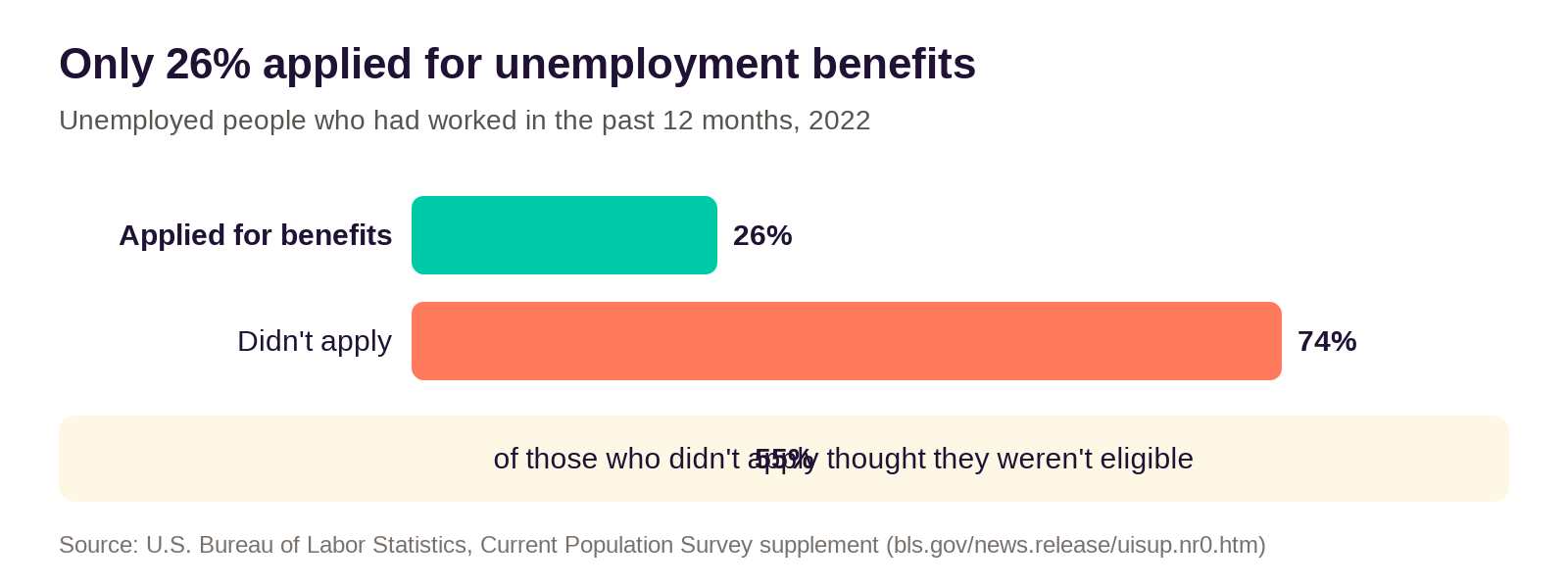
- Searches run long. Plan for 3 to 4 months.
How to file:
- Check your state's rules in the Labor Department's unemployment benefits finder.
- Have your layoff letter and last pay stub ready.
- File now. A late claim can cost you weeks of benefits.
4. In your first week: map your people
A referral is your best shot at an interview. In Ashby's data:
- Referrals were under 1% of applications.
- But 40% of referred applicants reached an interview.
- Referrals made up about 18% of hires.
Don't stop at friends and family. Weak ties, people you know a little, often help most. More in Networking and referrals. List:
- Former coworkers and managers
- Classmates and fellow alumni
- People you met at events and trade shows
- LinkedIn connections you've talked with, even once, in the past 2 or 3 years
Write down where each one works now, and check those companies for open roles. Start with the places where you have an in.
5. Fix your resume before you reach out
A referral gets your resume read, but your resume still has to show you fit. Get your resume in shape first, so you have something strong to share. See Write your resume.
After that, the rest of the search looks like anyone else's. For more on the first days, see my contribution to SUCCESS.
Your first 4 weeks
This plan works for anyone starting a search, laid off or not.
Block 2.5 to 10 hours a week for applications: 10 to 20 a week at 15 to 30 minutes each, or 30 minutes to 2 hours a weekday. Hiring timelines vary, so adjust as you go. Move interview prep forward as soon as an interview appears.
Week 1: Choose a target and build your evidence
- Write down your limits and 1 target role. See Plan your search.
- Compare 3 current job posts and note the repeated requirements.
- Start a master record of projects, duties, results, and work samples.
- Build a clear base resume in a readable format (see our resume format study), and match your LinkedIn profile to it.
- Set up Huntr's free job tracker, job alerts, and an employer list from the Hidden Job Market list.
- Tell 5 people what you're looking for.
Week 2: Apply and reach out
- Tailor each application using facts from your master record.
- Search several sources: Google job search, niche job boards, and company websites.
- Reconnect with people who know your work, and make specific asks.
- Save each resume version, job post, and next step.
- Practice your introduction and 5 stories.
Week 3: Find the bottleneck
- Work out your interview rate: interviews ÷ applications.
- Compare by source, target role, and resume version.
- Ask someone you trust to review 3 real applications.
- Change 1 important thing so you can learn from the result.
- Follow up 3 days after applying, up to 2 times.
Below 5% after 2 weeks? Find your problem in Where are you stuck?
Week 4: Keep what works and adjust
- Decide which roles and sources deserve more of your time.
- Rethink a target that turns up too few openings.
- Update your stories based on questions you got.
- Check that your pace is sustainable and your income plan still holds.
- Take time away from the search. Use your tracker to decide what to change.
Further reading
- Job search tips, ranked by impact
- Q3 2026 Job Search Trends Report and Q2 2026
- Huntr's job tracker and job search metrics
Consult the experts. Want someone to keep you on track week to week? Bogdan Zlatkov and Hannah Morgan both teach a structured search. More in the coaches I recommend.
Frequently asked questions
"What about ats? There is automatic scanning of resumes. What's your feedback in relation to that?"
DevOps engineer, on a free one-on-one Huntr job search support call
Short answers to the questions I hear most on calls. Each answer links to the section with the full story.
Your search
How many jobs should I apply to each week?
10 to 20, as long as you can still tailor each one. At 15 to 30 minutes each, that's 2.5 to 10 hours a week. In Q3 2026, people who sent 11 to 20 applications had an 8.0% interview rate, against 2.4% for those who sent 100+. See Plan your search.
How long will my search take?
Plan for 3 to 4 months. The median time to a first offer was 102 days in Q3 2026. See Plan your search.
Will ageism hurt my search?
Ageism is real. Many people tell me someone told them outright they were too old. But in our data, resumes with 20+ years of experience got interviews 7.2% of the time in Q2 2026, near the top rate. Don't cut relevant experience to look younger. Lead with fit, favor in-person and hybrid roles, and aim at companies you'd want to work for. See Career changes, gaps, ageism, and first jobs.
Should I mention my visa or work authorization?
Yes. Be honest and upfront, and answer knockout questions truthfully. If you don't need sponsorship, feel free to say so on your resume. If you do, sponsorship is much harder to get now, so read each job post's wording on sponsorship and apply where you're the strongest fit. See If you need a visa.
Which job sites work best?
Google job search and employer career sites beat LinkedIn in our data. See Where to find jobs.
Should I apply if I don't meet every requirement?
Yes, if you can make a believable case. Separate must-haves from nice-to-haves. There's no proven "meet 60%" rule. Answer screening questions honestly, and recruiters do look at near misses. See Understand the ATS.
I was just laid off. What do I do first?
Don't sign anything yet. Get the terms in writing, ask for time to review, and negotiate your severance. File for unemployment in your first week. See If you were just laid off.
The search is wearing me down. What helps?
72% of job seekers say the search hurt their mental health. Set search hours and stop at the end of them, track what you send, and talk to someone. If you're in crisis, call or text 988 in the U.S. See Look after your mental health.
How do I ask for a referral?
Message someone at the company about the specific job, and follow up 3 days later. See Networking and referrals.
Your resume
Should a resume be 1 page or 2?
Use the space your evidence needs. Our format study found 2-page resumes perform well for most candidates. Cut repetition first.
Is an ATS score worth worrying about?
No. An ATS score is a tool's guess, and no employer sees it. A person reads your resume, and fast rejections come from knockout questions. See Understand the ATS and how applicant tracking systems actually work.
Should I use AI to write my resume?
Use AI to draft and match keywords, then check every line. See Tailor your resume and use AI.
Should I write a cover letter for every job?
No. Only when the employer requires one. A strong resume summary does the same job, and I've seen no evidence that cover letters raise interview rates. If you must send one, write it yourself and give 1 specific reason for the role. See Follow-ups and cover letters.
Getting help
Should I pay for help?
Pay for a clear service or time saved, if it fits your budget. Ask what you'll get, who does the work, and how revisions and cancellation work. Free help from a career center, an American Job Center, or a free call with me may be enough. See Get the right help.
Should I do an AI interview?
Whether to do one is your call. But many people drop out of AI interviews, which means less competition for those who stay. Prepare the same way you would for any interview. See AI interviews.
How do I negotiate an offer?
Get every term in writing, pick the 1 or 2 changes that matter most, and explain why. See Job offers and negotiation.
Don't see your question? Ask me here or email [email protected]. The best questions get added to this page.
How I built this guide
I'm Sam Wright, Head of Career Strategy at Huntr. I joined in August 2021 as its first hire. Huntr is a resume builder and job search tracker with 500,000+ users, run by a team of about 6. This guide comes from 5+ years and 10,000+ hours of helping people find work.
What it draws on
- Job seekers: 1,000+ free one-on-one calls, 2,000+ resumes and 1,700+ LinkedIn profiles reviewed, and 400+ coaches, career services pros, and recruiters met.
- Research: about 2 million applications, 2.9 million job postings, 466,000+ resumes, 3,224 survey responses, and 9 applicant tracking systems tested.
- Recruiters: interviews with recruiters who have hired at Amazon, Microsoft, and other employers.
- Outside research: government data, peer-reviewed studies, and surveys from other companies, each linked where I use it.
How to read the numbers
Interview rate means the share of applications that reached the interview stage in a Huntr user's job tracker. Each number names its time period and links to the report it came from. Most come from our quarterly job search trends reports.
Our data shows patterns, not causes. Huntr users may differ from job seekers as a whole, and people log their own results. Where I give my own view from calls rather than data, I say so.
Quotes and examples
Job seeker quotes come from support calls recorded with consent and from Huntr surveys. I removed names and kept each person's role. Resume examples are anonymized composites, labeled by evidence, as described in our resume examples methodology.
Know who's writing this.
Huntr sells resume and job search tools, and I work there. Where I name Huntr tools or rank them, weigh my view with that in mind. Some coaches on my list partner with Huntr, and Huntr pays affiliates who refer subscribers. No one paid to be in this guide.
Who cites this work
Yale SOM, UCLA, Carnegie Mellon, Georgetown, and 40+ other schools link to Huntr's tools and research. Our data has appeared in Forbes, Quartz, and The Business Journals, and I've been quoted in Business Insider and The Wall Street Journal.
Keep in touch
Connect with me on LinkedIn and send me a DM, follow me on X (@sammillerwright), or subscribe to my newsletter, The Voice of the Job Huntr.co. For podcasts, media, or data requests, email [email protected].
📞 Free 15-minute call and resume review
One-on-one with me to review your resume and your search. Sign up for Huntr and email your resume to [email protected] first.
⭐ For Huntr Pro subscribers using this guide
A weekly 15-minute job search support session with me. Unlimited resume reviews and resume tailoring. Email [email protected] to book yours.
How can I make this guide better? Send me a quick note or email [email protected]. I read every one.
Last updated November 9, 2026.

Sam Wright
Sam Wright is the Head of Career Strategy at Huntr. Drawing on proprietary data from 1.7 million applications, 1 million job postings, 243,000 résumés, and a 1,049-respondent survey, Sam provides actionable, data-driven blueprints to help professionals navigate today's fractured hiring landscape. He has conducted over 900+ free support calls with job seekers, giving him frontline insight into today's job market. His work and insights have been featured in Business Insider, The Wall Street Journal, Forbes, and The Seattle Times.
Outside the tech world, Sam is a part-time farmer from a five-generation legacy of organic vegetable farming. He is a passionate advocate for farmland preservation.
Get More Interviews, Faster
Huntr streamlines your job search. Instantly craft tailored resumes and cover letters, fill out application forms with a single click, effortlessly keep your job hunt organized, and much more...
AI Resume Builder
Beautiful, perfectly job-tailored resumes designed to make you stand out, built 10x faster with the power of AI.
Next-Generation Job Tailored Resumes
Huntr provides the most advanced job <> resume matching system in the world. Helping you match not only keywords, but responsibilities and qualifications from a job, into your resume.
Job Keyword Extractor + Resume AI Integration
Huntr extracts keywords from job descriptions and helps you integrate them into your resume using the power of AI.
Application Autofill
Save hours of mindless form filling. Use our chrome extension to fill application forms with a single click.
Job Tracker
Move beyond basic, bare-bones job trackers. Elevate your search with Huntr's all-in-one, feature-rich management platform.
AI Cover Letters
Perfectly tailored cover letters, in seconds! Our cover letter generator blends your unique background with the job's specific requirements, resulting in unique, standout cover letters.
Resume Checker
Huntr checks your resume for spelling, length, impactful use of metrics, repetition and more, ensuring your resume gets noticed by employers.
Gorgeous Resume Templates
Stand out with one of 7 designer-grade templates. Whether you're a creative spirit or a corporate professional, our range of templates caters to every career aspiration.
Personal Job Search CRM
The ultimate companion for managing your professional job-search contacts and organizing your job search outreach.
Huntr
Blog Product Updates Resume Skill Guides Resume Examples Interview Question Guides Research 2025 Job Search Trends Report Affiliate Program Careers Privacy policy Terms of service Write for us LinkedIn Reddit r/HuntrCo Twitter @TryHuntr Email UsProduct
Job Tracker AI Resume Builder Resume Tailor Resume Checker AI Cover Letters Resume Summary Generator Resume Bullet Generator Resume Skills Generator Resume Headline Generator Resume Keyword Scanner Job Keyword Finder Targeted Resume Contact Tracker Interview Tracker Job Search Metrics Job Application Autofill Resume Storage AI Resume Review Job Clipper Resume Optimization ChatGPT Resume Builder Resume Fixer LinkedIn Resume Builder AI Resume Rewriter Interview Question Generator