
Huntr Blog
Job Search Tips for 2026: 6 Data-Backed Strategies Ranked by Impact
May 14, 2026

Some job search tips are recycled anecdotes from someone's uncle who last looked for work a decade ago. Most, are not data-backed, that is for sure.
I've spent the last two years pulling job search statistics from 1.7 million applications, 243,000 resumes, and 750-plus free calls with job seekers. I've also sat down with recruiters at Microsoft, Amazon, Deloitte, and Fortune 500 firms and asked them what they actually look for when they open a resume. I've also conducted deep dives into reports and studies on job-search best practices. Below are the job search tips for 2026 that actually increase your interview rate, ranked from the biggest impact to the smallest.
TL/DR: The #1 tip is to tailor your resume to match the job description. This is something you have the power to control and increases interviews more than 200%. Use Huntr to help.
1. Get a referral
What job seekers tell me: A former marketing director, laid off after more than a decade at the same company, sent more than 100 applications in three months. Her interview rate was about 1%. The one interview she landed came from a coworker she'd barely worked with five years earlier. Her words from our call:
"In the past, a referral will get me an interview. I would apply to five jobs and probably get four interviews. It's just drastically different now."
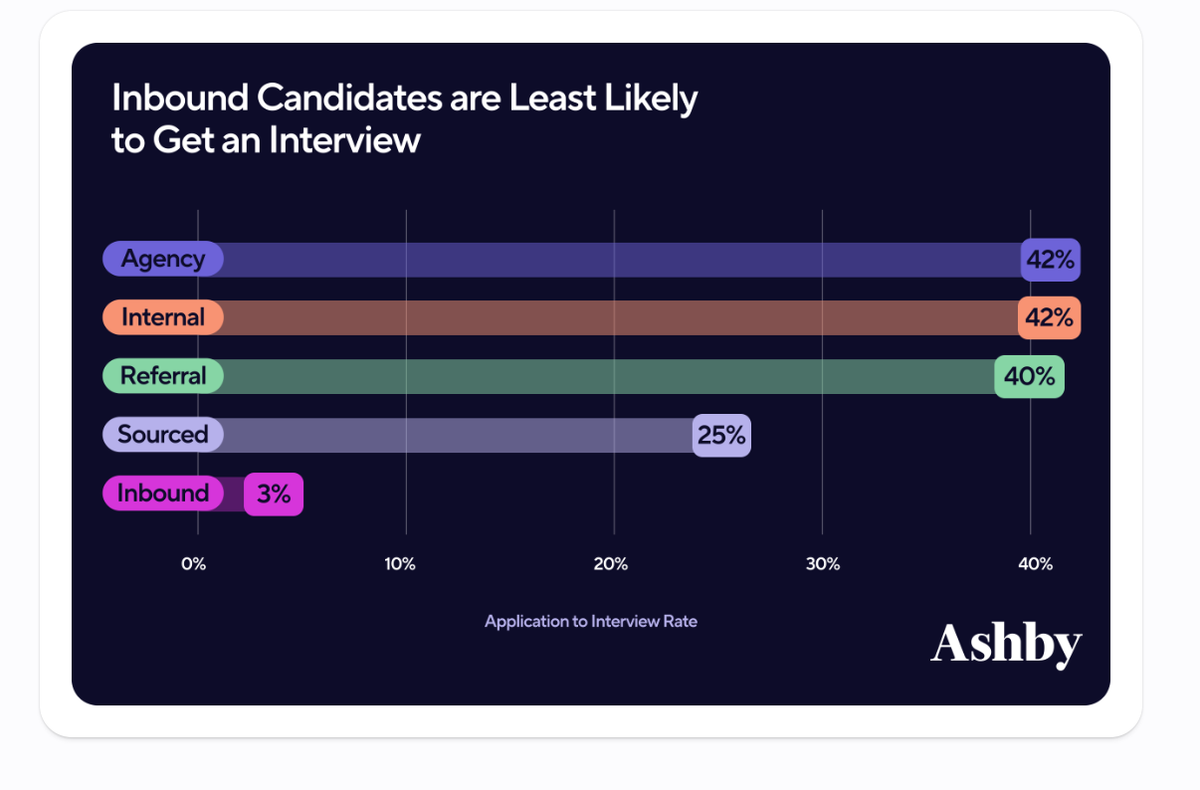
What the data says: Ashby's analysis of millions of applications shows that a cold application converts to an interview at about 3%. A referral converts at 40%. That is a 13x lift. No other job search strategy on this list matches it.
The catch: referrals are about 1% of all applications. As I tell job seekers on my free job search support calls, it takes years, sometimes generations, to build. If you need a job in eight weeks, you cannot rely on them alone.
Ted Staeb, a Microsoft recruiter, told me:
"It's a mixture of referrals, good resumes, being some of the first people to apply. There's a ton of people in the white collar market right now."
What to do this week: list every person you know in the field. Try to schedule five 15-minute networking calls a week. Ask for advice, not jobs. Stay in touch when you do not need anything. The next search you run, the network is there.
2. Tailor every resume
What job seekers tell me: A marketing strategist mid-search told me one Deloitte application took her two hours, between editing in Huntr, hand-writing cover letter copy, and looking up how to reach out to about the role. An engineer pivoting into UX research said:
"Matching my resume to the job description... sometimes it just feels like I'm faking my way through it."
The exhaustion is real. People overthink this, burn out, and stop tailoring.
What the data says:
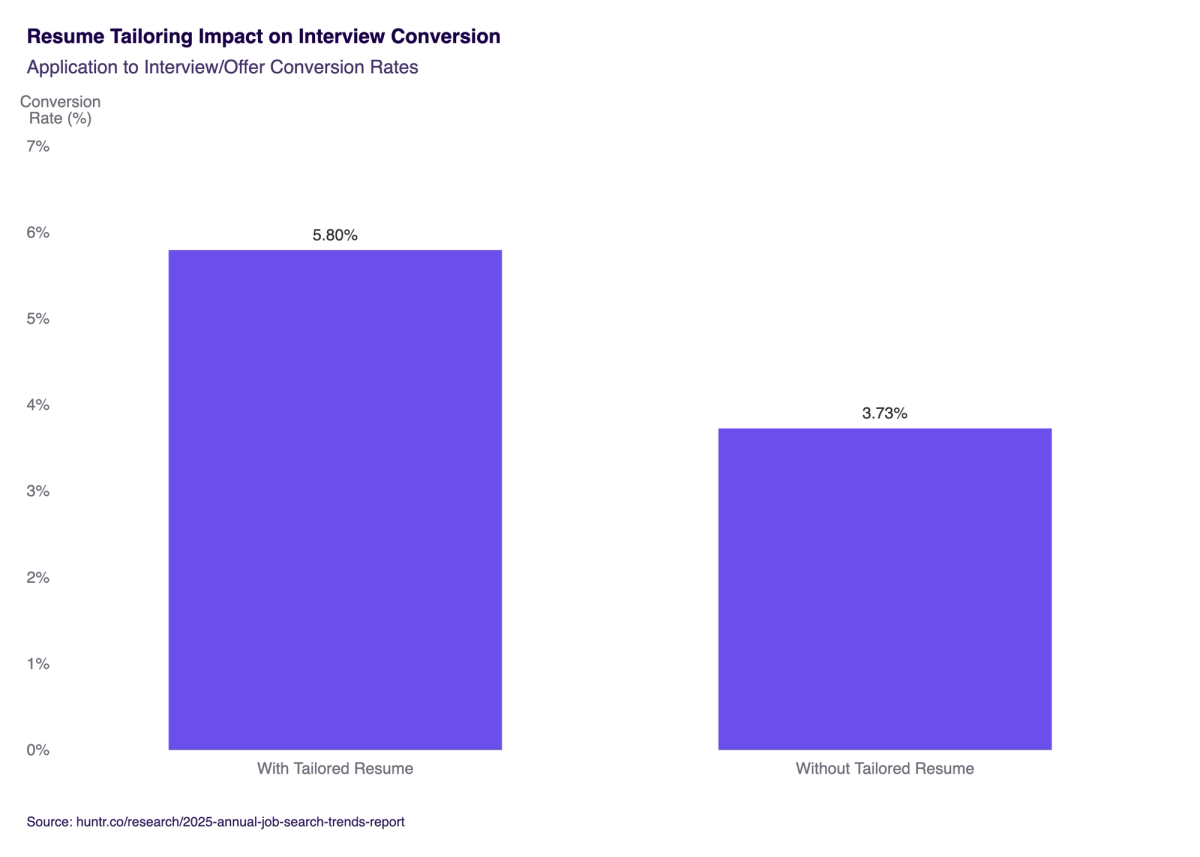
- Tailored: 5.8% interview rate
- Untailored: 3.73%
- Tailored resumes are 1.6x more effective. Roughly 1 interview per 17 applications, vs 1 per 33.
Tailoring should take 15 minutes, not two hours. Use AI to help you tailor. Hit three sections in this order: summary (lead with your best aggregated numbers and name the role), skills (let AI catch the gaps), and accomplishments (reframe to fit the job, putting the best bullet points first).
Ted Staeb on what dense, generic resumes get you:
"The more paragraphy a resume is, the more likely we are to simply not read it, because we've got 738 others that just gave us the data."
Skip "results-driven," "seasoned," and "detail-oriented" as your resume summary starters, too. Get to the good stuff asap.
3. Match the job title
What job seekers tell me: A candidate trying to land revenue operations roles:
"The target titles are so varied. For every 100 revenue operations roles posted, there are probably two or three that fit my criteria. My application pool is so low. I can't expect interviews out of two applications a week."
Career switchers feel this hardest. The engineer turning UX researcher:
"I have this software engineering experience that's a big chunk of my work history, but it's never going to be 100% related to UX research. I feel like I don't get a lot of credit for that."
What the data says: For every line on your resume, the title on your most recent role does the most work. Eye-tracking research shows a recruiter's second fixation lands on the current or most recent job title and company. A Fortune 500 recruiter told me plainly:
"Companies, title, tenure. That's what I look at first."
Kristen Fife, an Amazon recruiter, framed the deeper signal during her initial scan:
"If the job says you're an enterprise AE managing $50M per year, you should be somewhere in that ballpark. They're looking for someone with enterprise AE experience. It may not be $50M, it may be $30 or $15, but they're looking for multiples of tens of millions."
Title and scope are read together.
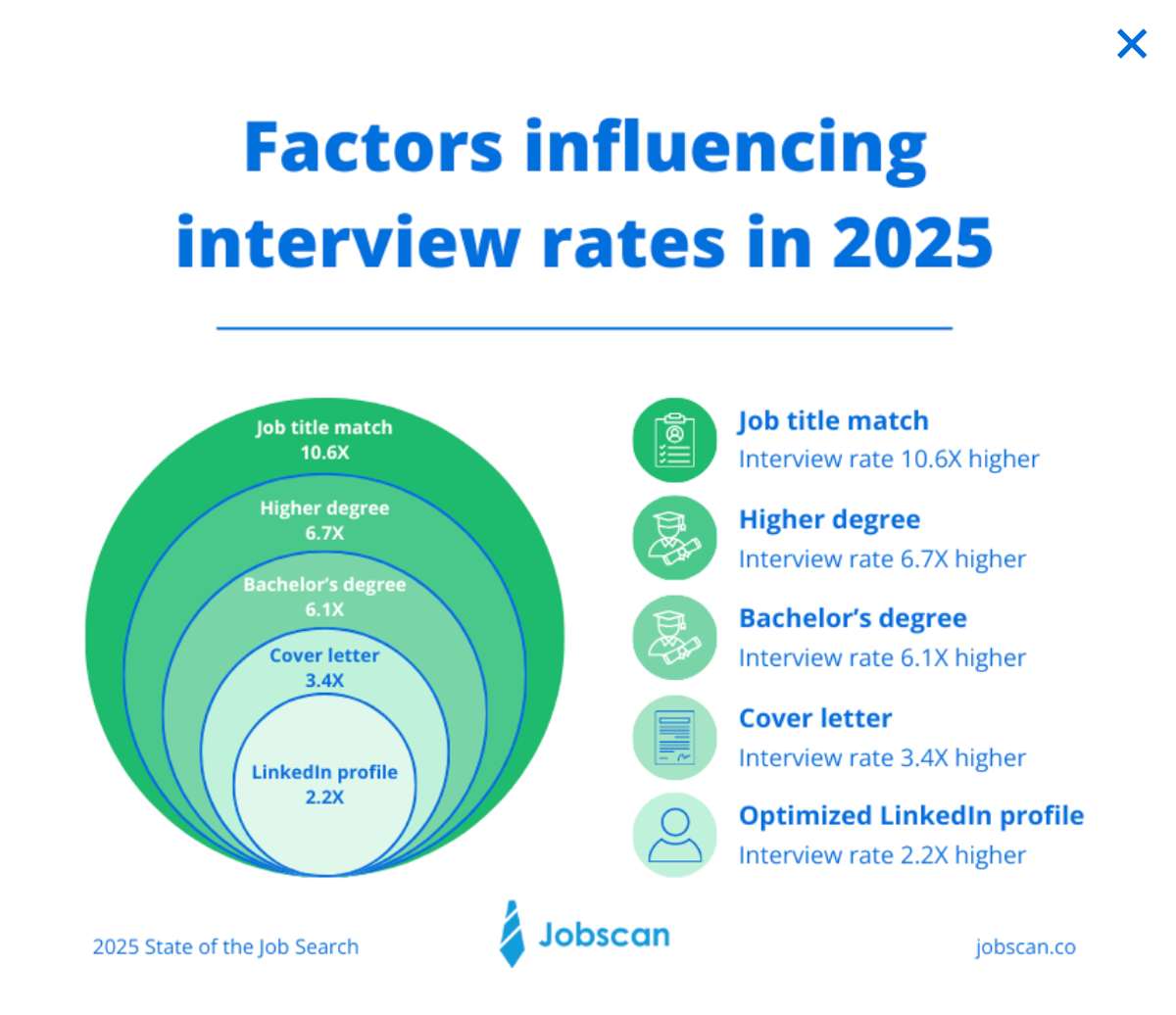
Jobscan's 2025 analysis put the lift from matching resume title to target title at 10.6x. That seems a bit steep, but directionally, I believe this is correct based on my 750+ job search support calls. Title matching is a good practice.
The cleanest match: Your last job has the same title as the role you are applying to. Write it on your resume exactly as the job description does. If your current title is non-standard or hides what you actually did, add the target title in parentheses or with an "and." You did the work. You are giving the recruiter the same context as your old manager would.
Be additive, not subtractive. Recruiters spend 6 to 10 seconds on the first scan. Help them see the fit fast.
4. Pick the right job board
What job seekers tell me: A software engineer sent around 300 applications, almost all through LinkedIn Easy Apply. He got one interview call. He told me:
"I was mostly applying to LinkedIn Easy Apply. I was not getting any response."
A senior UX designer, nine months unemployed:
"I've had two interviews and maybe 100 applications. I know I've been careless because I use Easy Apply. I know all the advice behind that."
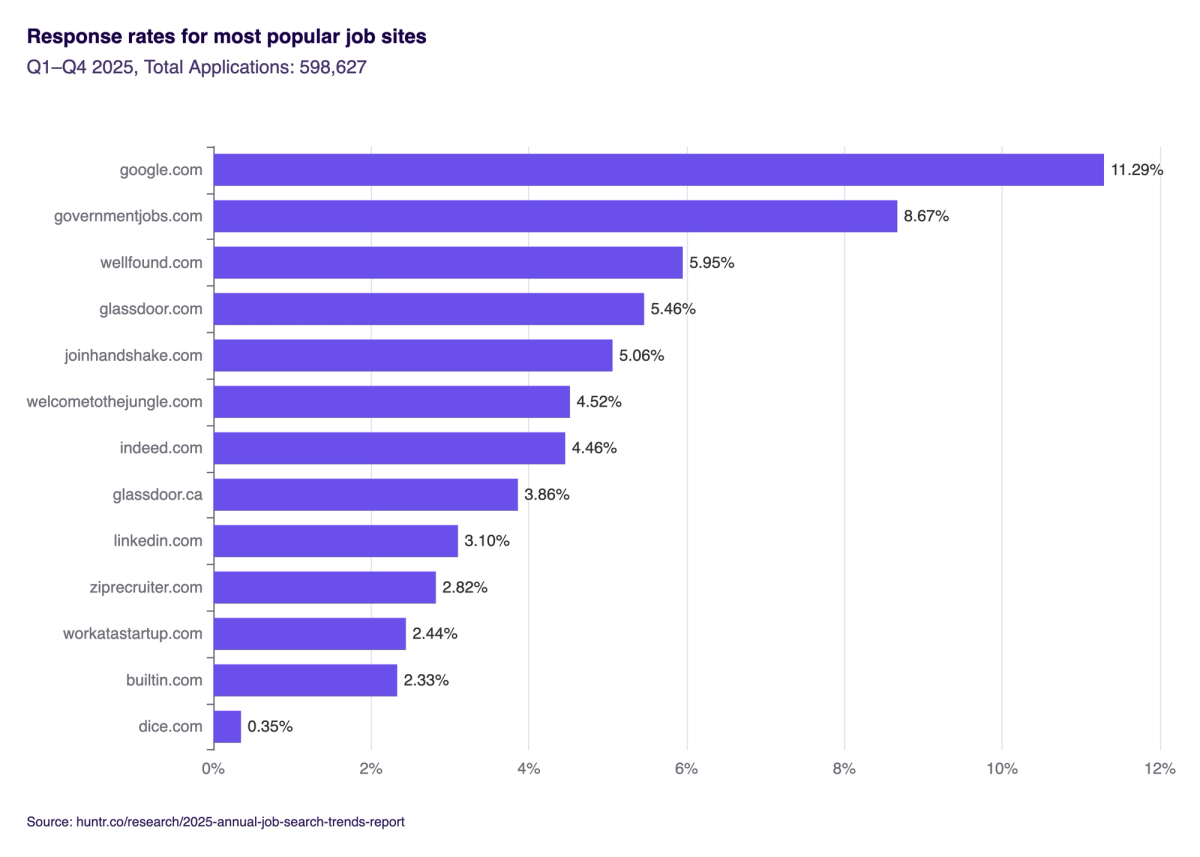
What the data says: Across 598,627 applications, we tracked the best job boards:
- Google Jobs: 11.3% response rate
- GovernmentJobs.com: 8.7%
- Wellfound: 6.0%
- Glassdoor: 5.5%
- Indeed: 4.5%
- LinkedIn: 3.1%
- Dice: 0.35%
Google aggregates every job board and company page on the web. Run a Boolean search, filter to the last 24 hours, and apply.
LinkedIn captures 75 to 80% of saved jobs on Huntr but ranks near the bottom on response. Easy Apply is worse: 72.5% of job seekers said it produced zero interviews in 2025. The role gets pushed to thousands of people. You stand at the back of a long line.
5. Apply early
What job seekers tell me: Most people on my calls do not know how fast a recruiter pipeline closes. Once five candidates are in the interview loop, the recruiter stops reading new applications.
Ted Staeb (Microsoft) said it this way:
"You can be the best candidate. But if you apply three weeks later and we've already got five people in the loop, we'll never see you because we're not looking anymore."
And on volume:
"I have six roles right now that have been open for less than a week. Each of them has over 500 candidates."
Scott Lipinski, a Big Four recruiter:
"Early bird gets the worm when you're dealing with a lot of these numbers."
What the data says: Every recruiter I have interviewed, at Amazon, Microsoft, Deloitte, and several AI companies, says the same thing. Apply in the first 24 hours, or be in the first 100 in the queue.
Set Google Jobs to the last 24 hours. Save searches. Get notifications. Move fast.
6. Message the hiring manager
What job seekers tell me: Marketing director, on the one interview she landed in three months:
"I reached out directly to someone I worked with briefly. Not even that closely. Five years ago. She sent my information directly to the hiring manager and HR. That, to me, was the difference. I truly think my resume is not getting to the point where it's getting seen in some cases."
That is the gap most people miss. Applying through the portal is step one. Getting your name into a human's inbox is step two.
The practice: After you apply, find the hiring manager or the closest person to the role on LinkedIn. Send a short note. Show you read the job description and want the job. Reference one thing from their team or product and show passion and enthusiasm for the role.
If you do not hear back in three days, follow up. Two follow-ups are the right number. One is forgettable. Three is annoying. It may feel uncomfortable if you are not used to sales, but it works.
This costs you 10 minutes per role and can make a difference. I know because I've seen it.
More 2026 job search tips that work
These may not double your interview rate on their own but they will help:
- Two pages, not one. Across 128,000 resumes, two-page resumes hit 3.24% interview rate. One-page hit 3.06%. Three pages drop to 2.6%. Four-plus drops 35% from peak.
- Have a summary section. 92.7% of interviewed resumes had one. 89.3% of non-interviewed did. Lead it with your best aggregated metrics. Keep it under 500 characters.
- Include your LinkedIn link. 71.7% of interviewed resumes had it. 64.3% of non-interviewed did.
- Apply 16-plus a week. That is the median for successful searches. 38% of job seekers land within 30 applications. Volume still matters.
- Use numerals, not spelled-out numbers. "4 years" stands out. "Four years" gets skimmed past. A Fortune 500 recruiter put it best: "I'm not gonna see F-O-U-R."
- Fill out the education section. Honors, clubs, sports, coursework. It correlates with higher conversion across every level we measured.
What to ignore in your 2026 job search
A few things that get a lot of airtime and do not move the data:
- ATS scores. No universal "ATS score" exists. No major ATS auto-rejects a resume. Recruiters at Amazon, Microsoft, and the Big Four told us so on the record. Ted Staeb (Microsoft): "An ATS is a filing cabinet. That's it. It doesn't make decisions."
- Keyword stuffing. That advice is from 2010 and was about sourcing, not screening. Have keywords, but don't overdo it.
- Fancy templates. PDF or Word, plain layout, fonts no smaller than 10pt.
- Applying to 15 jobs at the same company. Recruiters can see your full application history at that company. It hurts you.
How to put these 2026 job search tips into practice
If you are starting today:
- List 20 people who could refer you. Reach out this week.
- Pick two job boards. Make Google one of them. LinkedIn is fine, but not first. Check out Wellfound, Indeed, and Glassdoor.
- Set up alerts for the last 24 hours and only apply to fresh jobs.
- Tailor every resume in 15 minutes. Match your most recent title to the role.
- Message the hiring manager every time (or try to at least)
- Apply 16 a week and track everything.
- Pivot every 20-50 applications if you are not getting interviews.
The 2026 job market is harder than it was three years ago. Median time to first interview is 23 days and some searches run four months. The job search tips above will not promise you a job but they do give you the best odds I know how to give.
Frequently asked questions about the 2026 job search
What is the most effective job search strategy in 2026?
The most effective job search strategy in 2026 is getting a referral. Ashby's data shows referrals lift application-to-interview conversion from about 3% to 40%, a 10x jump. The catch is that referrals make up only about 1% of total applications, so build a network year-round and stack other tactics like resume tailoring, applying early, and matching your job title to the role.
Do tailored resumes really get more interviews?
Yes. Tailored resumes convert to interview at 5.8%, vs 3.73% for untailored, based on Huntr's 2025 analysis of 1.7 million applications. That works out to 1 interview per 17 applications when you tailor, vs 1 per 33 when you do not. Tailoring should take 15 minutes per role with AI help, not hours.
Does the job title on your resume matter?
The job title on your resume matters more than almost any other line. Jobscan's 2025 analysis found matching your resume title to the target job title lifted interview rates 10.6x. Eye-tracking research shows a recruiter's second fixation lands on your most recent job title. Match the title on your last role to the role you want, and add the target title in parentheses if your current title hides the work.
What is the best job board for finding a job in 2026?
The best job board for finding a job in 2026 is Google. Across 598,627 applications tracked by Huntr, Google hit an 11.3% response rate, vs 3.1% for LinkedIn. GovernmentJobs.com (8.7%), Wellfound (6.0%), and Glassdoor (5.5%) also beat LinkedIn. LinkedIn Easy Apply produced zero interviews for 72.5% of job seekers in 2025.
How fast should I apply after a job is posted?
Apply within the first 24 hours after a job is posted, or aim to be in the first 100 applicants. A Microsoft recruiter told me that once five candidates are in the interview loop, recruiters stop reading new applications. Postings that have been live for three weeks rarely get a fresh review.
Does an applicant tracking system auto-reject my resume?
No. No major applicant tracking system on the market in 2026 auto-rejects resumes without human review. There is no universal "ATS score." Knockout questions about visa status, certifications, and minimum experience are the only real automated filter. Most "beat the ATS" advice online describes how systems worked ten years ago.
How many jobs should I apply to per week in 2026?
Sixteen applications a week is the median for successful 2026 job searches. 38% of job seekers who land a role do it within 30 applications. The 75th percentile applies 40 a week and the 90th percentile applies 85.
How long does the average job search take in 2026?
The median job search in 2026 takes 23 days from first application to first interview, and 57 to 83 days to a first offer. The 75th percentile takes 60-plus days to a first interview, and the 90th percentile takes four-plus months.
What is the best job search advice for 2026 in one line?
Get a referral if you can. If you can't, tailor every resume in 15 minutes, match the title on your most recent job to the role you want, look for jobs using Google within 24 hours of posting, and message the hiring manager on LinkedIn (or the best contact you can find). That sequence beats almost everything else, especially mass applying to jobs.

Sam Wright
Sam Wright is the Head of Career Strategy at Huntr. Drawing on proprietary data from 1.7 million applications, 1 million job postings, 243,000 résumés, and a 1,049-respondent survey, Sam provides actionable, data-driven blueprints to help professionals navigate today's fractured hiring landscape. He has conducted over 900+ free support calls with job seekers, giving him frontline insight into today's job market. His work and insights have been featured in Business Insider, The Wall Street Journal, Forbes, and The Seattle Times.
Outside the tech world, Sam is a part-time farmer from a five-generation legacy of organic vegetable farming. He is a passionate advocate for farmland preservation.
Get More Interviews, Faster
Huntr streamlines your job search. Instantly craft tailored resumes and cover letters, fill out application forms with a single click, effortlessly keep your job hunt organized, and much more...
AI Resume Builder
Beautiful, perfectly job-tailored resumes designed to make you stand out, built 10x faster with the power of AI.
Next-Generation Job Tailored Resumes
Huntr provides the most advanced job <> resume matching system in the world. Helping you match not only keywords, but responsibilities and qualifications from a job, into your resume.
Job Keyword Extractor + Resume AI Integration
Huntr extracts keywords from job descriptions and helps you integrate them into your resume using the power of AI.
Application Autofill
Save hours of mindless form filling. Use our chrome extension to fill application forms with a single click.
Job Tracker
Move beyond basic, bare-bones job trackers. Elevate your search with Huntr's all-in-one, feature-rich management platform.
AI Cover Letters
Perfectly tailored cover letters, in seconds! Our cover letter generator blends your unique background with the job's specific requirements, resulting in unique, standout cover letters.
Resume Checker
Huntr checks your resume for spelling, length, impactful use of metrics, repetition and more, ensuring your resume gets noticed by employers.
Gorgeous Resume Templates
Stand out with one of 7 designer-grade templates. Whether you're a creative spirit or a corporate professional, our range of templates caters to every career aspiration.
Personal Job Search CRM
The ultimate companion for managing your professional job-search contacts and organizing your job search outreach.
Huntr
Blog Product Updates Resume Skill Guides Resume Examples Interview Question Guides Research 2025 Job Search Trends Report Affiliate Program Careers Privacy policy Terms of service Write for us LinkedIn Reddit r/HuntrCo Twitter @TryHuntr Email UsProduct
Job Tracker AI Resume Builder Resume Tailor Resume Checker AI Cover Letters Resume Summary Generator Resume Bullet Generator Resume Skills Generator Resume Headline Generator Resume Keyword Scanner Job Keyword Finder Targeted Resume Contact Tracker Interview Tracker Job Search Metrics Job Application Autofill Resume Storage AI Resume Review Job Clipper Resume Optimization ChatGPT Resume Builder Resume Fixer LinkedIn Resume Builder AI Resume Rewriter Interview Question Generator