
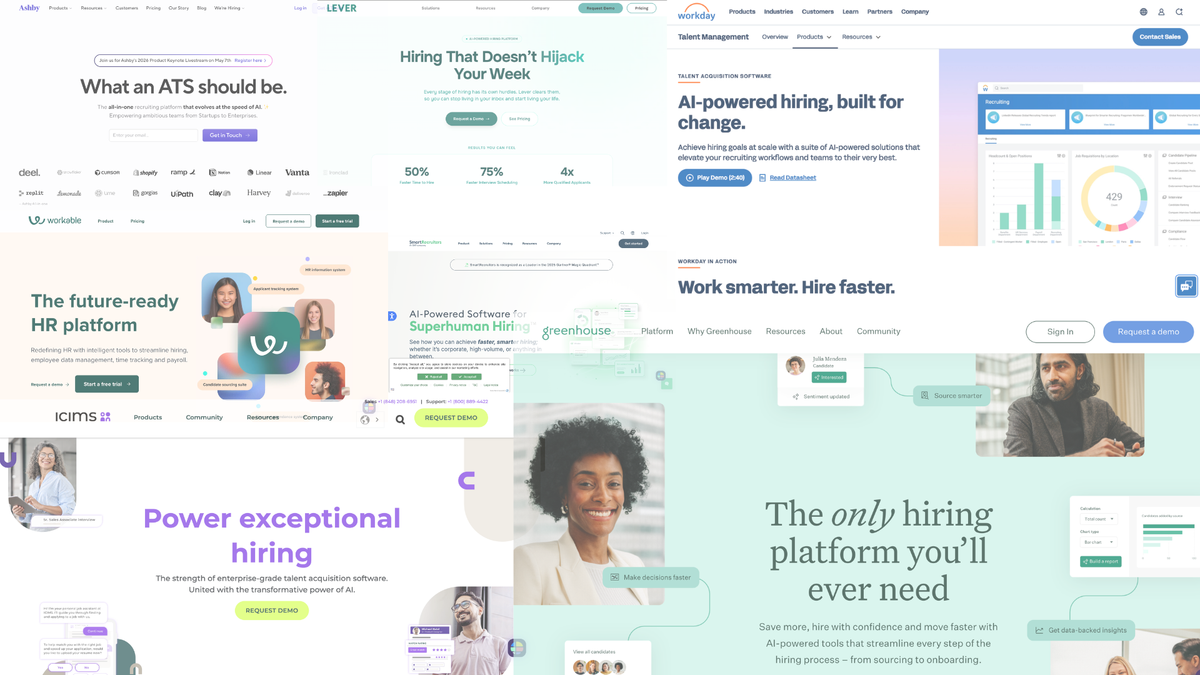
Most of what you've heard about applicant tracking systems is wrong. No major ATS on the market today auto-rejects your resume. There is no universal "ATS score." And the formatting rules you've seen repeated online come from how these systems worked ten years ago.
We know this because we analyzed 1.7 million job applications, reviewed 225,000 resumes, and interviewed recruiters at Amazon, Microsoft, a Big Four consulting firm, and a Fortune 500 manufacturer. We also researched every major ATS platform. We also tested what ChatGPT and other AI chatbots tell job seekers about ATS- They got most answers wrong.
This is the most complete report on applicant tracking systems published anywhere. Here's what we found.
Key Findings
- No major ATS auto-rejects resumes without human review - Greenhouse holds 30.6% market share; Workday is second at 19.6% - Tailored resumes convert to interviews at 2x the rate of generic ones - Two-page resumes perform as well or better than one-page at every level - ChatGPT gets 4 out of 5 key ATS claims wrong - Knockout questions, not keyword scanning, are the main automated filter - Recruiters spend 6-10 seconds on the first scan of your resume
Based on our analysis of 1.7 million applications, interviews with recruiters at Amazon, Microsoft, and two Fortune 500 companies, and a review of every major ATS platform, no major applicant tracking system auto-rejects resumes, there is no universal ATS score, and the formatting rules you've seen online are outdated.
What Is an Applicant Tracking System?
An applicant tracking system (ATS) is a database. It stores your application, tracks your progress in the hiring process, and helps recruiters manage their workflow.
It is not a robot that reads your resume. It is not an AI that scores you. It is not a gatekeeper that decides whether you get hired.
A recruiter at Microsoft, Ted Staeb, put it plainly:
"An ATS is a filing cabinet. That's it. It doesn't make decisions."
Every major ATS works the same way at its core. When you apply to a job, the system does three things: It saves your resume file, it records your answers to any application questions (knockout questions), and it places you in a queue for a recruiter to review.
A senior technical recruiter, Kristen Fife, at Amazon, who has used over a dozen ATS in her career, including Workday, Taleo, Greenhouse, and Lever, confirmed,
"Almost all applicant tracking systems are fairly similar to a degree. The things that are different are just the UI and how the workflows are put together."
This report exists because job seekers deserve the truth about how these systems work. At Huntr, we build data-backed job search tools that help people search smarter, including an AI resume tailor that matches your resume to any job description. Our data shows tailored resumes convert to interviews at roughly 2x the rate of generic ones. That finding drove this research: If tailoring matters this much, what's actually happening on the other side of the application?
What recruiters actually see
Every ATS gives recruiters two views. The first is the candidate view, which shows your full application history at that company, including every job you've applied to, every note a recruiter has made, and every piece of interview feedback. The second is the requisition view, which shows every applicant for a specific job. Recruiters typically work in the requisition view, reviewing applicants one by one.
The workflow stages are fairly consistent across platforms: Applied > Recruiter Screen > Hiring Manager Review > Assessment (if applicable) > Interview > Offer or Decline. A recruiter moves you from one stage to the next. That movement triggers emails, calendar invites, and internal notifications, but a human initiates it.
One important thing job seekers don't realize: Your full history is visible. If you've applied to 15 jobs at the same company in a week, every recruiter at that company can see that. A Fortune 500 recruiter told us: "If they're applying to, like, 15 jobs, I start questioning some things." This is important to remember when using mass AI apply tools.
What ChatGPT Gets Wrong About ATS Resumes
This is something we specifically set out to investigate. When job seekers can't get answers from employers, they turn to Google, and now to AI chatbots like ChatGPT. So we asked the major LLMs the same question: "How do applicant tracking systems screen resumes?" The answers were surprising.
We evaluated each response against what our recruiter interviews and platform research confirm.
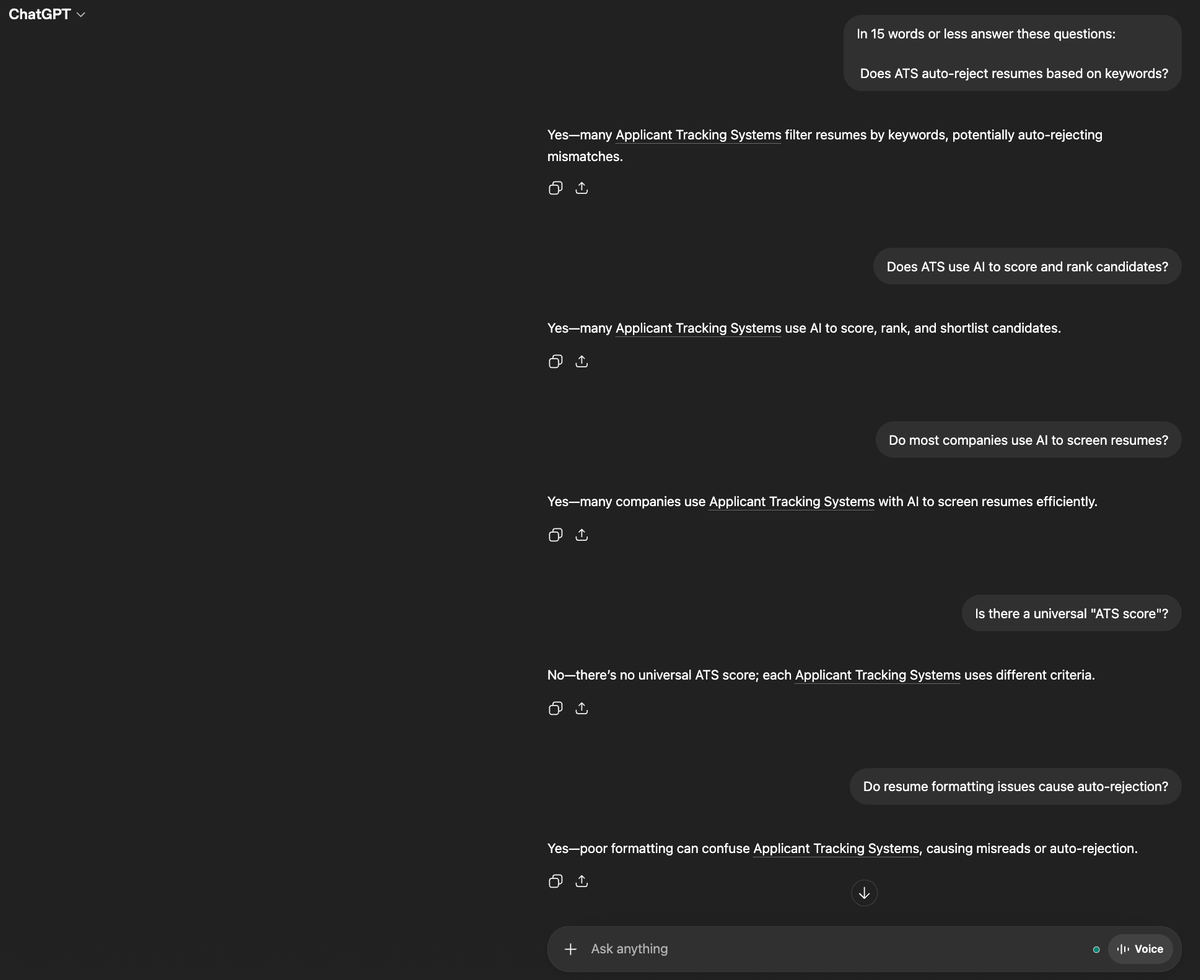
| Question | What ChatGPT Claims | What Huntr data shows |
| What does the data show? Does ATS auto-reject resumes based on keywords? | Yes. Many Applicant Tracking Systems filter resumes by keywords, potentially auto-rejecting mismatches. | No. Knockout questions can disqualify you based on your answers. Keyword filters are used for sourcing, not screening. |
| Does ATS use AI to score and rank candidates? | Yes. Many Applicant Tracking Systems use AI to score, rank, and shortlist candidates. | Some do (Workday, SmartRecruiters, Lever, Workable), some don't (Ashby). But none autonomously reject. |
| Do most companies use AI to screen resumes? | Yes. Many companies use Applicant Tracking Systems with AI to screen resumes efficiently. | No. Even Amazon's AI division uses fully human review. Legal risk is driving caution. |
| Is there a universal "ATS score"? | No. There’s no universal ATS score; each Applicant Tracking Systems uses different criteria. | No. No employer sees a score. Third-party tools create their own scores. |
| Do resume formatting issues cause auto-rejection? | Yes. Poor formatting can confuse Applicant Tracking Systems, causing misreads or auto-rejection | Rarely. Legacy parsers had issues, but recruiters can always open the original file. |
ChatGPT exaggerated claims of AI use and auto-rejection via ATS. Four of the five responses given did not match our findings and were, at best, exaggerations and, at worst, outright wrong. This shows the prevalence of incorrect information out there for job seekers about how applicant tracking systems work.
ATS Market Share: Which ATS Are Most Popular?
Huntr tracks job postings saved by its 500,000+ users. In 2025, that produced 1,665,447 saved jobs, which we grouped by ATS domain to see which systems dominate the market.
A note on methodology: When a company hosts its ATS on its own domain (e.g., careers.acme.com powered by Greenhouse), our data attributes that to the company rather than the ATS. This means that ATS platforms embedded within corporate domains are likely undercounted. The numbers below represent a lower bound of each platform's true market share.
December 2025 Market Share
| ATS Platform 🖥️ | Market Share % |
| Greenhouse | 30.6% |
| Workday | 19.6% |
| Ashby | 10.7% |
| iCIMS | 7.4% |
| Workable | 6.5% |
| Lever | 6.2% |
| SmartRecruiters | 5.2% |
| Other | 13.8% |
Source: Huntr.co analysis of 1,665,447 saved job postings, Jan-Dec 2025
The market share remained stable throughout 2025, with no major shifts month-to-month. What this tells job seekers: you will most likely encounter Greenhouse or Workday. Together, they account for half of all the job postings in our data. Here's what you need to know about each one.
How Each Major ATS Works: A Platform-by-Platform Breakdown
We researched every major ATS to answer the questions job seekers ask most: Does it use AI to screen me out? Does it rank my resume? Will my formatting get rejected? Below is the most comprehensive breakdown available, covering each platform's features, AI tools, and what actually happens to your application.
Feature Matrix: AI and Screening Tools Across Every Major ATS
| Feature | Greenhouse | Workday | Ashby | iCIMS | Workable | Lever | SmartRecruiters |
| Market share (Dec 2025) | 30.6% | 19.6% | 10.7% | 7.4% | 6.5% | 6.2% | 5.2% |
| Knockout questions | Yes | Yes | Yes | Yes | Yes | Yes | Yes |
| Resume parsing | Good | Poor (worst of all major ATS) | Good | Moderate (legacy) | Good | Good | Good |
| AI candidate ranking | Yes (4-tier match buckets) | Yes (HiredScore A-D grades) | No (explicitly refuses) | Yes (Role Fit algorithm) | Yes (Screening Assistant) | Yes (Talent Fit, LLM-based) | Yes (Winston Match, multi-model) |
| AI resume scoring | Strong/Good/Partial/Limited Match | Letter grades (A-D) | Meets/Does Not Meet/Undecided (per criterion, no overall score) | Best Fit/Close Match | Ranked list with requirement checklist | Ranked list with explanations | 4-star scale with explanations |
| Autonomous resume rejection (no human)? | No | No | No | No | No | No | No |
| Fraud/spam detection | Yes (Real Talent) | No native | Yes | No native | No native | No native | No native |
| Bias audit/compliance | Yes | Under legal scrutiny | Yes (FairNow partner) | Yes (TrustArc) | Yes (anonymized screening) | Yes (IBM watsonx) | Yes |
| Primary users | Tech, startups, mid-market | Enterprise, Fortune 500 | Tech startups, growth-stage | Enterprise, healthcare | SMBs, mid-market | Tech, mid-market | Enterprise, high-volume |
The most important row in this table is "Autonomous resume rejection." No major ATS on the market today will reject your resume without a human being involved. Knockout questions can disqualify you based on your answers. AI tools can rank and sort candidates (sometimes). But the final decision to advance or reject you is made by a person.
Greenhouse (30.6% Market Share)
The most popular ATS in our data. Greenhouse is used heavily by tech companies, startups, and mid-market firms. It was ranked the top ATS in G2's Spring 2026 reports.
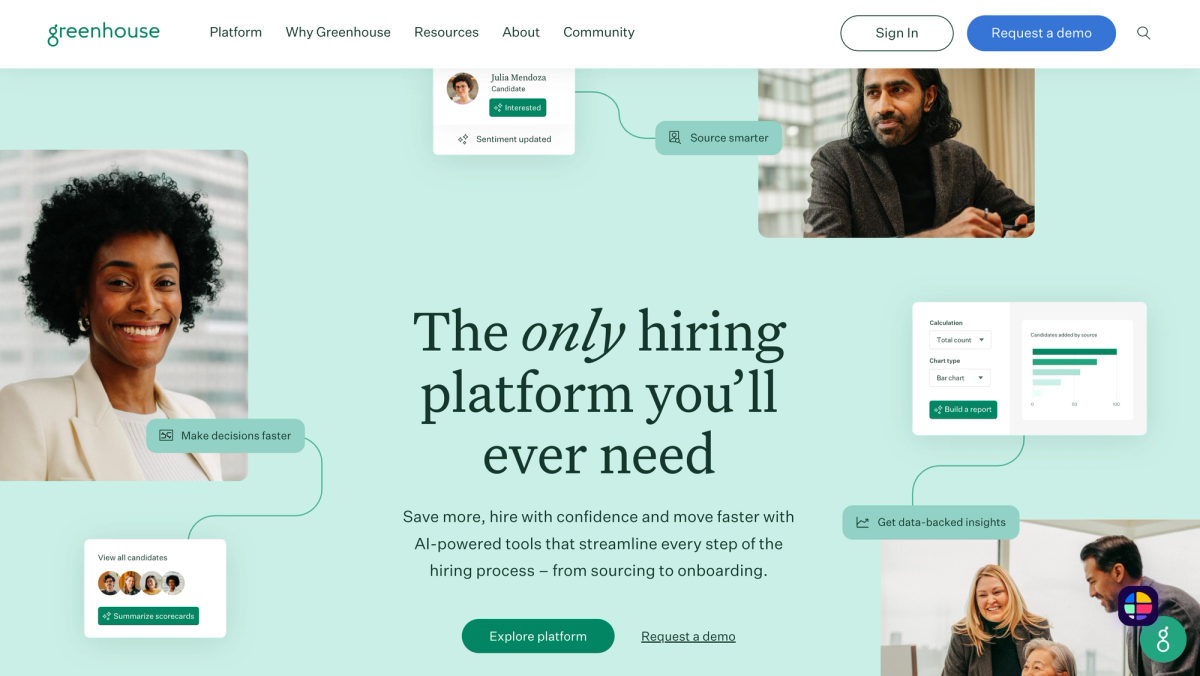
How your application is handled: When you apply, Greenhouse saves your resume and creates a candidate profile. Recruiters see your application in the requisition view and review you one by one. One recruiter we interviewed, who has used Greenhouse, described the process: "I just go down one by one, reviewing applicants.
Resume parsing: Greenhouse handles resume uploads cleanly. Recruiters open and read your actual file. A Fortune 500 recruiter who has used Greenhouse told us, "I don't parse it. I just read the resume."
AI features:
- AI Matching: Surfaces candidates whose skills and experience align with open roles. This helps recruiters find strong candidates faster, but it does not reject anyone. Not all recruiters using Greenhouse use AI matching.
- Real Talent: A fraud and spam detection tool that identifies fake applications and bots. Combined with CLEAR-powered identity checks.
- AI Interview Scheduling: Automates interviewer matching, conflict resolution, and self-scheduling.
- AI Screening Module: Added in 2026, offers AI-powered scoring and structured evaluation workflows to help teams review applicants faster.
Does it auto-reject your resume? No. Greenhouse uses knockout questions that can disqualify based on your answers (visa status, required certifications, etc.). The AI matching tool surfaces strong candidates at the top of the list, but it does not remove anyone. A recruiter must make every advance or reject decision. Not all recruiters use the AI features either.
What job seekers should know: Greenhouse is one of the cleaner systems. Your resume will be read as you uploaded it. Focus on answering application questions honestly and making sure your resume clearly shows your qualifications.
Sources: Greenhouse AI Features, Greenhouse G2 Spring 2026 Ranking
Workday (19.6% Market Share)
The second most popular ATS is the dominant system at large enterprises and Fortune 500 companies. Workday is not just an ATS. It's a full human capital management (HCM) platform that handles payroll, benefits, HR, and recruiting.
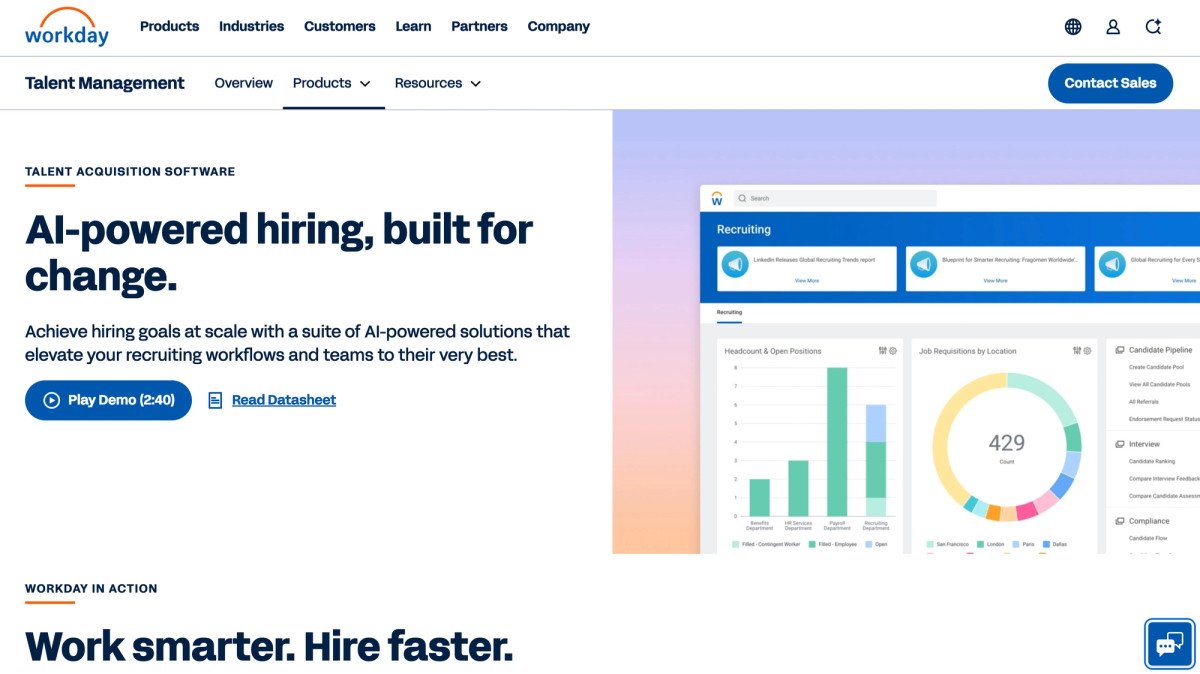
How your application is handled: Workday requires you to create an account (often a new one for each company) and typically asks several pre-qualification questions before you can submit your resume. These knockout questions are the primary screening mechanism. A Big Four recruiter we interviewed confirmed:
"Those bigger legacy systems were just heavily based on knockout questions. It wasn't any kind of tool going out to look for anything. It was all about what you're putting in."
Resume parsing: Workday has the worst resume parser of any major ATS. This is not opinion; it's consistent feedback from recruiters. A Microsoft recruiter told us:
"Workday: they are hands down the single worst parser I've ever used."
Workday converts uploads to searchable PDFs via OCR, then maps text to structured fields. This process mangles formatting, loses header information, and struggles with non-standard bullet characters. One study found that .docx files had 23% fewer parsing errors than PDFs on Workday.
However, here's what matters: Recruiters can still open your original file. The Amazon recruiter we interviewed explained that legacy systems like Workday create an HTML template preview, but the original resume is always accessible. She called reliance on the parsed preview "recruiters being lazy."
AI features:
- HiredScore AI for Recruiting: Workday acquired HiredScore in early 2024. It grades candidates (A through D) based on job relevance and historical hiring patterns, and surfaces top-graded candidates for recruiters to review first.
- Talent Rediscovery: Automatically finds strong past applicants and internal employees for new open roles.
- Illuminate AI Agents: Launched May 2025. Domain-specific assistants built into Workday HCM that provide recommendations for scheduling and next steps.
Does it auto-reject your resume? Knockout questions can auto-disqualify based on your answers. HiredScore ranks candidates by grade, which means lower-graded candidates may never be reviewed if a recruiter has enough A-graded candidates. But the system does not autonomously reject anyone. A human must take action.
Legal context: Workday is the subject of a major class action lawsuit (Mobley v. Workday), in which a job applicant alleges that Workday's AI-powered hiring tools discriminate based on age, race, and disability. In May 2025, a federal court allowed the case to proceed as a nationwide collective action. The court noted that more than 1 billion applicants may have been processed using Workday's tools. Workday has been ordered to turn over its list of employer clients who used HiredScore to score, sort, rank, or screen candidates.
What job seekers should know: Workday is the system most likely to cause formatting headaches. Use a plain .docx file if possible, or better a PDF, and make sure your contact information is not in headers or footers (Workday's parser often ignores those). Answer knockout questions carefully; they are the main filter. If you're over 40, the Mobley lawsuit is worth following.
Sources: Workday HiredScore Datasheet, Workday Illuminate Launch, Mobley v. Workday Class Action, Workday Parsing Guide
Ashby (10.7% Market Share)
A fast-growing ATS popular with tech startups and growth-stage companies. Ashby combines ATS, analytics, scheduling, and CRM in a single platform.
How your application is handled: Clean, modern interface. Recruiters open your resume directly and review it alongside your application responses.
Resume parsing: Ashby uses a modern parser. Recruiters read your uploaded file.
AI features:
- AI-Assisted Application Review: Helps recruiters process high volumes faster by surfacing key information and generating short candidate summaries. One case study showed a team reviewing 1,500 resumes in 6 hours using this feature.
- Fraudulent Candidate Detection: Identifies and flags potentially fraudulent applications.
- AI Notetaker: Records, transcribes, and summarizes interviews.
- AI Content Assistant: Helps recruiters write job descriptions and candidate emails.
Does it auto-reject your resume? No. And Ashby is the most explicit about this of any ATS on the market. From Ashby's own documentation:
"The AI never 'ranks' or gives numerical ratings to applicants. A human must always be involved in decision-making."
Ashby does not auto-reject or auto-advance. It filters by the criteria you set (such as knockout questions) and presents candidates for human review.
Compliance: Ashby partnered with FairNow for independent bias audits. It does not train AI models on customer data. Personally identifiable information (PII) is redacted from all resumes sent to AI models.
What job seekers should know: If you're applying through Ashby, a human is reading your resume. Period. Focus on clarity and relevance.
Sources: Ashby AI Features, Ashby AI-Assisted Application Review
iCIMS (7.4% Market Share)
An enterprise-grade ATS is common in large organizations, healthcare, and financial services. iCIMS is one of the older platforms on this list, alongside Workday and Taleo.
How your application is handled: iCIMS works like other enterprise ATS platforms: you fill out an application, answer pre-qualification questions, and upload your resume. Recruiters review candidates in pipeline view.
Resume parsing: As a legacy system, iCIMS is among the platforms that originally used OCR to generate HTML previews of uploaded resumes. This is one of the systems that contributed to the formatting myth. However, recruiters can always open your original uploaded file.
AI features:
- AI Candidate Ranking: Matches candidates to roles and presents ranked lists.
- AI Copilot: Assists recruiters with workflow tasks, candidate communication, and scheduling.
- AI Text Recruiting: Chatbot-powered candidate engagement through SMS.
- 750+ Integrations: Connects with third-party AI screening tools.
Does it auto-reject your resume? Knockout questions can auto-disqualify. AI ranking surfaces top candidates. But iCIMS has taken a cautious approach to AI, investing heavily in bias audits, transparency, and compliance measures. No autonomous rejection of resumes.
Compliance: TrustArc Responsible AI framework certified. Bias audits conducted. Opt-out options available for AI-assisted features.
What job seekers should know: iCIMS is widely used by large employers. If the application process feels long and asks many questions, you're likely on iCIMS or a similar enterprise platform. Those questions matter more than your resume formatting.
Sources: iCIMS AI Candidate Screening Comparison, iCIMS Review 2026
Workable (6.5% Market Share)
A mid-market ATS popular with small and mid-size businesses. Workable positions itself as the all-in-one platform for companies that want to move fast without a complex implementation.
How your application is handled: You apply, your resume is parsed, and you're placed in the candidate pipeline. Workable distributes postings to 200+ job boards, so you may encounter it even if the company's career page doesn't mention it.
Resume parsing: Modern parser with clean handling of standard formats.
AI features:
- AI Screening Assistant: The most notable feature. Uses semantic analysis (not just keyword matching) to understand context and meaning in your resume. It recognizes that "project management" and "program management" are related concepts, for example.
- Automated Candidate Ranking: AI evaluates candidates against job criteria and surfaces the strongest profiles at the top of the queue.
- Anonymized Screening: Hides personal identifiers during initial review to reduce bias.
Does it auto-reject your resume? No. Workable's Screening Assistant is one of the more aggressive AI tools on the market in terms of how actively it ranks and sorts candidates. But it surfaces recommendations for recruiters to act on. It does not reject candidates on its own.
What job seekers should know: Workable's semantic analysis means keyword stuffing is less effective (and less necessary) here than on other platforms. The system understands related terms and context. Focus on clearly describing what you did and what you achieved, and the AI will pick up the relevance.
Sources: Workable Screening Assistant Help, Workable AI ATS Reviews
Lever (6.2% Market Share)
A combined ATS and CRM (candidate relationship management) platform. Lever is popular in tech and mid-market companies and is particularly strong for nurturing candidate relationships over time.
How your application is handled: Lever stores your profile in both its ATS (for active applications) and CRM (for future opportunities). This means even if you're not selected for one role, you may be re-engaged for a future one.
Resume parsing: Clean, modern parser. No known issues with standard formats.
AI features:
- Talent Fit (launched 2025): Lever's AI-powered candidate ranking engine. It analyzes skills and experience to deliver a ranked list of top candidates, with transparent scoring and explanations for each ranking. Unlike basic keyword matching, Talent Fit looks at the full picture.
- AI Interview Companion: Acquired through Lever's purchase of Pillar. Provides AI-assisted interview notes and summaries.
- AI Screening Companion (upcoming): Lever has announced this as the next evolution of Talent Fit, designed to further automate early-stage screening.
Does it auto-reject your resume? No. Talent Fit creates a shortlist, not a reject list. The recruiter makes all advance/reject decisions. Lever uses IBM WatsonX governance to detect bias and ensure transparency across its AI features.
What job seekers should know: Lever's CRM component means your profile lives on. A good application to one role at a Lever-using company may lead to outreach for a different role months later. Make sure your resume represents you well beyond just the specific job you're applying to.
Sources: Lever AI Innovations, Lever Review 2026
SmartRecruiters (5.2% Market Share)
An enterprise platform with the most aggressive AI features of any major ATS. SmartRecruiters was acquired by SAP and now integrates with SAP SuccessFactors. It's particularly strong for high-volume hiring in retail, logistics, and healthcare.
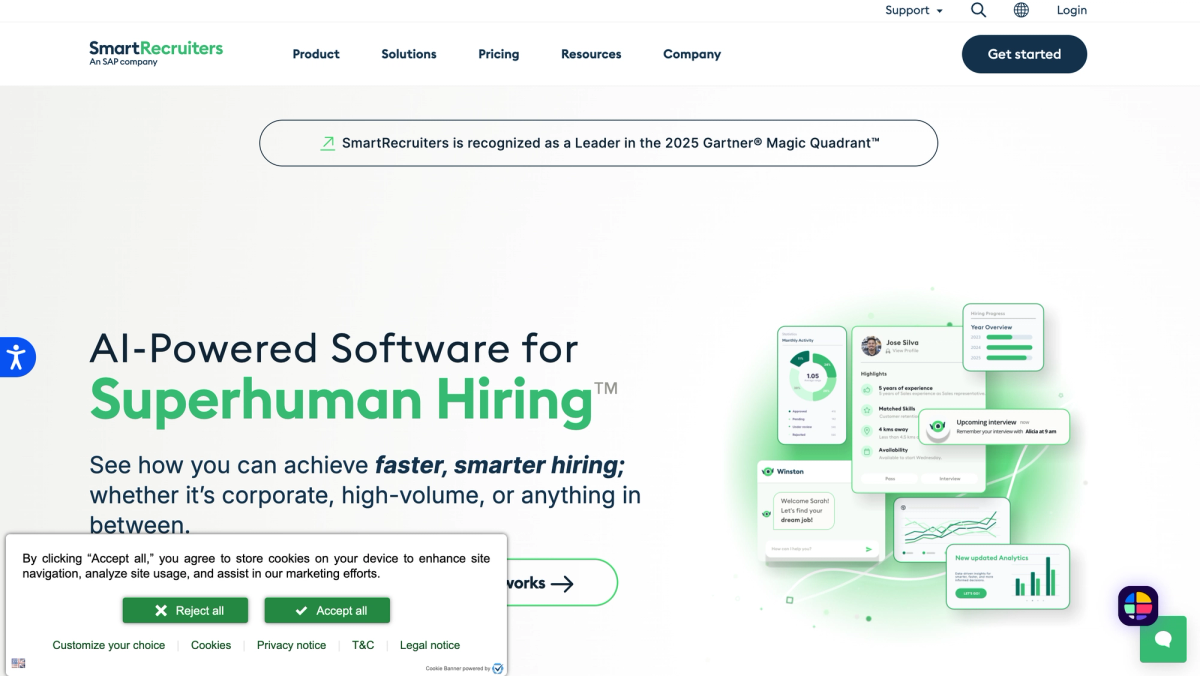
How your application is handled: SmartRecruiters emphasizes a "consumer-grade" candidate experience. You may interact with its AI chatbot (Winston Chat) during the application process. The system routes you through screening questions and evaluations.
Resume parsing: Modern parser integrated with AI analysis.
AI features (the "Winston" suite):
- Winston Match: Evaluates every applicant using a multi-model scoring system based on relevance, fit, and inferred potential. Scores are presented on a 4-star scale with explainability (the system tells the recruiter why it gave that score). Using NLP and deep learning, Winston Match goes beyond keyword matching to understand skills, career paths, industry context, and transferable skills. Claims 85% accuracy in surfacing top candidates and reduces review time from four hours to forty minutes.
- Winston Screen: Generates job-specific screening questions, collects structured responses from candidates, and automatically ranks candidates based on their answers. Recruiters can assign weights to must-haves and nice-to-haves.
- Winston Chat: A conversational AI that replaces traditional forms. Candidates ask questions, explore roles, and complete applications through a chat interface, with follow-up and interview scheduling in the same thread.
Does it auto-reject your resume? SmartRecruiters claims a 75% reduction in manual screening with its AI tools, making it the closest any major ATS comes to automated screening. But the system still requires human review before a candidate is officially rejected. Winston surfaces ranked shortlists and provides explanations for its scoring; the recruiter acts on those recommendations.
What job seekers should know: If you apply to a high-volume role (retail, logistics, healthcare) through SmartRecruiters, you're likely interacting with one of the most advanced AI screening systems in the ATS market. Your answers to screening questions may be evaluated by AI and ranked. Answer them thoughtfully and specifically. Generic responses will rank lower.
Sources: SmartRecruiters Winston, SmartRecruiters Candidate Screening, SmartRecruiters AI Talent Matching
Other Systems Worth Knowing
Oracle Taleo: A legacy system still used by some Fortune 500 companies. One of the oldest ATS platforms still in production. Heavily relies on knockout questions. The Big Four recruiter we interviewed confirmed extensive use of Taleo at large consulting firms. The interface is widely regarded as dated, and organizations often face multi-year migration projects to switch away from it. If you encounter a particularly clunky application process at a large company, you may be on Taleo.
SAP SuccessFactors: Enterprise HCM platform with built-in recruiting. Now integrated with SmartRecruiters and the Winston AI suite. Includes resume parsing, knockout questions, and AI-assisted skills matching. One recruiter we interviewed who used SuccessFactors extensively said, "I don't parse it. I just read the resume... Recruiters are not looking at the forms. We're looking at your resume."
Sources: Oracle Taleo Review 2026, SAP SuccessFactors + SmartRecruiters Integration
Applicant Tracking Systems Screen Out Resumes? The ATS Myth Explained
We showed above what AI chatbots get wrong. Here's where those wrong answers come from.
The origin story
In the 2000s and early 2010s, applicant tracking systems were crude. Systems like Workday, iCIMS, Taleo, and UltiPro used OCR (optical character recognition) to convert uploaded resumes into an HTML preview. This preview often mangled two-column layouts, dropped information from headers, and scrambled tables. If a recruiter relied on the preview instead of opening the original file, a perfectly good resume could look like garbage.
Job seekers noticed. They started Googling "how to get past ATS" and "ATS resume checker." This search demand created an entire industry. Companies built tools that promised to "score" your resume against ATS criteria. Career coaches wrote blog posts about "beating the ATS." The advice became self-reinforcing: more people searched, more content was created, and the myth grew.
What people think happens vs. what actually happens
The myth: AI reads your resume, scores it against keywords, and auto-rejects you if the score is too low. You need to stuff keywords, use a specific format, and run your resume through an ATS checker to get a passing score.
The reality: Knockout questions filter on hard requirements (visa status, minimum education, specific certifications, years of experience). If you pass those, a human recruiter reads your resume. The ATS stores it; the recruiter decides.
Here's what each of our four recruiters said:
Amazon recruiter: "Keyword filters are used when I'm searching inside [the database for sourcing]. Very rarely will I use a keyword filter on a specific application, and not all applicant tracking systems allow you to use a keyword inside a specific requisition."
Microsoft recruiter: "The filters are Boolean with a better paint job." Boolean search is a 30+ year old technology used for sourcing (going out to find candidates), not for screening incoming applications.
Big Four recruiter: "Those bigger legacy systems were just heavily based on knockout questions. It wasn't any type of tool that was going out and looking for anything."
Fortune 500 recruiter: "AI is screening my resume out? That's not a thing. What's screening you out are the questions that you answer."
What Is an ATS Score? (And Does It Matter?)
There is no universal "ATS score." No employer sees a score from 0 to 100 on your resume. The tools that give you an "ATS score" (Jobscan, Resume Worded, and others) are scoring against their own criteria, not against anything a real ATS uses.
These tools measure how closely your resume matches a job description, which can be useful as a self-check. But they do not replicate what any actual ATS does. The danger is that job seekers optimize for a score that recruiters will never see, while neglecting what recruiters actually look for.
What do recruiters look for? A 6-10 second scan: Do you meet the qualifications? Do your skills match? Does your experience match the scope of the role? Are you in the right location?
The Amazon recruiter broke down the scan:
"I'm doing a six-second scan. Do they actually meet the qualifications? I'm just looking to see are they a clear outstanding match of skills that they have. And then the education and the length of experience."
Does Resume Formatting Affect ATS?
This myth came from 4-5 legacy systems that used OCR to create HTML previews. The Amazon recruiter explained exactly how it works: "When you upload your resume, it basically scans it and makes an HTML template. I have the option to see the HTML template page, or I can just click on your resume and open it." She called reliance on the parsed preview "recruiters being lazy."
The bottom line: if you submit a PDF or Word doc, your resume gets attached as-is. The system takes a picture of it. The recruiter can always open the original. Two-column layouts, graphics, and colors- none of that will get your resume "rejected by the ATS." A lazy recruiter using a bad preview might miss information, but that's a recruiter problem, not an ATS problem.
Our recommendation: Use a clean, readable format. Submit as a PDF or Word doc. Don't use Canva templates saved in non-standard formats. Avoid putting contact information in headers or footers (Workday's parser ignores those). Two pages are fine. Our data shows that two-page resumes perform as well or better than one-page resumes across all experience levels.
Which ATS platforms actually have auto-screening?
| ATS | Auto-reject on knockout questions? | AI-powered candidate ranking? | Autonomous resume rejection (no human)? |
| Greenhouse | Yes (configurable) | Yes (AI matching) | No |
| Workday | Yes (configurable) | Yes (HiredScore grades A-D) | No (human-in-the-loop) |
| Ashby | Yes (configurable) | No (explicitly refuses to rank) | No |
| iCIMS | Yes (configurable) | Yes (AI copilot) | No |
| Workable | Yes (configurable) | Yes (Screening Assistant) | No (surfaces top candidates) |
| Lever | Yes (configurable) | Yes (Talent Fit) | No |
| SmartRecruiters | Yes (configurable) | Yes (Winston Match, 4-star scale) | No (strongest AI, still human review) |
Every major ATS supports knockout questions that can auto-disqualify. Most now offer AI-powered candidate ranking. But none autonomously reject candidates based on resume content alone without human involvement.
LLMs that claim otherwise are wrong. And they're wrong because they trained on years of blog posts and career coaching content that repeated the myth until it became accepted wisdom.
Where the misinformation comes from
The feedback loop works like this:
- Career coaches write blog posts claiming ATS auto-rejects resumes (some with good intentions, some to sell services). Because there is a massive search demand from job seekers on the subject.
- Google indexes those posts and ranks them because the search demand is massive ("ats resume" gets 23,000 monthly searches)
- LLMs train on that content and learn to repeat the claims as fact
- Job seekers ask LLMs and receive confident-sounding misinformation
- Career coaches cite the LLMs as confirmation of their original claims
The business incentive makes it worse. "ATS checker" tools generate 4,600 monthly searches and have a traffic potential of 39,000. "ATS score" generates 2,100 monthly searches with traffic potential of 39,000. There is real money in making you believe your resume is being scored by machines. If you believe the myth, you buy the tool.
The kernel of truth that got distorted: Knockout questions DO auto-reject, and that's real. But that's about your answers to screening questions, not about your resume's formatting or keyword density. The distinction matters. You can't optimize your resume to overcome answering "No" to "Do you have the right to work in the United States?" as a knock-out question.
The legal reality
Two major lawsuits are pushing back on AI in hiring and further discouraging companies from relying on automated screening:
Mobley v. Workday (filed 2023, class certified May 2025): An applicant over 40 alleges he was rejected from 100+ jobs by companies using Workday's AI screening tools. The case is proceeding as a nationwide collective action on behalf of all applicants over 40 who were denied employment through Workday's platform since September 2020. The court noted that more than 1 billion applicants may have been affected.
Kistler v. Eightfold AI (filed January 2026): Two applicants allege that Eightfold AI scraped personal data on over one billion workers, scored them 0-5 on "likelihood of success," and discarded low-ranked candidates before any human reviewed their applications. Eightfold's clients include Microsoft, PayPal, Morgan Stanley, Starbucks, and Chevron. The lawsuit alleges violations of the Fair Credit Reporting Act.
The Amazon recruiter connected the dots: "There are two lawsuits about AI and the use of evaluating resumes right now. AI is not used [for screening]. The majority of that is for legal reasons."
Companies are not racing to automate resume rejection.
Sources: Mobley v. Workday, Kistler v. Eightfold AI, Eightfold FCRA Lawsuit Analysis
How to Get Past ATS and Get Hired (Based on Data)
We've spent a lot of time explaining what doesn't matter. Here's what does, according to both our data and the recruiters we interviewed.
What recruiters look for in 6-10 seconds
Every recruiter we spoke with described the same initial scan: a quick check of qualifications, skills, experience scope, and location. Then they sort into three buckets: qualified, not qualified, and maybe.
Amazon recruiter: "The people that are not qualified go directly into a no bucket. The people that are well qualified go into 'I'd like to set up a time to chat with you.' And then there's a mid-level bucket."
But here's the nuance most advice misses. It's not just about matching requirements. Read the role and responsibilities section, not just the requirements. The Amazon recruiter was emphatic: "A lot of people are falling flat because they're not reading the role and responsibilities. They're going straight to the requirements."
Microsoft recruiter: "Look at your resume as a technical manual of accomplishment. I solved this problem using these tools, and I was successful. Give me numbers, percentages, dollar signs. Something other than letters."
Fortune 500 recruiter: "Companies, title, tenure, education. I do not read the summary." This recruiter scrolls to the bottom of the resume first to see career progression, then works upward. She emphasized: "I don't want you to write F-O-U-R, I want the number 4." Numerals stand out on the page. Spelled-out numbers don't.
Big Four recruiter: "There isn't a silver bullet. There's always an individual on the other end of that screen."
What our data says
From our analysis of 1.7M+ applications and 225K+ resumes:
- Tailored resumes see a 2x interview conversion rate. About 6% (1 in 17 applications) for tailored resumes vs. ~3% (1 in 33) for generic. This is the single biggest lever you can pull.
- Two-page resumes perform as well or better than one-page resumes across all experience levels. Stop squeezing everything onto one page.
- More filled-out education sections correlate with higher conversion rates. List honors, clubs, sports, and relevant coursework. It humanizes you.
- Top-performing job sites by conversion rate: Google Jobs, Glassdoor, Wellfound, Indeed, and Welcome to the Jungle all beat LinkedIn for application-to-interview conversion.
- Average job search time: about 83 days. Plan accordingly.
How to Write an ATS-Friendly Resume
- Read the full job posting. The "role and responsibilities" section tells you what the job actually involves. The "requirements" section is just the minimum bar.
- Lead with accomplishments that match the scope of the role. If they want someone managing $50M accounts, show that you've managed accounts in the tens of millions, not that you've "managed client relationships."
- Use numbers. Dollar signs, percentages, quantities. Every recruiter we talked to said this. Numbers catch the eye in a 6-second scan.
- Answer knockout questions honestly. If you can't answer them truthfully in the way the employer needs, the role may not be the right fit. Lying will catch up with you; recruiters see your full application history.
- Apply early. The Microsoft recruiter told us, "If you apply three weeks later and we've already got five people in the loop, we'll never see you because we're not looking anymore." He aims to get five candidates interviewing per role. Once those five are in process, the pipeline often closes.
- Don't over-optimize with AI. Multiple recruiters flagged AI-written resumes as a red flag. The Amazon recruiter said, "They're taking AI and using it to actually rewrite to match the job description with their supposed experience. And it looks too close to the job description." Use AI to help you think through how to present your real experience. Don't use it to fabricate a new one.
- Include context. If you work at a small company, explain what they do in one line. If you're at a large company, specify your division and the internal teams you support. "I work at Amazon" tells a recruiter nothing. "I recruit for AI, specifically NLP and LLM training roles," tells them everything.
- File format: PDF or Word doc. Avoid non-standard formats from Canva or LaTeX unless saved as PDF. Don't put contact info in headers or footers (Workday ignores them). Font size no smaller than 10pt. If you use columns, fill every space in them.
- Don't spray applications. If a recruiter sees you've applied to 15 jobs at the same company, that's a red flag. Be targeted. And know that AI-bot applications are easily spotted: the return email address, the formatting, and the application velocity all give them away.
- Don't skip cover letters entirely, but know when they matter. Every recruiter we talked to said they don't read cover letters at large companies. But for small companies and startups, a thoughtful one addressed to the founder can make a difference. In most cases, reaching out to the recruiter directly on LinkedIn is a better use of your time.
Frequently Asked Questions
Do applicant tracking systems automatically reject resumes?
No. ATS platforms store resumes and manage hiring workflows. Knockout questions in the application can auto-disqualify you based on your answers (e.g., visa status, required certifications). But the resume itself is not automatically rejected by any major ATS. A human recruiter reviews it.
What is an ATS score, and does it matter?
There is no universal ATS score. Tools like Jobscan and Resume Worded give you a match score based on their own criteria. No employer sees that score. It can be useful as a self-check for keyword alignment, but it does not replicate what any real ATS does.
Can ATS read PDF resumes?
Yes. Every major ATS can read PDFs. The myth that PDFs are unreadable comes from very old systems. Modern ATS platforms handle PDFs and Word docs equally well. Workday's parser works slightly better with .docx files, but your PDF will still be readable.
Do I need a one-page resume for ATS?
No. Data from 225,000+ resumes shows two-page resumes perform as well or better than one-page resumes across all experience levels. Multiple recruiters confirmed they prefer more detail over cramped formatting.
Does resume formatting affect ATS screening?
Minimally. The formatting myth originated in legacy systems (Workday, iCIMS, Taleo) that used OCR previews, which could mangle complex layouts. But recruiters can always open your original file. Use a clean format with standard fonts, submit as a PDF or Word doc, and don't put contact info in headers or footers.
How do knockout questions work?
These are the questions you answer before or during the application (e.g., "Do you have the right to work in the US?", "Do you have at least 3 years of experience in X?"). If you answer "wrong" based on the employer's configured criteria, you can be automatically disqualified before a recruiter ever sees your resume. This is the primary automated filter in hiring.
Should I use an ATS checker before applying?
It can be useful as a gut check to see if your resume aligns with the job description. But don't obsess over the score. No employer sees it. Your time is better spent tailoring your resume to the role's scope and responsibilities.
Do companies use AI to screen resumes?
Some ATS platforms now include AI tools that rank or sort candidates (Workday's HiredScore, SmartRecruiters' Winston Match, Lever's Talent Fit, Workable's Screening Assistant). But these tools surface recommendations for human recruiters. None autonomously rejects candidates. Many recruiters report that companies use no AI in resume review at all. The most important point here is that you are writing your resume for a human, not a machine. There is no difference.
What is the most common ATS?
Based on our data from 1.7M+ job postings in 2025, Greenhouse leads at 30.6% market share, followed by Workday at 19.6% and Ashby at 10.7%.
How can I tell which ATS a company uses?
Check the URL when you're on the application page. Many ATS platforms have recognizable domains, such as greenhouse.io and lever.co, myworkdayjobs.com, ashbyhq.com, smartrecruiters.com, icims.com, apply.workable.com. If the application is hosted on the company's own domain, it's harder to tell.
Does applying to multiple jobs at the same company hurt my chances?
It can raise flags. Recruiters see your full application history within their company. Applying to a few related roles is fine. Applying to 15 unrelated positions in a week signals that you're not being targeted, and that's a negative signal.
How long do recruiters spend looking at a resume?
6-10 seconds for the initial scan. If you pass that scan, they'll spend more time. Use that knowledge: put your strongest qualifications and accomplishments in the top third of page one.
What is the difference between ATS screening and recruiter sourcing?
Screening is what happens to your incoming application (knockout questions, human review). Sourcing is the process of a recruiter finding candidates through keyword searches in databases, LinkedIn, and job boards. Most of the "keyword optimization" advice online is actually about sourcing, not screening. It matters more for your LinkedIn profile than your resume application.
Methodology
Application data: 1,665,447 saved jobs from Huntr users, January through December 2025. Jobs grouped by source URL domain to identify job boards and ATS platforms.
ATS market share: Derived from ATS-specific domains in saved job URLs. Platforms embedded in corporate domains are attributed to the company rather than the ATS, resulting in a likely undercount of ATS platform reach.
Response rates: Based on Huntr users moving a saved job into "Interview" stage or beyond within the platform.
Resume analysis: 225,000+ resumes analyzed for format, length, section completeness, and content patterns.
Recruiter interviews: Four interviews conducted February through March 2026:
- Senior Technical Recruiter, Amazon (AI division). 12+ ATS platforms used. Former Seattle Times columnist.
- Senior Recruiter, Microsoft. Handles 30-50 open requisitions. Agency, RPO, and in-house experience.
- Fortune 500 Recruiter (Big Four/Consulting). Deloitte, Tata Consulting Services. Deep experience with Taleo, Workday, SuccessFactors.
- Fortune 500 Recruiter (Manufacturing/CPG). Sealed Air. Experience with SuccessFactors, Greenhouse, Ashby.
Job seeker survey: 1,000+ job seekers surveyed on job search behaviors and beliefs.
Members of the media are welcome to cite this research with attribution to Huntr.co. For embargoed data, custom analysis, or interviews with Sam Wright, contact: [email protected]
This report is part of Huntr's ongoing research into job search trends. For the full 2025 Annual Job Search Trends Report, visit huntr.co/research.

Sam Wright
Sam Wright is the Head of Career Strategy at Huntr. Drawing on proprietary data from 1.7 million applications, 1 million job postings, 243,000 résumés, and a 1,049-respondent survey, Sam provides actionable, data-driven blueprints to help professionals navigate today's fractured hiring landscape. He has conducted over 900+ free support calls with job seekers, giving him frontline insight into today's job market. His work and insights have been featured in Business Insider, The Wall Street Journal, Forbes, and The Seattle Times.
Outside the tech world, Sam is a part-time farmer from a five-generation legacy of organic vegetable farming. He is a passionate advocate for farmland preservation.
Get More Interviews, Faster
Huntr streamlines your job search. Instantly craft tailored resumes and cover letters, fill out application forms with a single click, effortlessly keep your job hunt organized, and much more...
AI Resume Builder
Beautiful, perfectly job-tailored resumes designed to make you stand out, built 10x faster with the power of AI.
Next-Generation Job Tailored Resumes
Huntr provides the most advanced job <> resume matching system in the world. Helping you match not only keywords, but responsibilities and qualifications from a job, into your resume.
Job Keyword Extractor + Resume AI Integration
Huntr extracts keywords from job descriptions and helps you integrate them into your resume using the power of AI.
Application Autofill
Save hours of mindless form filling. Use our chrome extension to fill application forms with a single click.
Job Tracker
Move beyond basic, bare-bones job trackers. Elevate your search with Huntr's all-in-one, feature-rich management platform.
AI Cover Letters
Perfectly tailored cover letters, in seconds! Our cover letter generator blends your unique background with the job's specific requirements, resulting in unique, standout cover letters.
Resume Checker
Huntr checks your resume for spelling, length, impactful use of metrics, repetition and more, ensuring your resume gets noticed by employers.
Gorgeous Resume Templates
Stand out with one of 7 designer-grade templates. Whether you're a creative spirit or a corporate professional, our range of templates caters to every career aspiration.
Personal Job Search CRM
The ultimate companion for managing your professional job-search contacts and organizing your job search outreach.
Huntr
Blog Product Updates Resume Skill Guides Resume Examples Interview Question Guides Research 2025 Job Search Trends Report Affiliate Program Careers Privacy policy Terms of service Write for us LinkedIn Reddit r/HuntrCo Twitter @TryHuntr Email UsProduct
Job Tracker AI Resume Builder Resume Tailor Resume Checker AI Cover Letters Resume Summary Generator Resume Bullet Generator Resume Skills Generator Resume Headline Generator Resume Keyword Scanner Job Keyword Finder Targeted Resume Contact Tracker Interview Tracker Job Search Metrics Job Application Autofill Resume Storage AI Resume Review Job Clipper Resume Optimization ChatGPT Resume Builder Resume Fixer LinkedIn Resume Builder AI Resume Rewriter Interview Question Generator