
Huntr Blog
ChatGPT vs. Claude vs. Gemini: Which AI Writes the Best Resume?
June 06, 2026

Job hunting in 2026 feels less like applying for roles and more like constantly tailoring your resume for every job description.
I ended up turning to AI for the same reason everyone else does: speed.
But after trying them, it became obvious that generating a resume and generating a convincing one are two very different things.
A lot of AI-written resumes sound polished at first glance, yet still feel generic enough that recruiters can spot them immediately.
I wanted to find out which model actually does this well.
Not just which one produces the most polished-looking output, but which one makes smart decisions, about tone, about keywords, about what to claim and what to leave alone.
To test this, I used Geekflare Chat, a multi-model AI tool that lets you run the same prompt through GPT-5.5 Pro, Claude Haiku 4.5, and Gemini 3.1 Pro side by side.
Same input, same prompt, three different outputs. I ran four rounds: write the resume, tailor it for specific industries, optimize it for ATS, and generate a cover letter.
The baseline candidate was a fictional mid-level software engineer: realistic background, deliberate gaps, the kind of profile that gives AI something to work with and enough room to either get it right or get it wrong.
Here's what I found.
Strengths and weaknesses: what each model brings to resume writing
Before the results, a quick sketch of what each model is generally known for, because the patterns held up.
ChatGPT is built for structure. It defaults to clean formatting, strong action verbs, and high keyword density. It knows what a resume is supposed to look like and delivers that consistently.
The risk is that it can tip into formula, and, as I found out in Round 1, it has a habit of inventing metrics that sound great but didn't come from anywhere.
Claude writes like a person. The summaries feel earned rather than assembled. It tends to preserve the candidate's actual voice while still elevating the language.
It's also the most conservative of the three. It won't make claims the source material doesn't support, which is either a strength or a limitation depending on what you need.
Gemini sits between the two. It's good at surfacing technical keywords and presenting data-driven experience credibly. It doesn't fabricate, but it also doesn't quite have Claude's narrative instinct.
What it does well, sometimes better than either of the others, is technical vocabulary and keyword elevation.
How I used Geekflare Chat
The setup was straightforward. I created a fictional candidate: Alex Rivera, a backend software engineer with five years of experience at a fintech startup, who’s transitioning toward data infrastructure and distributed systems roles.
The kind of profile that's solid but not polished: real skills, buried achievements, a few gaps that a good resume writer would know to address.
I wrote a raw, unformatted brain dump of Alex's career history; the kind of messy notes a real person might hand to a recruiter.
Then I took that same text into Geekflare Chat and ran it through all three models using identical prompts for each round.
The Stripe Software Engineer, Data & AI role served as the real-world anchor for Rounds 3 and 4: ATS optimization against an actual live job description, and a cover letter targeting a real company with a well-documented culture.
Everything before that was controlled lab conditions. Everything after was as close to real-world as a fictional candidate allows.
Round 1: Writing the resume from scratch
The prompt was straightforward:
“Act as a professional resume writer. I am going to provide you with raw, unformatted details about my career history. Please write a professional, modern resume including a Professional Summary, Core Skills, and Work Experience. Use strong action verbs and format the output in clean, easy-to-read Markdown. Here is my raw background: [raw text].”
All three models produced a complete, structured resume. The differences showed up in the details.
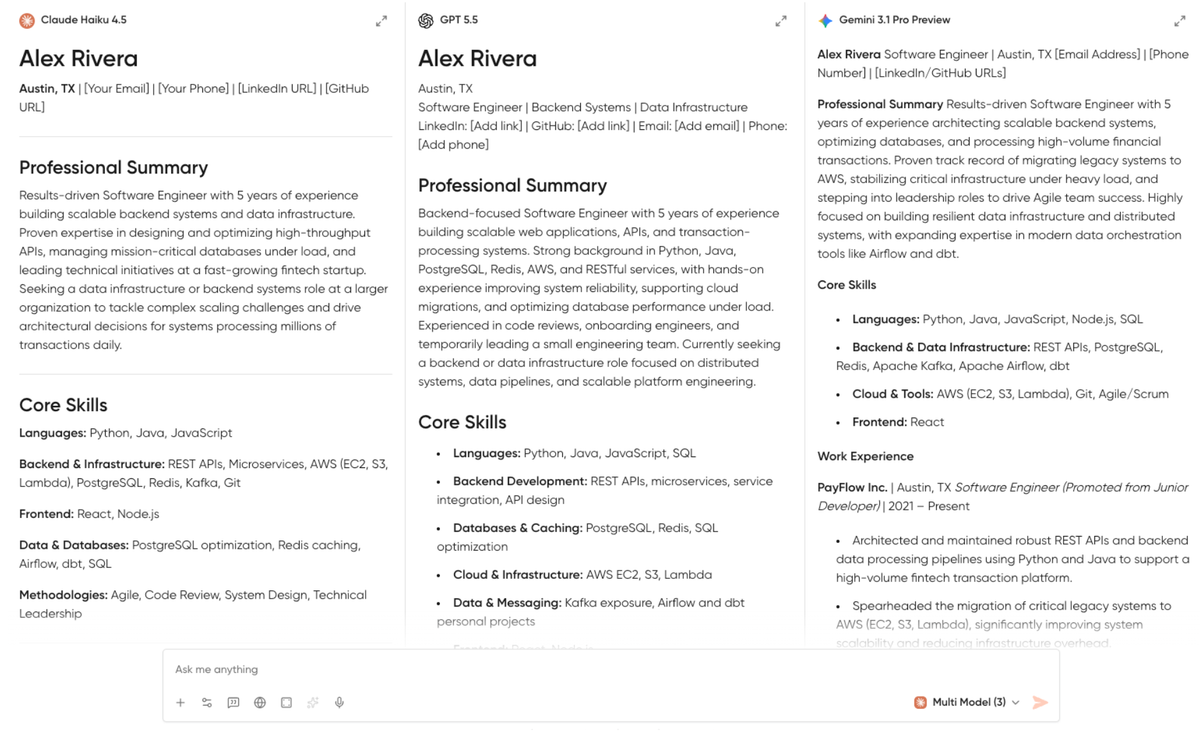
ChatGPT’s draft looked the most impressive on first read. Clean hierarchy, punchy bullets, specific numbers everywhere. It claimed Alex “reduced latency by 30%,” and “cut infrastructure costs by 25%”
None of those numbers exist in the source material. ChatGPT invented them. The structure was excellent. But hand it vague raw material, and it fills the gaps with plausible-sounding fiction.
Claude’s draft refused to fabricate. Every bullet was strong and active, but metric-free: “Improved database stability after recurring load-related crashes” rather than “reduced downtime by 40%.”
It kept the Junior Developer role as a separate entry, added a “Target Roles” line for ATS, and handled the informal team lead experience more naturally than the others:
“Temporarily led a team of 3 engineers” rather than “Assumed technical leadership responsibilities.”
More honest throughout, less flashy.
Gemini’s draft was the leanest of the three. Where it stood out was keyword handling: full names like “Apache Kafka” and “Apache Airflow” rather than just “Kafka” and “Airflow,” which matters for ATS parsing.
The weakness: it stripped enough context that the resume felt thin for a five-year candidate. Efficient, but at the cost of substance.
Round 1 verdict: ChatGPT wins on first impression and loses on integrity. Claude is the most trustworthy but the least dramatic. Gemini handles technical keywords better than either, but it underserves the narrative.
None of them is the obvious choice, which is exactly why the next rounds matter.
Round 2: Tailoring the resume for a tech role
Once you have a working resume, the next question is whether AI can adapt it intelligently for a specific industry. This is called tailoring a resume.
For the tech round, I used this prompt:
“Act as an expert technical recruiter. Rewrite this raw resume data into a highly professional, ATS-optimized resume. Focus on impact, using the Google X-Y-Z formula (Accomplished [X] as measured by [Y], by doing [Z]). Highlight Python, Java, PostgreSQL, AWS, and distributed systems experience.”
Same raw input for all three. Each model revealed a different failure mode.
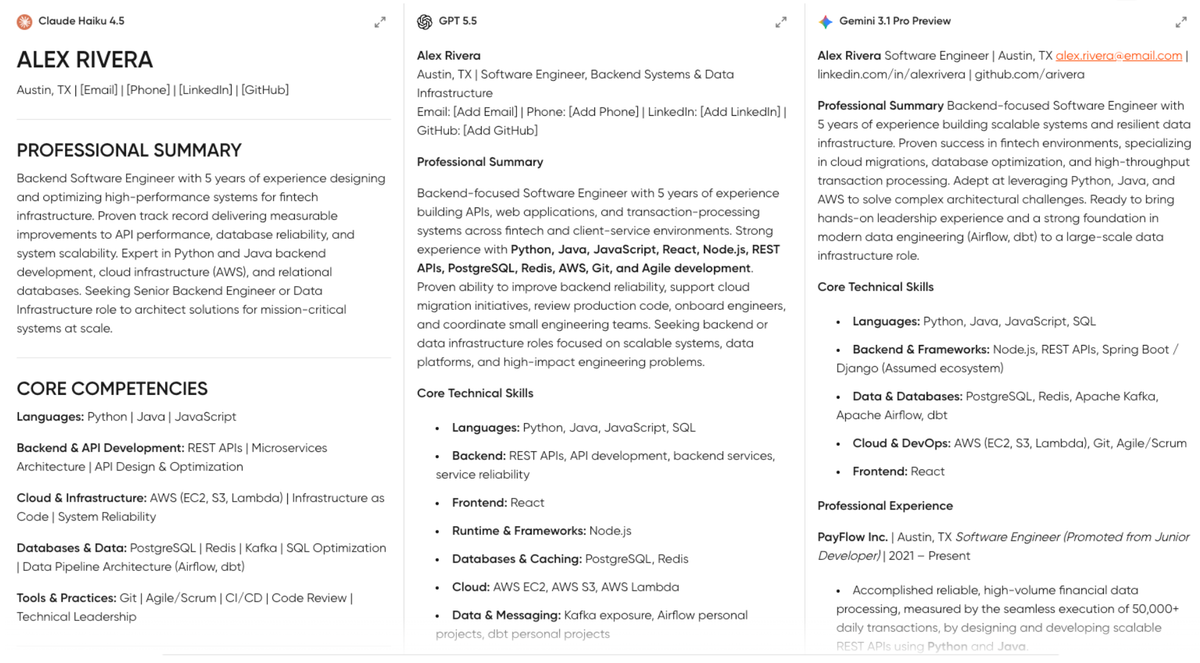
Claude followed the XYZ formula hard. The bullets looked impressive:
“Improved API response latency by 35% and increased throughput to 500K+ daily transactions.”
The problem is identical to Round 1. None of those numbers came from Alex. When you instruct an AI to write with impact and give it nothing to measure, it measures things it made up.
Gemini took the formula even more literally. Every single bullet followed the exact Accomplished/measured by/by doing scaffold. By the fourth bullet, it read like a form being filled out.
It also fabricated, though more cautiously: “50,000+ daily transactions” where Claude wrote “500K+.”
Still invented, but the lower numbers suggest some restraint.
Keyword elevation was strong again. Full tool names throughout, dbt and Airflow surfaced prominently.
GPT-5.5 Pro ignored the XYZ instruction entirely. Not a single bullet followed the structure.
Instead, it produced a tighter, more ATS-dense version of Round 1 and added a raw “ATS Keywords” section at the bottom.
Transparently mechanical, but no invented metrics.
The XYZ formula only works when you have real numbers to plug in. Without them, come prepared: “reduced load time from 4 seconds to 1.2 seconds” is usable. “Reduced load time” is not.
Round 2 verdict: GPT’s refusal to hallucinate metrics accidentally makes it the most honest output, even if it didn’t follow instructions. Gemini handled keywords best. Claude produced the most polished-looking bullets and the most dangerous ones to leave unchecked.
Round 3: ATS optimization against a real job description
A well-written resume still fails if an ATS filters it out.
This round tests something more specific: can each model identify what’s missing relative to a real job description and close that gap without stuffing keywords?
The job description was Stripe’s live “Software Engineer, Data & AI” posting.
The prompt:
“Here is a candidate’s raw resume background: [raw text]. Here is a job description: [Stripe JD]. Identify missing keywords and rewrite the work experience bullet points to naturally integrate those keywords without keyword stuffing.”
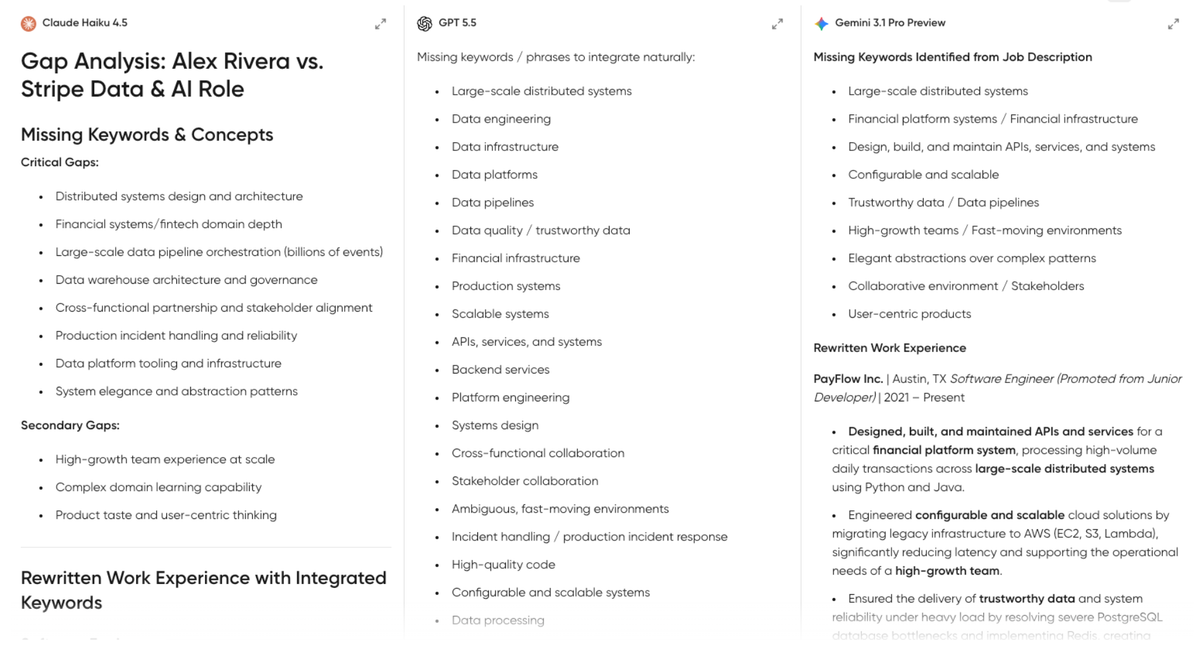
Claude went well beyond the prompt and produced a full gap analysis, interview prep advice, and positioning strategy alongside the rewritten bullets. Nobody asked for any of that.
The bullets themselves were the best-structured of the three, with Stripe-specific language like “financial infrastructure” and “production reliability” woven in naturally.
But the fabricated metrics reappeared (500K transactions, 99.95% uptime, $200K revenue), now attached to a real company’s JD.
If those numbers come up in a Stripe screen, the conversation ends badly.
GPT flagged what shouldn’t be added right there in the keyword list:
“AI/Data Ops should not be emphasized unless the candidate has real experience there.”
No other model showed that restraint.
The rewritten bullets stayed close to what Alex actually did, using Stripe’s own language accurately. No invented numbers.
For a company with a high hiring bar, that’s the right call.
Gemini integrated keywords, but the writing slipped.
One bullet read:
“maintained a highly collaborative environment in an ambiguous, fast-moving environment”
The word “environment” twice in the same sentence.
Small, but the kind of error that signals machine-generated text.
The vague dramatization habit returned too: “severe PostgreSQL bottlenecks,” “significantly reducing latency”. Language that sounds impactful but says nothing specific.
Round 3 verdict: GPT wins clearly.
Knowing what not to include is often the harder part, because the same words can make sense in one context and feel completely wrong in another.
Claude produced the most comprehensive response, but couldn’t shake fabrication. Gemini closed the keyword gaps but introduced sloppy writing.
ATS optimization is where the honesty gap matters most: an ATS won’t catch invented metrics, but the recruiter reading the shortlist will.
Round 4: Writing the cover letter for Stripe
A resume gets you past the ATS. A cover letter is supposed to answer a different question: why this company, why this role, why this person. Same raw background, same Stripe JD, with this prompt:
“Using this candidate's background and this job description, write a highly tailored, 3-paragraph cover letter for a Software Engineer, Data & AI position at Stripe. Align the tone with Stripe's culture: high craft, high bar, systems thinking. Do not use generic clichés like ‘I am writing to express my interest.’”
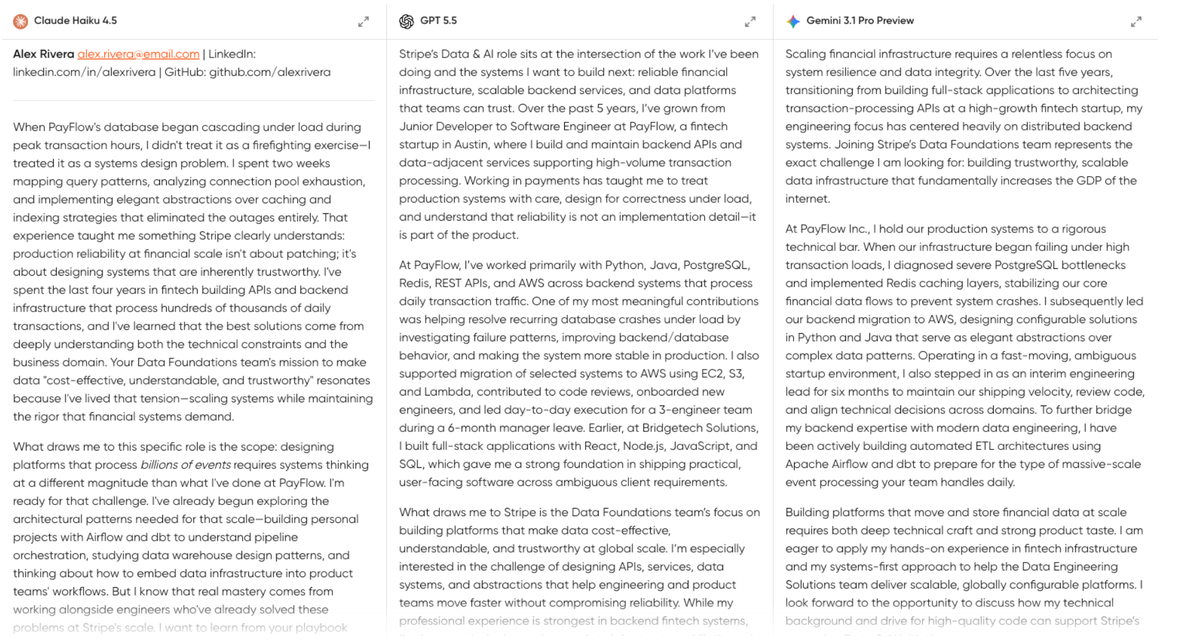
Claude opened with a story: the moment PayFlow's database began to cascade under load, and how Alex treated it as a systems design problem rather than a firefighting exercise.
From there, it drew a direct line to Stripe's mission around trustworthy data, using the company's language in a way that felt earned.
The second paragraph acknowledged Alex's gaps honestly rather than pretending they don't exist.
The third tied craft and culture together without a generic closer.
It's the only letter that sounds like a person who actually wants this specific job.
GPT produced something accurate and forgettable. The opening was decent, but paragraph two derailed into resume narration: "I've worked primarily with Python, Java, PostgreSQL, Redis, REST APIs, and AWS."
That's a resume with the formatting removed. By the time the third paragraph said something interesting about Stripe's Data Foundations mission, the reader had already moved on.
Gemini had a strong opening: "Scaling financial infrastructure requires a relentless focus on system resilience" works for a Stripe audience.
But it unraveled quickly. Stripe's own mission statement got dropped mid-paragraph with no transition.
The closing: "I look forward to the opportunity to discuss how my technical background and drive for high-quality code can support Stripe's upcoming Data & AI initiatives", is precisely the kind of line the prompt told it not to write.
Round 4 verdict: Claude wins, and it's not close. Narrative intelligence is where it genuinely outperforms the other two. GPT is a reliable second, honest and grounded, just not compelling. Gemini had the right instincts in the opening and lost the thread completely by the close.
Verdict: Which AI writes the best resume?
After four rounds, the honest answer is that none of them wins cleanly. Each model has a distinct ceiling and a distinct failure mode, and which one you use depends entirely on what you're trying to accomplish.
ChatGPT is the most disciplined editor
It won Round 3 (the ATS round) because it was the only model that flagged what shouldn't be added, on top of what was missing. It doesn't hallucinate as aggressively as the others when given a specific optimization task rather than a blank canvas.
The weakness is that it mistakes thoroughness for impact. Its cover letter read like a resume. Its Round 2 output ignored the XYZ instruction entirely. When it has clear constraints, it works well within them.
When it needs to make a creative judgment call, it defaults to safe and forgettable.
Claude is the best writer
The cover letter round wasn't close, and the gap was structural rather than stylistic. Claude understood that a cover letter is a narrative device.
It opened with a scene, acknowledged gaps honestly, and closed without reaching for a cliche.
That same instinct showed up in the resume work too. "Temporarily led" instead of "assumed technical leadership responsibilities," keeping the Junior Developer role as a separate entry, adding a Target Roles line.
Small decisions, but they add up to a resume that reads like a person rather than a template.
The persistent fabrication problem is real and worth flagging to anyone using it, but the underlying writing quality is genuinely better than the other two.
Gemini is the most technically precise about keywords
Full tool names, careful ATS vocabulary, good instincts about surfacing undersold skills.
If your primary concern is keyword matching and you have a technically dense background, Gemini elevates that material well.
The problem is that its writing quality degrades under pressure. The XYZ round produced mechanical bullet after mechanical bullet, and the cover letter lost the thread completely in the third paragraph.
It's a strong first-pass tool for technical roles, less reliable for anything requiring sustained narrative.
The fabrication problem cuts across all three, and it's worth being direct about: if you give any of these models vague raw material and ask for impact, they will invent metrics.
Claude does it most confidently. Gemini does it most cautiously. GPT tries to sidestep it. None of them will tell you they're making numbers up; they'll just make them up. The responsibility for catching that sits entirely with you.
Here's the practical takeaway for anyone using these tools for a real job search:
- Use Claude to write your summary and cover letter: Its narrative instinct is real, and it shows up consistently. Run the output through your own fact-check before sending anything. Strip any metric that didn't come from you.
- Use GPT for ATS optimization: Give it a specific job description, ask it to identify gaps, and trust it to be conservative. It won't dress the resume up in numbers it invented.
- Use Gemini if your role is heavily technical and keyword-dense: It handles technical vocabulary better than the others and surfaces buried skills effectively.
The smarter move, if you're using Geekflare Chat, is to treat the three models as specialists rather than competitors: Claude for story, GPT for precision, Gemini for technical depth. And combine the outputs rather than picking a winner.
Conclusion
Six prompts, three models, one candidate, and the results were messier and more interesting than a clean ranking would suggest.
The models are genuinely useful. Any of the three will produce a more structured, better-formatted resume than most people write on their own.
But "better than a blank page" is a low bar, and the gap between a polished-looking AI resume and a good one is wider than it appears on first read.
Invented metrics, ignored instructions, mechanical XYZ scaffolding, cover letters that recap the resume: these aren't edge cases. They showed up in every round.
The job seekers who will get the most out of these tools are the ones who come prepared: real numbers to plug into the XYZ formula, a clear sense of which keywords actually apply to their experience, and enough familiarity with their own story to catch when an AI has invented one on their behalf.
If that sounds like more work than you want to manage across multiple models and prompts, there are platforms built specifically for this.
Huntr's AI Resume Builder handles the tailoring, ATS optimization, and cover letter generation in one place, with a job tracker that keeps your applications organized alongside your documents. Less switching between tools, less manual comparison, less cleaning up after hallucinations.
The AI isn't going to replace the judgment you bring to your own job search. But the right tool, used the right way, can get you a lot closer to a resume worth sending.

Sam Wright
Sam Wright is the Head of Career Strategy at Huntr. Drawing on proprietary data from 1.7 million applications, 1 million job postings, 243,000 résumés, and a 1,049-respondent survey, Sam provides actionable, data-driven blueprints to help professionals navigate today's fractured hiring landscape. He has conducted over 900+ free support calls with job seekers, giving him frontline insight into today's job market. His work and insights have been featured in Business Insider, The Wall Street Journal, Forbes, and The Seattle Times.
Outside the tech world, Sam is a part-time farmer from a five-generation legacy of organic vegetable farming. He is a passionate advocate for farmland preservation.
Get More Interviews, Faster
Huntr streamlines your job search. Instantly craft tailored resumes and cover letters, fill out application forms with a single click, effortlessly keep your job hunt organized, and much more...
AI Resume Builder
Beautiful, perfectly job-tailored resumes designed to make you stand out, built 10x faster with the power of AI.
Next-Generation Job Tailored Resumes
Huntr provides the most advanced job <> resume matching system in the world. Helping you match not only keywords, but responsibilities and qualifications from a job, into your resume.
Job Keyword Extractor + Resume AI Integration
Huntr extracts keywords from job descriptions and helps you integrate them into your resume using the power of AI.
Application Autofill
Save hours of mindless form filling. Use our chrome extension to fill application forms with a single click.
Job Tracker
Move beyond basic, bare-bones job trackers. Elevate your search with Huntr's all-in-one, feature-rich management platform.
AI Cover Letters
Perfectly tailored cover letters, in seconds! Our cover letter generator blends your unique background with the job's specific requirements, resulting in unique, standout cover letters.
Resume Checker
Huntr checks your resume for spelling, length, impactful use of metrics, repetition and more, ensuring your resume gets noticed by employers.
Gorgeous Resume Templates
Stand out with one of 7 designer-grade templates. Whether you're a creative spirit or a corporate professional, our range of templates caters to every career aspiration.
Personal Job Search CRM
The ultimate companion for managing your professional job-search contacts and organizing your job search outreach.
Huntr
Blog Product Updates Resume Skill Guides Resume Examples Interview Question Guides Research 2025 Job Search Trends Report Affiliate Program Careers Privacy policy Terms of service Write for us LinkedIn Reddit r/HuntrCo Twitter @TryHuntr Email UsProduct
Job Tracker AI Resume Builder Resume Tailor Resume Checker AI Cover Letters Resume Summary Generator Resume Bullet Generator Resume Skills Generator Resume Headline Generator Resume Keyword Scanner Job Keyword Finder Targeted Resume Contact Tracker Interview Tracker Job Search Metrics Job Application Autofill Resume Storage AI Resume Review Job Clipper Resume Optimization ChatGPT Resume Builder Resume Fixer LinkedIn Resume Builder AI Resume Rewriter Interview Question Generator