
Resume Examples
September 07, 2026
22 Site Reliability Engineer Resume Examples, Backed by Real Resumes (2026)
by Sam Wright22 site reliability engineer resume examples, led by one that landed interviews at Cisco Meraki, Braze, and Axon, plus entry-level, senior, Kubernetes, and cloud examples.
Build a resume for free
Whether you're early in your career or a veteran engineer, your resume is the first signal that you can keep systems running under pressure. This guide gathers real resumes that reached interviews plus clearly labeled illustrative ones, drawing on Huntr's research into what works, with practical advice to help you optimize your resume and land your dream job.
Build your site reliability engineer resume today
Use our AI Resume Builder, Interview Prep and Job Search Tools to land your next job.
What Interview-Stage Site Reliability Engineer Resumes Share
These patterns come from Huntr's analysis of real site reliability engineer resumes that reached the interview stage. Each verified example blends 3 or more real resumes from Huntr's database. Names, employers, schools, dates and figures are changed so no one can be identified. The interview companies are real.
- A metric-rich summary led most resumes. They stated years of experience and a headline reliability number such as 99.99% availability.
- A cloud and monitoring stack ran through nearly every resume. AWS, Kubernetes, Terraform, Docker, and a Prometheus and Grafana pairing showed up again and again.
- Automation rested on a few core languages. Python, Go, and Bash formed the baseline for scripting and tooling.
- Achievements carried numbers. Uptime and SLO targets, cloud spend cuts, faster release and scale times, and lower incident resolution time all appeared as figures.
- Two pages were common at the senior level. Many paired the length with a Master's or Bachelor's in computing and an AWS or Kubernetes certification.
Site Reliability Engineer Resume Example That Landed Interviews
This example blends 3 or more real resumes from the interview set above. Names, employers, schools, dates and figures are changed so no one can be identified. The interview companies are real.
Site Reliability Engineer Resume Example That Reached Interviews
Reached the interview stage
This site reliability engineer resume landed interviews at Cisco Meraki, Braze, and Axon.
Isaac Lindqvist
[email protected] - 111-111-1111 - Harrisburg, PA - linkedin.com/in/isaac-lindqvist-example1
About
Site reliability engineer with more than a decade keeping busy services up on AWS, Kubernetes, and bare metal. Led cost and reliability work across cloud platforms, including $250K a year saved by retiring a costly data warehouse service. Skilled in release monitoring and test automation that catch most problems before customers see them.
Experience
Senior Site Reliability Engineer
Duolingo
04/2021 - Present
Remote
- Replaced a paid monitoring vendor with a self-hosted stack for metrics, logs, and traces, cutting that bill by 60%.
- Taught database design and query habits to 75+ developers in a series of short internal classes.
- Worked 25+ reported web security flaws through to fixes with the owning dev teams.
- Built Git-driven CI/CD pipelines with linting, tests, and security scans for a team of 8 engineers, and wired in monitoring that catches about 80% of issues before release.
- Run the infrastructure behind a customer support contact center serving 7M+ users, from design and vendor choice through automated deploys.
- Set SLIs and SLOs with product teams and coach them on using error budgets.
Site Reliability Engineer
Shutterstock
01/2018 - 03/2021
New York, NY
- Managed configuration for a fleet of 30,000+ servers with Chef cookbooks, with every change peer-reviewed before it shipped.
- Stood up and ran a 25-node Kubernetes cluster for a telemetry pipeline.
- Wrote self-serve tooling for Aurora test databases that cut setup time by 50%, so dev and QA teams stopped waiting on tickets.
- Replaced hand-run deploy scripts with a shared Jenkins pipeline that every app team could use.
- Reviewed AWS service use and moved traffic onto private endpoints, saving up to $12K a month.
Systems Engineer
Linode
08/2015 - 12/2017
Galloway, NJ
- Automated server builds with Ansible playbooks, ending config drift and cutting build time by about two thirds.
- Tuned and patched busy LAMP web hosts so hosting customers stayed within their service targets.
- Shared on-call for a multi-region Linux stack running Tomcat, MySQL, and message queues.
- Built a log ingestion pipeline that handled 120GB+ a day and cut ops requests for old logs by 75%.
Education
Bachelor of Science - Computer Science
Temple University
Philadelphia, PA
Skills
AWS • AWS Aurora • Kubernetes • Ansible • Chef • Jenkins • Linux • MySQL • CI/CD Pipelines • GitOps • Observability (Metrics, Logs, Traces) • SLIs and SLOs • On-Call and Incident Response • Security Remediation • Cloud Cost Optimization
- Size & Scope: More than a decade in site reliability, managing configuration for a fleet of 30,000+ servers and running infrastructure for 7M+ users.
- Proof of Impact: $250K a year saved by retiring a costly data warehouse service, up to $12K a month saved by moving AWS traffic onto private endpoints, and a monitoring bill cut by 60% with a self-hosted stack.
- Career Arc: Systems Engineer, then Site Reliability Engineer, then Senior Site Reliability Engineer.
- Skills (tailored to the job): AWS, Kubernetes, Ansible, CI/CD Pipelines, Observability (Metrics, Logs, Traces), SLIs and SLOs
The rest are illustrative examples, shaped by Huntr's best-practice guidance and the skills real site reliability engineer postings name, so you can see how each level and specialty reads on the page.
Site Reliability Engineer Resume Examples by Level and Specialty
Entry-Level Site Reliability Engineer Resume Example
Illustrative example
Drawn from 806 scripting-focused site reliability engineer job postings saved on Huntr.
Emma Jones
[email protected] - (555) 123-4567 - Seattle, WA - linkedin.com/in/example
About
Passionate and detail-oriented Computer Science graduate with a strong foundation in software engineering principles and a keen interest in site reliability engineering. Seeking an entry-level position to apply my knowledge of cloud technologies, automation, and monitoring systems to contribute to maintaining robust and scalable infrastructure.
Education
Bachelor of Science
University of Washington
09/2020 - 05/2024
Seattle, WA
- GPA: 3.8/4.0
Projects
Automated Deployment Pipeline
09/2023 - 12/2023
- Developed a CI/CD pipeline using Jenkins, Docker, and Kubernetes for automated testing and deployment
- Implemented monitoring and alerting using Prometheus and Grafana, reducing system downtime by 25%
- Collaborated with a team of 4 to design and implement infrastructure-as-code using Terraform
Cloud-Based Load Balancer
01/2023 - 04/2023
- Created a scalable load balancer on AWS using EC2 and Elastic Load Balancing
- Implemented auto-scaling policies to handle traffic spikes, improving response times by 40%
- Designed and implemented logging and monitoring solutions for real-time performance analysis
Certifications
AWS Certified Cloud Practitioner
Skills
Python • Go • Java • Linux/Unix • Docker • Kubernetes • AWS • Prometheus • Grafana • Problem-solving • Teamwork • Communication • Continuous Learning
- Size & Scope: Early-career profile anchored by a computer science degree, hands-on projects, and cloud coursework.
- Proof of Impact: Applies automation and monitoring to small, self-hosted infrastructure projects.
- Career Arc: Computer science degree, then a first site reliability engineer role.
- Average Page Length: 1.25 pages
- Skills (tailored to the job): Python, Linux, Docker, Kubernetes, AWS, and Prometheus.
For those just starting their journey in site reliability engineering, this example showcases how to highlight relevant skills and projects when professional experience is limited.
Build Your Entry-Level Site Reliability Engineer ResumeMid-Level Site Reliability Engineer Resume Example
Illustrative example
Pulled from 1,587 monitoring-focused site reliability engineer job postings saved on Huntr.
Yusuf Hassan
[email protected] - (555) 987-6543 - Austin, TX - linkedin.com/in/example
About
Dedicated Site Reliability Engineer with 4 years of experience optimizing and maintaining large-scale distributed systems. Skilled in implementing automation, improving system reliability, and fostering a culture of DevOps. Seeking to apply my expertise in cloud technologies and incident management to drive operational excellence in a dynamic tech environment.
Experience
Senior Site Reliability Engineer
TechInnovate Solutions
06/2021 - Present
Austin, TX
- Lead a team of 3 SREs in designing and implementing scalable infrastructure solutions, resulting in a 99.99% uptime for critical services
- Developed and maintained CI/CD pipelines using Jenkins and GitLab, reducing deployment time by 40%
- Implemented comprehensive monitoring and alerting systems using Prometheus, Grafana, and PagerDuty, decreasing MTTR by 30%
- Orchestrated the migration of legacy systems to a microservices architecture on Kubernetes, improving system flexibility and scalability
Site Reliability Engineer
CloudScale Systems
07/2019 - 05/2021
Dallas, TX
- Collaborated with development teams to implement infrastructure-as-code using Terraform and Ansible
- Designed and implemented auto-scaling solutions for cloud-based applications, reducing infrastructure costs by 25%
- Conducted post-mortem analyses and implemented preventive measures, reducing recurring incidents by 50%
Education
Master of Science - Computer Engineering
Texas A&M University
09/2017 - 05/2019
College Station, TX
Bachelor of Science - Computer Science
University of Texas
09/2013 - 05/2017
Austin, TX
Projects
Chaos Engineering Framework
01/2022 - 04/2022
- Developed a custom chaos engineering framework to test system resilience
- Implemented automated fault injection tests, improving system reliability by 20%
- Presented findings and best practices at internal tech talks, promoting a culture of resilience engineering
Certifications
Google Cloud Professional Cloud Architect
AWS Certified Solutions Architect - Associate
Skills
Python • Go • Java • Bash • Linux/Unix • Docker • Kubernetes • AWS • GCP • Terraform • Ansible • Jenkins • GitLab • Prometheus • Grafana • ELK Stack • Leadership • Problem-solving • Communication • Incident Management • Performance Optimization
- Size & Scope: Leads a team of 3 SREs holding critical services to 99.99% uptime.
- Proof of Impact: Jenkins and GitLab CI/CD cut deployment time 40%; Prometheus, Grafana, and PagerDuty cut MTTR 30%.
- Career Arc: Site Reliability Engineer, then Senior Site Reliability Engineer.
- Average Page Length: 1.5 pages
- Skills (tailored to the job): AWS, Kubernetes, Jenkins, GitLab CI, Prometheus, and Grafana.
This example demonstrates how to highlight a few years of experience and showcase growing expertise in site reliability engineering.
Build Your Mid-Level Site Reliability Engineer ResumeSenior Site Reliability Engineer Resume Example
Illustrative example
From 390 mentoring-focused site reliability engineer job postings saved on Huntr.
Mei Wang
[email protected] - (555) 234-5678 - San Francisco, CA - linkedin.com/in/example
About
Site Reliability Engineer with 8+ years of experience architecting, implementing, and managing large-scale distributed systems. Proven track record in leading cross-functional teams, optimizing system performance, and driving cultural changes towards DevOps and SRE best practices. Seeking a senior role to apply my expertise in cloud technologies, automation, and reliability engineering to drive innovation and operational excellence.
Experience
Lead Site Reliability Engineer
InnovateTech Solutions
08/2019 - Present
San Francisco, CA
- Spearheaded the design and implementation of a multi-region, highly available infrastructure on AWS and GCP, achieving 99.999% uptime for critical services
- Led a team of 7 SREs, mentoring junior engineers and fostering a culture of continuous improvement and knowledge sharing
- Architected and implemented a comprehensive observability platform using Prometheus, Grafana, and OpenTelemetry, reducing MTTR by 60%
- Drove the adoption of GitOps practices, resulting in a 70% reduction in configuration drift and improved deployment consistency
Senior Site Reliability Engineer
CloudScale Enterprises
06/2016 - 07/2019
Seattle, WA
- Designed and implemented auto-healing and self-scaling systems using Kubernetes and custom controllers, reducing manual interventions by 80%
- Led the migration of monolithic applications to microservices architecture, improving system scalability and reducing deployment time by 65%
- Implemented chaos engineering practices, uncovering and addressing critical vulnerabilities, thereby improving system resilience by 40%
Site Reliability Engineer
TechPioneer Inc.
05/2014 - 05/2016
Portland, OR
- Developed and maintained CI/CD pipelines using Jenkins and Ansible, streamlining the deployment process
- Implemented infrastructure-as-code practices using Terraform, reducing provisioning time by 50%
- Collaborated with development teams to optimize application performance, resulting in a 30% improvement in response times
Education
Master of Science - Computer Science
Stanford University
09/2012 - 06/2014
Stanford, CA
Bachelor of Science - Software Engineering
University of California, Berkeley
09/2008 - 05/2012
Berkeley, CA
Certifications
Google Cloud Professional DevOps Engineer
AWS Certified DevOps Engineer - Professional
Kubernetes Certified Administrator (CKA)
Skills
Python • Go • Rust • Java • Bash • Linux/Unix • Docker • Kubernetes • AWS • GCP • Azure • Terraform • Ansible • Jenkins • GitLab • Prometheus • Grafana • ELK Stack • Istio • Envoy • OpenTelemetry • Leadership • Strategic Planning • Problem-solving • Cross-functional Collaboration • Incident Management • Performance Optimization • Mentoring
- Size & Scope: Leads 7 SREs running multi-region AWS and GCP infrastructure at 99.999% uptime.
- Proof of Impact: A Prometheus, Grafana, and OpenTelemetry platform cut MTTR 60%; Kubernetes self-healing cut manual work 80%.
- Career Arc: Site Reliability Engineer, then Senior Site Reliability Engineer, then Lead Site Reliability Engineer.
- Average Page Length: 2 pages
- Skills (tailored to the job): AWS, Kubernetes, Terraform, SLO and SLI practice, incident response, and on-call leadership.
For experienced SREs, this example demonstrates how to highlight leadership, complex problem-solving, and significant contributions to organizational success.
Build Your Senior Site Reliability Engineer ResumeCloud-Focused Site Reliability Engineer Resume Example
Illustrative example
Based on 746 cloud infrastructure site reliability engineer job postings saved on Huntr.
Kenji Jeong
[email protected] - (555) 345-6789 - New York, NY - linkedin.com/in/example
About
Innovative Cloud-Focused Site Reliability Engineer with 6 years of experience designing, implementing, and managing highly scalable and resilient cloud-native infrastructures. Expertise in multi-cloud environments, containerization, and serverless architectures. Passionate about using cutting-edge cloud technologies to optimize performance, reduce costs, and enhance system reliability.
Experience
Senior Cloud Site Reliability Engineer
CloudNova Technologies
03/2020 - Present
New York, NY
- Architected and implemented a multi-cloud infrastructure spanning AWS, GCP, and Azure, achieving 99.999% availability for mission-critical applications
- Led the migration of legacy monolithic applications to cloud-native microservices, resulting in a 40% reduction in operational costs and 60% improvement in scalability
- Designed and implemented a centralized observability platform using Prometheus, Grafana, and OpenTelemetry, reducing MTTR by 50%
- Spearheaded the adoption of serverless technologies (AWS Lambda, Google Cloud Functions) for event-driven architectures, improving system responsiveness by 70%
Cloud Site Reliability Engineer
TechCloud Solutions
06/2017 - 02/2020
Boston, MA
- Implemented infrastructure-as-code practices using Terraform and CloudFormation, reducing provisioning time by 65%
- Designed and maintained CI/CD pipelines using Jenkins and AWS CodePipeline, streamlining deployment processes across multiple environments
- Optimized cloud resource utilization through implementation of auto-scaling policies and spot instances, reducing infrastructure costs by 30%
Junior DevOps Engineer
InnoSys Corporation
07/2015 - 05/2017
Chicago, IL
- Assisted in the migration of on-premises applications to AWS, improving system performance and reducing downtime
- Implemented monitoring and alerting solutions using CloudWatch and SNS, enhancing incident response times by 40%
Education
Master of Science - Cloud Computing
Northeastern University
09/2013 - 05/2015
Boston, MA
Bachelor of Science - Computer Science
University of Illinois at Urbana-Champaign
09/2009 - 05/2013
Champaign, IL
Projects
Multi-Cloud Disaster Recovery Solution
01/2022 - 05/2022
Designed and implemented a cross-cloud disaster recovery solution using AWS and GCP
- Achieved an RPO of 5 minutes and RTO of 15 minutes for critical applications
- Automated failover and failback procedures, reducing manual intervention and human error
Serverless ETL Pipeline
06/2021 - 09/2021
Developed a serverless ETL pipeline using AWS Lambda, Step Functions, and S3
- Reduced data processing time by 70% and operational costs by 50% compared to traditional EC2-based solution
Certifications
AWS Certified Solutions Architect - Professional
Google Cloud Professional Cloud Architect
Microsoft Certified: Azure Solutions Architect Expert
Skills
Python • Go • JavaScript • Bash • Linux/Unix • Docker • Kubernetes • AWS (EC2, S3, Lambda, EKS, CloudFormation) • GCP (Compute Engine, Cloud Storage, Cloud Functions, GKE) • Azure (Virtual Machines, Blob Storage, Functions, AKS) • Terraform • Ansible • Jenkins • GitLab • Prometheus • Grafana • ELK Stack • Istio • Problem-solving • Communication • Team Collaboration • Continuous Learning • Adaptability
- Size & Scope: Runs multi-cloud infrastructure across AWS, GCP, and Azure at 99.999% availability.
- Proof of Impact: A cloud-native migration cut operational costs 40% and improved scalability 60%; autoscaling and spot instances cut spend 30%.
- Career Arc: Junior DevOps Engineer, then Cloud Site Reliability Engineer, then Senior Cloud Site Reliability Engineer.
- Average Page Length: 1.75 pages
- Skills (tailored to the job): AWS, GCP, Terraform, CloudFormation, autoscaling, and cost optimization.
This example highlights expertise in cloud technologies and showcases how to emphasize cloud-specific skills and experiences in site reliability engineering.
Build Your Cloud-Focused Site Reliability Engineer ResumeDevOps-Oriented Site Reliability Engineer Resume Example
Illustrative example
Built from 1,891 DevOps-focused site reliability engineer job postings saved on Huntr.
Ibrahim Abdullah
[email protected] - (555) 456-7890 - Toronto, ON - linkedin.com/in/example
About
Driven DevOps-oriented Site Reliability Engineer with 5+ years of experience in designing, implementing, and maintaining robust CI/CD pipelines and infrastructure automation. Passionate about bridging the gap between development and operations to deliver high-quality, reliable software at scale. Seeking to apply my expertise in DevOps practices and SRE principles to drive operational excellence and foster a culture of continuous improvement.
Experience
Lead DevOps Engineer
InnoTech Solutions
09/2020 - Present
Toronto, ON
- Spearheaded the implementation of a GitOps-based CI/CD pipeline using GitLab, ArgoCD, and Kubernetes, reducing deployment time by 75% and improving release frequency by 300%
- Designed and implemented a comprehensive Infrastructure as Code (IaC) strategy using Terraform and Ansible, achieving 100% infrastructure automation and reducing provisioning time by 80%
- Led the adoption of container orchestration technologies, migrating 90% of applications to Kubernetes, resulting in improved scalability and resource utilization
- Implemented advanced monitoring and observability solutions using Prometheus, Grafana, and Jaeger, reducing MTTR by 60% and improving overall system reliability
DevOps Engineer
CloudScale Systems
06/2018 - 08/2020
Vancouver, BC
- Developed and maintained CI/CD pipelines using Jenkins and Docker, streamlining the software delivery process and reducing deployment errors by 70%
- Implemented configuration management using Ansible, ensuring consistency across 200+ servers and reducing system drift by 90%
- Collaborated with development teams to implement microservices architecture, improving system modularity and reducing time-to-market for new features by 50%
Junior Systems Administrator
TechPro Services
07/2016 - 05/2018
Calgary, AB
- Assisted in the migration of on-premises infrastructure to AWS, improving system scalability and reducing operational costs by 30%
- Implemented basic monitoring and alerting solutions using Nagios, enhancing incident response times by 40%
Education
Bachelor of Science in Computer Engineering
University of Waterloo
09/2012 - 05/2016
Waterloo, ON
Projects
Automated Blue-Green Deployment System
01/2022 - 04/2022
Designed and implemented an automated blue-green deployment system using Kubernetes and Istio
- Reduced deployment downtime to near-zero and improved rollback capabilities, enhancing overall system reliability
Self-Healing Infrastructure Framework
05/2021 - 08/2021
Developed a custom self-healing infrastructure framework using Kubernetes Operators and Prometheus AlertManager
- Automated remediation for common system issues, reducing manual interventions by 70% and improving system stability
Certifications
Certified Kubernetes Administrator (CKA)
AWS Certified DevOps Engineer - Professional
HashiCorp Certified: Terraform Associate
Skills
Python • Go • Bash • Ruby • Linux/Unix • Docker • Kubernetes • AWS • GCP • Terraform • Ansible • Jenkins • GitLab • ArgoCD • Prometheus • Grafana • ELK Stack • Jaeger • Istio • Helm • Problem-solving • Team Collaboration • Communication • Continuous Learning • Process Improvement • Mentoring
- Size & Scope: Owns GitOps CI/CD and Infrastructure as Code across a Kubernetes estate.
- Proof of Impact: GitLab, ArgoCD, and Kubernetes cut deployment time 75% and lifted release frequency 300%; Terraform and Ansible reached full infrastructure automation.
- Career Arc: Junior Systems Administrator, then DevOps Engineer, then Lead DevOps Engineer.
- Average Page Length: 1.5 pages
- Skills (tailored to the job): CI/CD, Jenkins, GitHub Actions, Docker, Ansible, and Kubernetes.
This example emphasizes the intersection of DevOps practices and site reliability engineering, showcasing skills in automation, continuous integration, and deployment.
Build Your DevOps-Oriented Site Reliability Engineer ResumeAutomation Specialist Site Reliability Engineer Resume Example
Illustrative example
Taken from 1,904 Ansible-focused site reliability engineer job postings saved on Huntr.
Charlotte Smith
[email protected] - (555) 567-8901 - San Jose, CA - linkedin.com/in/example
About
Innovative Automation Specialist Site Reliability Engineer with 7+ years of experience designing, implementing, and optimizing automated solutions for large-scale distributed systems. Expertise in infrastructure automation, CI/CD pipelines, and process optimization. Passionate about using cutting-edge automation technologies to enhance system reliability, scalability, and operational efficiency.
Experience
Senior Automation Engineer
TechAutomation Solutions
11/2019 - Present
San Jose, CA
- Architected and implemented a fully automated, self-healing infrastructure using Kubernetes, Terraform, and custom Python scripts, reducing manual interventions by 90% and improving system uptime to 99.99%
- Developed an AI-driven capacity planning system using machine learning algorithms and historical data, optimizing resource allocation and reducing cloud costs by 35%
- Led the implementation of GitOps practices using ArgoCD and Flux, achieving 100% automated deployments and reducing deployment errors by 80%
- Mentored a team of 5 junior engineers, fostering a culture of automation-first thinking and continuous improvement
Automation Specialist
CloudInnovate Systems
08/2016 - 10/2019
San Francisco, CA
- Designed and implemented a comprehensive CI/CD pipeline using Jenkins, Docker, and Ansible, reducing deployment time from days to minutes and increasing release frequency by 400%
- Developed custom Ansible modules and Terraform providers to automate complex, company-specific processes, saving 30 hours of manual work per week
- Implemented automated testing and security scanning in the CI/CD pipeline, reducing post-deployment issues by 70% and improving overall system security
DevOps Engineer
TechPro Corporation
06/2014 - 07/2016
Mountain View, CA
- Assisted in the migration of legacy applications to a containerized environment using Docker and Kubernetes
- Implemented basic infrastructure-as-code practices using CloudFormation and Terraform, improving consistency and reducing provisioning time by 50%
Education
Master of Science in Software Engineering
Stanford University
09/2012 - 06/2014
Stanford, CA
Bachelor of Science in Computer Science
University of California, Berkeley
09/2008 - 05/2012
Berkeley, CA
Projects
Automated Multi-Cloud Cost Optimization System
02/2022 - 06/2022
Developed an automated system to analyze and optimize cloud resource usage across AWS, GCP, and Azure
- Implemented intelligent resource scheduling and auto-scaling, resulting in a 25% reduction in overall cloud spending
Self-Service Infrastructure Portal
07/2021 - 11/2021
Created a user-friendly web portal for developers to provision pre-approved, compliant infrastructure using Terraform and custom APIs
- Reduced infrastructure provisioning time from days to minutes and ensured 100% compliance with company policies
Certifications
Red Hat Certified Specialist in Ansible Automation
AWS Certified DevOps Engineer - Professional
Google Cloud Professional Cloud DevOps Engineer
Skills
Python • Go • Bash • PowerShell • Groovy • Linux/Unix • Docker • Kubernetes • AWS • GCP • Azure • Terraform • Ansible • Puppet • Chef • Jenkins • GitLab • ArgoCD • Flux • Prometheus • Grafana • ELK Stack • RabbitMQ • Apache Kafka • Problem-solving • Analytical Thinking • Team Leadership • Communication • Process Optimization • Continuous Learning
- Size & Scope: Runs a self-healing infrastructure on Kubernetes, Terraform, and Python at 99.99% uptime.
- Proof of Impact: Automation cut manual interventions 90%; a capacity-planning system cut cloud costs 35%; GitOps reached fully automated deployments.
- Career Arc: DevOps Engineer, then Automation Specialist, then Senior Automation Engineer.
- Average Page Length: 1.5 pages
- Skills (tailored to the job): Python, Bash, Ansible, Terraform, self-healing infrastructure, and Git.
This example focuses on showcasing expertise in automation technologies and processes within the context of site reliability engineering.
Build Your Automation Specialist Site Reliability Engineer ResumeNetwork-Focused Site Reliability Engineer Resume Example
Illustrative example
Drawn from 1,185 networking-focused site reliability engineer job postings saved on Huntr.
Yusuf Mahmoud
[email protected] - +44 20 1234 5678 - London, UK - linkedin.com/in/example
About
Experienced Network-Focused Site Reliability Engineer with 6+ years of expertise in designing, implementing, and optimizing large-scale network infrastructures for distributed systems. Skilled in network automation, software-defined networking, and cloud networking technologies. Passionate about using cutting-edge network solutions to enhance system reliability, performance, and security.
Experience
Senior Network Reliability Engineer
GlobalNet Solutions
01/2020 - Present
London, UK
- Architected and implemented a global, multi-cloud network infrastructure using AWS Direct Connect, Google Cloud Interconnect, and Azure ExpressRoute, reducing latency by 40% and improving cross-region data transfer speeds by 60%
- Led the adoption of software-defined networking (SDN) using Cisco ACI and VMware NSX, resulting in a 70% reduction in network provisioning time and improved network segmentation for enhanced security
- Designed and implemented a zero-trust network architecture, reducing the attack surface by 80% and enhancing overall system security
- Developed a custom network automation framework using Python and Ansible, automating 90% of routine network tasks and reducing configuration errors by 75%
Network DevOps Engineer
TechInfra Systems
03/2017 - 12/2019
Manchester, UK
- Implemented network infrastructure as code using Terraform and Ansible, achieving 100% automation of network provisioning and configuration management
- Designed and deployed a scalable load balancing solution using F5 BIG-IP and NGINX, improving application performance by 50% and ensuring 99.99% uptime
- Collaborated with security teams to implement network segmentation and microsegmentation strategies, enhancing overall system security posture
Junior Network Engineer
DataComm Ltd
06/2015 - 02/2017
Birmingham, UK
- Assisted in the design and implementation of MPLS networks for enterprise clients
- Implemented basic network monitoring solutions using Nagios and Cacti, improving network visibility and reducing troubleshooting time by 30%
Education
Master of Science - Computer Networks
Imperial College London
09/2013 - 06/2015
London, UK
Bachelor of Science - Computer Science
University of Birmingham
09/2009 - 06/2013
Birmingham, UK
Projects
Global Network Observability Platform
04/2022 - 08/2022
Designed and implemented a comprehensive network observability platform using Prometheus, Grafana, and custom exporters. Achieved end-to-end visibility of network performance metrics, reducing MTTR for network-related issues by 60%.
Automated Network Compliance System
09/2021 - 12/2021
Developed an automated system to ensure network configurations comply with industry standards and company policies. Implemented continuous compliance checking, reducing audit preparation time by 80% and ensuring 99.9% compliance rate.
Certifications
Cisco Certified Network Professional (CCNP) Enterprise
AWS Certified Advanced Networking - Specialty
Juniper Networks Certified Internet Specialist (JNCIS-SP)
Skills
Python • Go • Bash • Linux/Unix • Cisco IOS • Juniper Junos • F5 BIG-IP • NGINX • AWS (VPC, Direct Connect, Route 53) • GCP (VPC, Cloud Interconnect) • Azure (Virtual Network, ExpressRoute) • Terraform • Ansible • Puppet • Jenkins • GitLab • Prometheus • Grafana • ELK Stack • Wireshark • tcpdump • Problem-solving • Analytical Thinking • Team Collaboration • Communication • Network Design • Troubleshooting • Documentation
- Size & Scope: Runs global multi-cloud networking across AWS, Google Cloud, and Azure interconnects.
- Proof of Impact: Software-defined networking cut provisioning time 70%; a redesign cut latency 40% and lifted cross-region transfer speeds 60%.
- Career Arc: Junior Network Engineer, then Network DevOps Engineer, then Senior Network Reliability Engineer.
- Average Page Length: 1.75 pages
- Skills (tailored to the job): TCP/IP, DNS, load balancing, BGP, firewalls, and VPC networking.
This example emphasizes expertise in network infrastructure and protocols within the context of site reliability engineering.
Build Your Network-Focused Site Reliability Engineer ResumeSecurity-Oriented Site Reliability Engineer Resume Example
Illustrative example
Pulled from 488 security-focused site reliability engineer job postings saved on Huntr.
Emma Papadopoulos
[email protected] - +49 30 1234 5678 - Berlin, Germany - linkedin.com/in/example
About
Security-focused Site Reliability Engineer with 7+ years of experience in designing, implementing, and maintaining secure, large-scale distributed systems. Expertise in DevSecOps practices, cloud security, and automated security testing. Passionate about integrating security at every stage of the software development lifecycle to build robust, resilient, and secure systems.
Experience
Lead Security SRE
SecureCloud Technologies
03/2020 - Present
Berlin, Germany
- Architected and implemented a comprehensive DevSecOps pipeline, integrating automated security testing and compliance checks, reducing security vulnerabilities in production by 80%
- Led the design and implementation of a zero-trust security model across multi-cloud environments (AWS, GCP, Azure), enhancing overall system security posture
- Developed a custom security orchestration and automated response (SOAR) platform, reducing mean time to detect (MTTD) and mean time to respond (MTTR) to security incidents by 70%
- Mentored a team of 5 junior SREs on security best practices and DevSecOps methodologies, fostering a culture of security-first thinking
Senior Security Engineer
CyberGuard Systems
06/2017 - 02/2020
Munich, Germany
- Implemented infrastructure-as-code practices using Terraform and AWS CloudFormation with built-in security controls, ensuring 100% compliance with security policies
- Designed and deployed a centralized log management and security information and event management (SIEM) solution using ELK stack and Splunk, improving threat detection capabilities by 60%
- Conducted regular security assessments and penetration testing, identifying and remediating critical vulnerabilities before they could be exploited
DevOps Engineer
TechInnovate GmbH
08/2015 - 05/2017
Hamburg, Germany
- Assisted in the implementation of basic security measures in CI/CD pipelines, including static code analysis and dependency scanning
- Collaborated with development teams to implement secure coding practices and conducted security awareness training sessions
Education
Master of Science - Information Security
Technical University of Munich
09/2013 - 07/2015
Munich, Germany
Bachelor of Science - Computer Science
University of Athens
09/2009 - 06/2013
Athens, Greece
Projects
Automated Compliance Monitoring System
01/2022 - 04/2022
Developed an automated system to continuously monitor and report on compliance with GDPR, ISO 27001, and PCI DSS standards. Implemented real-time alerts for compliance violations, reducing audit preparation time by 70% and ensuring ongoing compliance.
Secure Container Orchestration Framework
06/2021 - 09/2021
Designed and implemented a secure container orchestration framework using Kubernetes, Istio, and Open Policy Agent. Enhanced container security through automated vulnerability scanning, runtime protection, and policy enforcement.
Certifications
Certified Information Systems Security Professional (CISSP)
AWS Certified Security - Specialty
Offensive Security Certified Professional (OSCP)
Skills
Python • Go • Bash • Ruby • Linux/Unix • Docker • Kubernetes • AWS • GCP • Azure • Terraform • Ansible • Jenkins • GitLab • Prometheus • Grafana • ELK Stack • Splunk • OSSEC • Snort • Nessus • Metasploit • OWASP ZAP • Threat Modeling • Risk Assessment • Incident Response • Team Leadership • Communication • Problem-solving • Security Architecture Design
- Size & Scope: Runs DevSecOps and zero-trust security across multi-cloud environments.
- Proof of Impact: A DevSecOps pipeline cut production vulnerabilities 80%; an ELK and Splunk SIEM lifted threat detection 60%.
- Career Arc: DevOps Engineer, then Senior Security Engineer, then Lead Security SRE.
- Average Page Length: 1.75 pages
- Skills (tailored to the job): IAM, secrets management, vulnerability scanning, TLS, SIEM, and system hardening.
This example focuses on the intersection of security and site reliability engineering, emphasizing skills in securing large-scale systems and implementing security best practices.
Build Your Security-Oriented Site Reliability Engineer ResumeMonitoring and Observability Specialist Site Reliability Engineer Resume Example
Illustrative example
From 1,220 observability-focused site reliability engineer job postings saved on Huntr.
Liam O'Connor
[email protected] - +353 1 234 5678 - Dublin, Ireland - linkedin.com/in/example
About
Dedicated Monitoring and Observability Specialist Site Reliability Engineer with 6+ years of experience in designing, implementing, and optimizing monitoring and observability solutions for large-scale distributed systems. Expertise in metrics collection, log aggregation, and distributed tracing. Passionate about using data-driven insights to enhance system reliability, performance, and user experience.
Experience
Lead Observability Engineer
DataVision Technologies
05/2020 - Present
Dublin, Ireland
- Architected and implemented a comprehensive observability platform using Prometheus, Grafana, Loki, and Jaeger, providing end-to-end visibility across microservices architecture and reducing MTTR by 65%
- Developed custom exporters and integrations to capture business-specific metrics, enabling data-driven decision making and improving overall system performance by 40%
- Led the implementation of distributed tracing using OpenTelemetry, enhancing the ability to diagnose and resolve complex issues in a microservices environment
- Mentored a team of 4 junior engineers on observability best practices and fostered a culture of data-driven operations
Senior Monitoring Engineer
CloudScale Solutions
08/2017 - 04/2020
Cork, Ireland
- Designed and implemented a centralized logging solution using the ELK stack, improving log search and analysis capabilities and reducing troubleshooting time by 50%
- Developed automated alerting and escalation procedures using PagerDuty and custom integrations, ensuring timely response to critical issues and reducing alert fatigue by 30%
- Collaborated with development teams to implement application-level instrumentation, providing deeper insights into system behavior and user experience
DevOps Engineer
TechInnovate Ltd
06/2015 - 07/2017
Galway, Ireland
- Assisted in the implementation of basic monitoring solutions using Nagios and Zabbix
- Developed and maintained dashboards for key performance indicators (KPIs) using Grafana, improving visibility into system health and performance
Education
Master of Science - Computer Science
Trinity College Dublin
09/2013 - 06/2015
Dublin, Ireland
Bachelor of Science - Software Engineering
University College Cork
09/2009 - 06/2013
Cork, Ireland
Projects
AI-Powered Anomaly Detection System
02/2022 - 05/2022
Developed an AI-powered anomaly detection system using machine learning algorithms and historical metrics data
- Implemented predictive alerting, reducing false positives by 70% and improving proactive issue resolution
Custom SLO Monitoring Framework
07/2021 - 10/2021
Designed and implemented a custom Service Level Objective (SLO) monitoring framework integrated with existing observability stack
- Enabled teams to define and track custom SLOs, improving alignment between technical and business objectives
Certifications
Certified Prometheus Administrator (CPA)
AWS Certified DevOps Engineer - Professional
Google Cloud Professional Cloud DevOps Engineer
Skills
Python • Go • Java • Ruby • Linux/Unix • Docker • Kubernetes • AWS • GCP • Azure • Terraform • Ansible • Jenkins • GitLab • Prometheus • Grafana • Loki • Jaeger • OpenTelemetry • ELK Stack • InfluxDB • Telegraf • StatsD • Nagios • Zabbix • PagerDuty • Data Analysis • Problem-solving • System Architecture Design • Team Collaboration • Communication • Continuous Improvement • Performance Optimization
- Size & Scope: Runs an end-to-end observability platform across a microservices architecture.
- Proof of Impact: Prometheus, Grafana, Loki, and Jaeger cut MTTR 65%; custom metrics lifted system performance 40%.
- Career Arc: DevOps Engineer, then Senior Monitoring Engineer, then Lead Observability Engineer.
- Average Page Length: 1.5 pages
- Skills (tailored to the job): Prometheus, Grafana, Loki, OpenTelemetry, Datadog, and alerting.
This example emphasizes expertise in implementing and managing monitoring and observability solutions for complex distributed systems.
Build Your Monitoring and Observability Specialist Site Reliability Engineer ResumeIncident Response Site Reliability Engineer Resume Example
Illustrative example
Based on 1,078 incident management site reliability engineer job postings saved on Huntr.
Sophia Chen
[email protected] - +65 1234 5678 - Singapore - linkedin.com/in/example
About
Experienced Incident Response Site Reliability Engineer with 7+ years of expertise in designing, implementing, and optimizing incident management processes for large-scale distributed systems. Skilled in rapid problem diagnosis, root cause analysis, and post-incident learning. Passionate about fostering a culture of continuous improvement and resilience engineering to minimize service disruptions and enhance overall system reliability.
Experience
Senior Incident Response Engineer
GlobalTech Solutions
04/2019 - Present
Singapore
- Led the redesign of the company's incident management process, reducing Mean Time to Resolve (MTTR) by 60% and improving customer satisfaction scores by 35%
- Implemented an AI-driven incident triage system, automating 70% of initial incident classifications and reducing response times by 40%
- Developed and conducted regular incident response simulations and chaos engineering exercises, improving team readiness and system resilience
- Mentored a team of 6 junior engineers on incident response best practices and blameless post-mortem techniques
Incident Management Specialist
AsiaCloud Systems
07/2016 - 03/2019
Hong Kong
- Designed and implemented a centralized incident management platform using PagerDuty and custom integrations, streamlining communication and reducing incident escalation time by 50%
- Collaborated with development teams to implement automated runbooks and self-healing mechanisms, reducing the number of human-involved incidents by 30%
- Conducted thorough post-incident reviews and facilitated learning sessions, leading to a 25% reduction in repeat incidents
DevOps Engineer
TechInnovate Pte Ltd
09/2014 - 06/2016
Singapore
- Assisted in the implementation of basic monitoring and alerting solutions using Nagios and Grafana
- Participated in on-call rotations, gaining hands-on experience in troubleshooting and resolving production issues
Education
Master of Science in Information Systems
National University of Singapore
08/2012 - 05/2014
Singapore
Bachelor of Engineering in Computer Science
Nanyang Technological University
08/2008 - 05/2012
Singapore
Projects
Automated Incident Playbook System
03/2022 - 06/2022
Developed an AI-powered system to generate and update incident response playbooks based on historical incident data and resolutions
- Reduced average incident resolution time by 30% through improved guidance and standardized response procedures
Incident Prediction Model
08/2021 - 11/2021
Created a machine learning model to predict potential incidents based on system metrics and historical data
- Implemented proactive alerts, preventing 40% of potential major incidents before they occurred
Certifications
ITIL 4 Foundation in IT Service Management
AWS Certified Solutions Architect - Professional
Google Cloud Professional Cloud Architect
Skills
Python • Go • Bash • Ruby • Linux/Unix • Docker • Kubernetes • AWS • GCP • Azure • Terraform • Ansible • Jenkins • GitLab • Prometheus • Grafana • ELK Stack • PagerDuty • Opsgenie • Jira • Rundeck • Chaos Monkey • Incident Management • Root Cause Analysis • Problem-solving • Crisis Communication • Team Leadership • Stress Management • Continuous Improvement
- Size & Scope: Owns incident management and on-call practice for large distributed systems.
- Proof of Impact: An incident-management redesign cut MTTR 60% and lifted customer satisfaction 35%; automated triage handled 70% of first classifications.
- Career Arc: DevOps Engineer, then Incident Management Specialist, then Senior Incident Response Engineer.
- Average Page Length: 1.5 pages
- Skills (tailored to the job): PagerDuty, on-call rotation, postmortems, SLO and SLI, runbooks, and MTTR reduction.
This example focuses on expertise in managing and optimizing incident response processes within the context of site reliability engineering.
Build Your Incident Response Site Reliability Engineer ResumePerformance Optimization Site Reliability Engineer Resume Example
Illustrative example
Built from 362 capacity planning site reliability engineer job postings saved on Huntr.
Mateo Rodriguez
[email protected] - +55 11 1234 5678 - São Paulo, Brazil - linkedin.com/in/example
About
Driven Performance Optimization Site Reliability Engineer with 8+ years of experience in designing, implementing, and fine-tuning high-performance, large-scale distributed systems. Expertise in application profiling, database optimization, and scalable architecture design. Passionate about using cutting-edge technologies and methodologies to maximize system efficiency, reduce latency, and enhance overall user experience.
Experience
Lead Performance Engineer
TechOptima Solutions
06/2018 - Present
São Paulo, Brazil
- Spearheaded a company-wide performance optimization initiative, resulting in a 70% reduction in average response time and a 50% decrease in infrastructure costs
- Designed and implemented a real-time performance monitoring and alerting system using Prometheus, Grafana, and custom exporters, enabling proactive optimization and reducing performance-related incidents by 60%
- Led the migration of monolithic applications to a microservices architecture, improving system scalability and reducing deployment time by 80%
- Mentored a team of 5 junior engineers on performance optimization techniques and best practices, fostering a culture of performance-first thinking
Senior Site Reliability Engineer
CloudScale Systems
09/2015 - 05/2018
Rio de Janeiro, Brazil
- Optimized database queries and implemented caching strategies, resulting in a 40% reduction in database load and a 30% improvement in application response times
- Designed and implemented auto-scaling solutions for cloud-based applications, ensuring optimal resource utilization and cost efficiency
- Conducted regular performance audits and implemented improvements, resulting in a 25% increase in overall system throughput
Performance Analyst
DataTech Innovations
07/2013 - 08/2015
Belo Horizonte, Brazil
- Assisted in the implementation of application performance monitoring (APM) tools and conducted performance testing using JMeter and Gatling
- Collaborated with development teams to identify and resolve performance bottlenecks, improving code efficiency and reducing resource consumption
Education
Master of Science - Computer Engineering
University of São Paulo
03/2011 - 12/2012
São Paulo, Brazil
Bachelor of Science - Computer Science
Federal University of Minas Gerais
03/2007 - 12/2010
Belo Horizonte, Brazil
Projects
AI-Powered Load Balancing System
01/2022 - 04/2022
Developed an intelligent load balancing system using machine learning algorithms to predict traffic patterns and optimize resource allocation
- Achieved a 35% improvement in resource utilization and a 25% reduction in response times during peak loads
Distributed Caching Framework
06/2021 - 09/2021
Designed and implemented a custom distributed caching framework using Redis and Kafka for real-time data synchronization
- Reduced database load by 60% and improved read performance by 80% for frequently accessed data
Certifications
AWS Certified Advanced Networking - Specialty
Google Cloud Professional Cloud Developer
Oracle Certified Master, Java SE 11 Developer
Skills
Java • Python • Go • SQL • Linux/Unix • Docker • Kubernetes • AWS • GCP • Azure • Terraform • Ansible • Jenkins • GitLab • Prometheus • Grafana • ELK Stack • Apache JMeter • Gatling • New Relic • Dynatrace • Redis • Memcached • Nginx • Performance Analysis • Scalable System Design • Problem-solving • Data Analysis • Team Leadership • Communication • Continuous Improvement
- Size & Scope: Leads company-wide performance and capacity work across cloud services.
- Proof of Impact: A performance initiative cut average response time 70% and infrastructure costs 50%; caching and query tuning cut database load 40%.
- Career Arc: Performance Analyst, then Senior Site Reliability Engineer, then Lead Performance Engineer.
- Average Page Length: 1.75 pages
- Skills (tailored to the job): profiling, load testing, capacity planning, caching, OS tuning, and autoscaling.
This example emphasizes expertise in optimizing system performance and efficiency within the context of site reliability engineering.
Build Your Performance Optimization Site Reliability Engineer ResumeContainerization and Orchestration Site Reliability Engineer Resume Example
Illustrative example
Taken from 567 containerization-focused site reliability engineer job postings saved on Huntr.
Akira Tanaka
[email protected] - +81 3 1234 5678 - Tokyo, Japan - linkedin.com/in/example
About
Innovative Containerization and Orchestration Site Reliability Engineer with 7+ years of experience in designing, implementing, and managing containerized environments and orchestration platforms for large-scale distributed systems. Expertise in Docker, Kubernetes, and cloud-native technologies. Passionate about using containerization to enhance system scalability, portability, and reliability while optimizing resource utilization and deployment processes.
Experience
Lead Container Platform Engineer
CloudNative Solutions
03/2019 - Present
Tokyo, Japan
- Architected and implemented a multi-cloud Kubernetes platform supporting over 500 microservices, improving deployment frequency by 300% and reducing infrastructure costs by 40%
- Designed and implemented a custom Kubernetes operator for automating application lifecycle management, reducing operational overhead by 60%
- Led the migration of legacy monolithic applications to containerized microservices, improving system scalability and reducing time-to-market for new features by 50%
- Mentored a team of 6 engineers on container technologies and Kubernetes best practices, fostering a culture of cloud-native thinking
Senior DevOps Engineer
TechInnovate Corp
06/2016 - 02/2019
Osaka, Japan
- Implemented a containerized CI/CD pipeline using Docker, Jenkins, and GitLab, reducing build and deployment times by 70%
- Designed and deployed a Kubernetes-based staging environment, improving consistency between development and production environments
- Developed custom Helm charts and Kubernetes manifests for standardizing application deployments across multiple teams
Systems Engineer
DataSphere Inc
08/2014 - 05/2016
Fukuoka, Japan
- Assisted in the initial adoption of Docker for development environments, improving developer productivity and environment consistency
- Implemented basic container monitoring and logging solutions using cAdvisor and ELK stack
Education
Master of Engineering - Information and Communication Engineering
University of Tokyo
04/2012 - 03/2014
Tokyo, Japan
Bachelor of Engineering - Computer Science
Kyoto University
04/2008 - 03/2012
Kyoto, Japan
Projects
Kubernetes-native Disaster Recovery Solution
02/2022 - 05/2022
Designed and implemented a Kubernetes-native disaster recovery solution using Velero and custom controllers
- Achieved an RPO of 5 minutes and RTO of 15 minutes for critical applications across multiple regions
Serverless Kubernetes Platform
07/2021 - 10/2021
Developed a custom serverless platform on top of Kubernetes using Knative and Istio
- Reduced operational overhead by 70% and improved resource utilization by 40% for event-driven workloads
Certifications
Certified Kubernetes Administrator (CKA)
AWS Certified DevOps Engineer - Professional
Docker Certified Associate
Skills
Docker • Kubernetes • Helm • Istio • Linkerd • Prometheus • Grafana • Fluentd • Elasticsearch • Jenkins • GitLab CI • ArgoCD • Terraform • Ansible • AWS EKS • GKE • Azure AKS • Go • Python • Bash • YAML • System Architecture Design • Problem-solving • Performance Optimization • Team Leadership • Communication • Continuous Learning • Documentation
- Size & Scope: Runs a multi-cloud Kubernetes platform supporting 500+ microservices.
- Proof of Impact: The platform lifted deployment frequency 300% and cut infrastructure costs 40%; a custom operator cut operational overhead 60%.
- Career Arc: Systems Engineer, then Senior DevOps Engineer, then Lead Container Platform Engineer.
- Average Page Length: 1.75 pages
- Skills (tailored to the job): Kubernetes, Docker, Helm, Argo CD, service mesh, and Amazon EKS.
This example focuses on expertise in container technologies and orchestration platforms within the context of site reliability engineering.
Build Your Containerization and Orchestration Site Reliability Engineer ResumeDatabase Reliability Engineer Resume Example
Illustrative example
Drawn from 441 PostgreSQL-focused site reliability engineer job postings saved on Huntr.
Amelia Fernandez
[email protected] - +34 91 234 5678 - Madrid, Spain - linkedin.com/in/example
About
Experienced Database Reliability Engineer with 8+ years of expertise in designing, implementing, and optimizing highly available and scalable database solutions for large-scale distributed systems. Proficient in relational and NoSQL databases, data replication, and disaster recovery strategies. Passionate about using cutting-edge database technologies to enhance system reliability, performance, and data integrity while ensuring optimal resource utilization.
Experience
Senior Database Reliability Engineer
DataScale Solutions
05/2018 - Present
Madrid, Spain
- Led the design and implementation of a globally distributed multi-region database architecture using PostgreSQL and Cassandra, achieving 99.999% availability and sub-millisecond read latencies
- Developed an automated database performance tuning system using machine learning algorithms, resulting in a 40% improvement in query performance and a 30% reduction in resource utilization
- Implemented a comprehensive database observability solution using Prometheus, Grafana, and custom exporters, reducing MTTR for database-related issues by 60%
- Mentored a team of 5 junior engineers on database reliability best practices and performance optimization techniques
Database Engineer
CloudTech Innovations
08/2015 - 04/2018
Barcelona, Spain
- Designed and implemented automated backup and recovery procedures for mission-critical databases, reducing recovery time objective (RTO) from hours to minutes
- Optimized database schemas and query patterns, resulting in a 50% reduction in storage costs and a 35% improvement in application response times
- Implemented data replication and failover mechanisms using PostgreSQL streaming replication and pgpool-II, ensuring high availability for critical services
Junior Database Administrator
TechSphere Corp
06/2013 - 07/2015
Valencia, Spain
- Assisted in the management and maintenance of MySQL and MongoDB databases for web applications
- Implemented basic monitoring and alerting solutions for database health and performance metrics
Education
Master of Science - Data Engineering
Polytechnic University of Madrid
09/2011 - 06/2013
Madrid, Spain
Bachelor of Science - Computer Engineering
University of Valencia
09/2007 - 06/2011
Valencia, Spain
Projects
Autonomous Database Management System
01/2022 - 04/2022
Developed an AI-driven autonomous database management system for automated index creation, query optimization, and capacity planning
- Achieved a 50% reduction in DBA workload and a 30% improvement in overall database performance
Multi-Model Database Migration Framework
06/2021 - 09/2021
Designed and implemented a framework for seamless migration between different database models (relational, document, key-value)
- Reduced migration time by 70% and ensured data integrity during complex migrations
Certifications
Oracle Certified Master, MySQL Database Administrator
MongoDB Certified DBA Associate
AWS Certified Database - Specialty
Skills
PostgreSQL • MySQL • Oracle • MongoDB • Cassandra • Redis • Elasticsearch • Docker • Kubernetes • AWS RDS • Google Cloud SQL • Azure Database • Terraform • Ansible • Python • Bash • SQL • NoSQL • Prometheus • Grafana • ELK Stack • Database Design • Performance Tuning • Problem-solving • Data Modeling • Capacity Planning • Team Leadership • Communication • Continuous Learning
- Size & Scope: Runs globally distributed, multi-region databases on PostgreSQL and Cassandra at 99.999% availability.
- Proof of Impact: Automated tuning lifted query performance 40% and cut resource use 30%; backup and recovery work cut RTO from hours to minutes.
- Career Arc: Junior Database Administrator, then Database Engineer, then Senior Database Reliability Engineer.
- Average Page Length: 1.75 pages
- Skills (tailored to the job): PostgreSQL, MySQL, replication, backup and restore, query tuning, and high availability.
This example emphasizes expertise in ensuring the reliability, performance, and scalability of database systems within the context of site reliability engineering.
Build Your Database Reliability Engineer ResumeInfrastructure as Code Specialist Site Reliability Engineer Resume Example
Illustrative example
Pulled from 1,380 infrastructure as code site reliability engineer job postings saved on Huntr.
Olivia Chen
[email protected] - +1 604 123 4567 - Vancouver, Canada - linkedin.com/in/example
About
Innovative Infrastructure as Code (IaC) Specialist Site Reliability Engineer with 7+ years of experience in designing, implementing, and managing infrastructure automation solutions for large-scale distributed systems. Expertise in Terraform, CloudFormation, Ansible, and Pulumi. Passionate about using IaC practices to enhance system reliability, scalability, and reproducibility while optimizing operational efficiency and maintaining infrastructure consistency across multiple environments.
Experience
Lead Infrastructure Automation Engineer
CloudScape Technologies
04/2019 - Present
Vancouver, Canada
- Architected and implemented a comprehensive IaC framework using Terraform and AWS CDK, reducing infrastructure provisioning time by 80% and ensuring 100% consistency across development, staging, and production environments
- Developed a custom Terraform provider for internal services, enabling seamless integration of proprietary systems into the IaC workflow and improving overall operational efficiency by 40%
- Led the migration of legacy manually-managed infrastructure to IaC, resulting in a 60% reduction in configuration drift and a 70% decrease in human errors
- Mentored a team of 6 engineers on IaC best practices and GitOps workflows, fostering a culture of infrastructure-as-code thinking
Senior DevOps Engineer
TechInnovate Solutions
07/2016 - 03/2019
Toronto, Canada
- Implemented infrastructure-as-code practices using CloudFormation and Ansible, achieving 90% automation of infrastructure provisioning and configuration management
- Designed and deployed a multi-region disaster recovery solution using Terraform, reducing recovery time objective (RTO) from hours to minutes
- Developed automated testing frameworks for infrastructure code, increasing code quality and reducing failed deployments by 50%
Systems Administrator
DataSphere Inc
09/2014 - 06/2016
Montreal, Canada
- Assisted in the initial adoption of Ansible for configuration management, improving consistency across server environments
- Implemented basic infrastructure monitoring solutions using Nagios and Grafana
Education
Master of Science - Computer Engineering
University of British Columbia
09/2012 - 04/2014
Vancouver, Canada
Bachelor of Science - Computer Science
McGill University
09/2008 - 04/2012
Montreal, Canada
Projects
Multi-Cloud IaC Orchestrator
02/2022 - 05/2022
Developed a custom multi-cloud IaC orchestration tool using Terraform and Go, enabling unified management of resources across AWS, GCP, and Azure
- Reduced cross-cloud resource provisioning time by 70% and improved multi-cloud deployment consistency by 90%
GitOps-based Infrastructure Management Platform
07/2021 - 10/2021
Designed and implemented a GitOps-based platform for infrastructure management using ArgoCD and custom Kubernetes operators
- Achieved 100% auditability of infrastructure changes and reduced mean time to recovery (MTTR) for infrastructure issues by 60%
Certifications
HashiCorp Certified: Terraform Associate
AWS Certified DevOps Engineer - Professional
Red Hat Certified Specialist in Ansible Automation
Skills
Terraform • AWS CDK • CloudFormation • Ansible • Pulumi • Python • Go • Bash • YAML • HCL • Docker • Kubernetes • AWS • GCP • Azure • Jenkins • GitLab CI • ArgoCD • Prometheus • Grafana • ELK Stack • Infrastructure Design • Problem-solving • Automation Strategy • Team Leadership • Communication • Documentation • Continuous Learning
- Size & Scope: Owns an Infrastructure as Code framework across development, staging, and production.
- Proof of Impact: Terraform and AWS CDK cut provisioning time 80% and reached full environment consistency; a custom provider lifted operational efficiency 40%.
- Career Arc: Systems Administrator, then Senior DevOps Engineer, then Lead Infrastructure Automation Engineer.
- Average Page Length: 1.5 pages
- Skills (tailored to the job): Terraform, CloudFormation, Ansible, Packer, GitOps, and modular environments.
This example focuses on expertise in Infrastructure as Code (IaC) practices and tools within the context of site reliability engineering.
Build Your Infrastructure as Code Specialist Site Reliability Engineer ResumeMachine Learning Operations (MLOps) Site Reliability Engineer Resume Example
Illustrative example
From 27 MLOps site reliability engineer job postings saved on Huntr.
Jessamy Calderwood
[email protected] - +91 80 1234 5678 - Bengaluru, India - linkedin.com/in/example
About
Innovative Machine Learning Operations (MLOps) Site Reliability Engineer with 6+ years of experience in designing, implementing, and maintaining scalable ML infrastructure for large-scale distributed systems. Expertise in ML model deployment, monitoring, and lifecycle management. Passionate about bridging the gap between data science and operations to ensure reliable, efficient, and reproducible ML systems in production environments.
Experience
Senior MLOps Engineer
AI Innovate Technologies
06/2019 - Present
Bengaluru, India
- Architected and implemented a comprehensive MLOps platform using Kubeflow, MLflow, and custom Kubernetes operators, reducing ML model deployment time from weeks to hours and improving model performance tracking by 80%
- Developed an automated ML model monitoring system using Prometheus and Grafana, detecting model drift and performance degradation in real-time, resulting in a 40% improvement in model accuracy maintenance
- Led the implementation of a feature store using Feast, enabling efficient feature sharing across teams and reducing feature engineering time by 60%
- Mentored a team of 4 junior engineers on MLOps best practices and fostered collaboration between data scientists and operations teams
Machine Learning Engineer
DataTech Solutions
08/2016 - 05/2019
Mumbai, India
- Implemented CI/CD pipelines for ML models using Jenkins and Docker, streamlining the model deployment process and reducing time-to-production by 70%
- Designed and deployed scalable inference services using TensorFlow Serving and Kubernetes, handling millions of predictions per day with 99.9% uptime
- Collaborated with data scientists to optimize ML workflows, resulting in a 50% reduction in model training time and improved resource utilization
Data Analyst
InsightSphere Corp
06/2014 - 07/2016
Pune, India
- Assisted in data preprocessing and feature engineering for machine learning projects
- Implemented basic data pipelines using Apache Airflow for ETL processes
Education
Master of Technology - Artificial Intelligence
Indian Institute of Technology Bombay
07/2012 - 06/2014
Mumbai, India
Bachelor of Engineering - Computer Science
University of Pune
08/2008 - 05/2012
Pune, India
Projects
Automated Model Retraining Pipeline
01/2022 - 04/2022
Developed an end-to-end automated model retraining pipeline using Kubeflow Pipelines and MLflow. Implemented automated data validation, model training, and A/B testing, reducing model update cycle time by 70%.
Scalable Real-time Fraud Detection System
06/2021 - 09/2021
Designed and implemented a real-time fraud detection system using Apache Kafka, Flink, and TensorFlow Serving. Achieved sub-second latency for real-time predictions and scaled to handle 100,000+ transactions per second.
Certifications
Google Cloud Professional Machine Learning Engineer
AWS Certified Machine Learning - Specialty
Certified Kubernetes Application Developer (CKAD)
Skills
Python • Go • SQL • Docker • Kubernetes • Kubeflow • MLflow • Feast • TensorFlow • PyTorch • Scikit-learn • AWS SageMaker • Google Cloud AI Platform • Azure Machine Learning • Terraform • Ansible • Jenkins • GitLab CI • Prometheus • Grafana • ELK Stack • MLOps Strategy • System Architecture Design • Problem-solving • Data Analysis • Team Leadership • Communication • Continuous Learning
- Size & Scope: Runs an MLOps platform serving machine learning systems at scale.
- Proof of Impact: Kubeflow and MLflow cut deployment time from weeks to hours; automated monitoring lifted accuracy maintenance 40%; inference served millions of predictions daily at 99.9% uptime.
- Career Arc: Data Analyst, then Machine Learning Engineer, then Senior MLOps Engineer.
- Average Page Length: 2 pages
- Skills (tailored to the job): Kubernetes, Kubeflow, MLflow, Airflow, ML monitoring, and Python.
This example focuses on the intersection of machine learning operations and site reliability engineering, emphasizing skills in deploying and maintaining ML systems at scale.
Build Your MLOps Site Reliability Engineer ResumePlatform Site Reliability Engineer Resume Example
Illustrative example
Based on 106 platform engineering site reliability engineer job postings saved on Huntr.
Noah Adeyemi
[email protected] - (555) 204-1180 - Denver, CO - linkedin.com/in/example
About
Platform Site Reliability Engineer with 7 years building internal developer platforms and golden paths on Kubernetes and AWS. Focused on self-service infrastructure, paved-road tooling, and platform reliability at 99.95% availability.
Experience
Senior Platform SRE
Northwind Cloud
04/2022 - Present
Denver, CO
- Built a self-service platform on Backstage and Crossplane that cut environment provisioning from days to under an hour.
- Ran the internal Kubernetes platform at 99.95% availability across 40+ service teams.
- Standardized golden-path pipelines with Argo CD, lifting deployment frequency by 60%.
Platform Engineer
Beacon Systems
06/2019 - 03/2022
Denver, CO
- Migrated 120 services to a shared EKS platform, cutting per-team infrastructure toil by 50%.
- Authored reusable Terraform modules adopted across 30 teams.
Education
Bachelor of Science, Computer Science
University of Michigan
05/2015
Ann Arbor, MI
Certifications
Certified Kubernetes Administrator (CKA)
Skills
Kubernetes • AWS • Terraform • Backstage • Helm • Argo CD • Go • Python • Crossplane • Prometheus • Grafana • GitOps
- Size & Scope: Runs an internal Kubernetes platform at 99.95% availability across 40+ service teams.
- Proof of Impact: A Backstage and Crossplane self-service platform cut environment provisioning from days to under an hour; reusable Terraform modules reached 30 teams.
- Career Arc: Platform Engineer, then Senior Platform SRE.
- Average Page Length: 1.5 pages
- Skills (tailored to the job): Kubernetes, AWS, Terraform, Backstage, Argo CD, and Go.
This example centers platform engineering within SRE, showing how to present internal developer platforms and paved-road tooling.
Build Your Platform Site Reliability Engineer ResumeKubernetes Platform Site Reliability Engineer Resume Example
Illustrative example
Built from 4,890 Kubernetes site reliability engineer job postings saved on Huntr.
Lorcan Hashemi
[email protected] - (555) 671-3092 - Atlanta, GA - linkedin.com/in/example
About
Kubernetes-focused Site Reliability Engineer with 6 years operating multi-tenant clusters at scale. Deep in cluster lifecycle, service mesh, and workload autoscaling with a 99.99% uptime record.
Experience
Kubernetes Platform SRE
Meridian Data
05/2023 - Present
Atlanta, GA
- Operated 15 multi-tenant EKS clusters at 99.99% uptime with automated upgrades.
- Rolled out Istio service mesh, cutting cross-service error rates by 35%.
- Tuned KEDA and HPA autoscaling, reducing cluster cost by 25% at peak.
Site Reliability Engineer
Larkspur Labs
07/2020 - 04/2023
Atlanta, GA
- Automated cluster upgrades with zero-downtime blue-green node rotation.
- Built Prometheus alerting that cut mean time to detect by 45%.
Education
Bachelor of Science, Computer Engineering
Georgia Institute of Technology
05/2017
Atlanta, GA
Certifications
Certified Kubernetes Administrator (CKA)
Skills
Kubernetes • Istio • Helm • Argo CD • KEDA • Cilium • Terraform • Prometheus • Grafana • Go • AWS EKS • GitOps
- Size & Scope: Operates 15 multi-tenant EKS clusters at 99.99% uptime.
- Proof of Impact: An Istio service mesh cut cross-service error rates 35%; Prometheus alerting cut mean time to detect 45%.
- Career Arc: Site Reliability Engineer, then Kubernetes Platform SRE.
- Average Page Length: 1.5 pages
- Skills (tailored to the job): Kubernetes, Istio, Helm, Argo CD, KEDA, and Terraform.
This example focuses on operating Kubernetes at scale, from cluster lifecycle to service mesh.
Build Your Kubernetes Platform Site Reliability Engineer ResumeLead Site Reliability Engineer Resume Example
Illustrative example
Taken from 123 SLO-focused site reliability engineer job postings saved on Huntr.
Marcus Feld
[email protected] - (555) 448-7715 - Pittsburgh, PA - linkedin.com/in/example
About
Lead Site Reliability Engineer with 12 years across SRE and platform teams. Sets reliability strategy, SLO frameworks, and on-call practice for large distributed systems at 99.99% availability.
Experience
Lead Site Reliability Engineer
Cardinal Freight Tech
02/2021 - Present
Pittsburgh, PA
- Set the company-wide SLO framework adopted by 60+ services, cutting SLO breaches by 40%.
- Led incident command for major outages, cutting mean time to resolve by 50%.
- Mentored 8 SREs and built the on-call training program.
Senior Site Reliability Engineer
Halcyon Payments
08/2016 - 01/2021
Pittsburgh, PA
- Designed multi-region failover that held 99.99% availability during regional outages.
- Introduced error budgets that aligned product and reliability roadmaps.
Education
Master of Science, Computer Science
Carnegie Mellon University
05/2012
Pittsburgh, PA
Certifications
AWS Certified Solutions Architect - Professional
Skills
SLO/SLI • Incident Command • AWS • Kubernetes • Terraform • Python • Go • Observability • On-Call Leadership • Chaos Engineering • PagerDuty • Capacity Planning
- Size & Scope: Sets reliability strategy and SLO frameworks across 60+ services.
- Proof of Impact: A company-wide SLO framework cut SLO breaches 40%; incident command cut mean time to resolve 50%; multi-region failover held 99.99% availability.
- Career Arc: Senior Site Reliability Engineer, then Lead Site Reliability Engineer.
- Average Page Length: 2 pages
- Skills (tailored to the job): SLO and SLI practice, incident command, AWS, Kubernetes, Terraform, and capacity planning.
This example shows how a lead or staff SRE frames strategy, mentoring, and organization-wide reliability.
Build Your Lead Site Reliability Engineer ResumeMulti-Cloud Site Reliability Engineer Resume Example
Illustrative example
Drawn from 1,101 Azure site reliability engineer job postings saved on Huntr.
Dalia Navarro
[email protected] - (555) 330-8842 - Austin, TX - linkedin.com/in/example
About
Multi-cloud Site Reliability Engineer with 8 years running workloads across AWS, GCP, and Azure. Strong in cross-cloud networking, infrastructure as code, and portable observability at 99.95% availability.
Experience
Multi-Cloud Site Reliability Engineer
Solstice Retail Group
03/2022 - Present
Austin, TX
- Standardized infrastructure as code across AWS, GCP, and Azure with Terraform and Terragrunt, cutting drift by 90%.
- Built portable observability with Prometheus and Grafana across three clouds.
- Held 99.95% availability during a cross-cloud failover exercise.
Cloud Site Reliability Engineer
Fennmark Media
05/2018 - 02/2022
Austin, TX
- Migrated 40 services from single-cloud to an active-active multi-cloud setup.
- Cut egress cost 20% through cross-cloud traffic routing.
Education
Bachelor of Science, Information Technology
University of Texas at Austin
05/2016
Austin, TX
Certifications
Google Cloud Professional Cloud Architect
Skills
AWS • GCP • Azure • Terraform • Kubernetes • Anthos • Prometheus • Grafana • Python • Terragrunt • Vault • Cloud Networking
- Size & Scope: Runs active-active workloads across AWS, GCP, and Azure.
- Proof of Impact: Terraform and Terragrunt cut configuration drift 90%; cross-cloud routing cut egress cost 20%.
- Career Arc: Cloud Site Reliability Engineer, then Multi-Cloud Site Reliability Engineer.
- Average Page Length: 1.75 pages
- Skills (tailored to the job): AWS, GCP, Azure, Terraform, Kubernetes, and cloud networking.
This example highlights running workloads across multiple cloud providers with consistent tooling.
Build Your Multi-Cloud Site Reliability Engineer ResumeResilience Engineering Site Reliability Engineer Resume Example
Illustrative example
Pulled from 156 chaos engineering site reliability engineer job postings saved on Huntr.
Daniel Okoro
[email protected] - (555) 917-2264 - Seattle, WA - linkedin.com/in/example
About
Resilience-focused Site Reliability Engineer with 7 years in chaos engineering and disaster recovery. Builds fault-tolerant systems and validates recovery to a sub-15-minute RTO.
Experience
Resilience Site Reliability Engineer
Tidewater Health Systems
06/2022 - Present
Seattle, WA
- Ran a chaos engineering program with Gremlin that surfaced 30+ latent failure modes before production.
- Validated disaster recovery to a 15-minute RTO across critical services.
- Cut Sev-1 incidents by 35% through regular game-day exercises.
Site Reliability Engineer
Quill Analytics
07/2019 - 05/2022
Seattle, WA
- Built automated failover testing into CI, catching resilience regressions early.
- Reduced blast radius with a cell-based architecture.
Education
Bachelor of Science, Computer Science
University of Washington
05/2017
Seattle, WA
Certifications
AWS Certified Solutions Architect - Associate
Skills
Chaos Engineering • Gremlin • Kubernetes • AWS • Terraform • Disaster Recovery • Python • Prometheus • Grafana • Load Testing • SLO/SLI • Incident Response
- Size & Scope: Runs a chaos engineering and disaster recovery program for critical services.
- Proof of Impact: A Gremlin chaos program surfaced 30+ latent failure modes before production; disaster recovery validated a 15-minute RTO.
- Career Arc: Site Reliability Engineer, then Resilience Site Reliability Engineer.
- Average Page Length: 1.75 pages
- Skills (tailored to the job): chaos engineering, Gremlin, Kubernetes, disaster recovery, load testing, and SLO and SLI.
This example emphasizes chaos engineering and disaster recovery within site reliability engineering.
Build Your Resilience Engineering Site Reliability Engineer ResumeCost Optimization Site Reliability Engineer Resume Example
Illustrative example
From 56 FinOps site reliability engineer job postings saved on Huntr.
Hana Suzuki
[email protected] - (555) 782-5531 - Chicago, IL - linkedin.com/in/example
About
Cost-focused Site Reliability Engineer with 6 years pairing reliability with cloud financial management. Cuts cloud spend while holding 99.95% availability through rightsizing and autoscaling.
Experience
Cost Optimization Site Reliability Engineer
Aperture Commerce
01/2023 - Present
Chicago, IL
- Cut annual AWS spend 28% through rightsizing, Savings Plans, and Karpenter spot autoscaling.
- Built cost dashboards in Grafana that gave 20 teams real-time spend visibility.
- Held 99.95% availability while reducing idle capacity by 40%.
Site Reliability Engineer
Brightline Logistics
08/2020 - 12/2022
Chicago, IL
- Automated shutdown of non-production environments, saving $8,000 a month.
- Introduced tagging and showback that cut untracked spend to under 5%.
Education
Bachelor of Science, Computer Science
University of Illinois Urbana-Champaign
05/2018
Champaign, IL
Certifications
AWS Certified SysOps Administrator - Associate
Skills
AWS • FinOps • Kubernetes • Terraform • Cost Explorer • Autoscaling • Python • Prometheus • Grafana • Spot Instances • Karpenter • Reserved Instances
- Size & Scope: Pairs reliability with cloud cost management across 20 teams at 99.95% availability.
- Proof of Impact: Rightsizing, Savings Plans, and Karpenter spot autoscaling cut annual AWS spend 28%; automated shutdowns saved $8,000 a month.
- Career Arc: Site Reliability Engineer, then Cost Optimization Site Reliability Engineer.
- Average Page Length: 1.5 pages
- Skills (tailored to the job): AWS, FinOps, Kubernetes, Terraform, Karpenter, and autoscaling.
This example blends reliability work with cloud cost management and FinOps practice.
Build Your Cost Optimization Site Reliability Engineer ResumeHow to Write a Site Reliability Engineer Resume
Site Reliability Engineer Resume Outline
A well-structured site reliability engineer resume should include the following sections:
- Contact Information
- Professional Summary or Objective
- Work Experience
- Education
- Technical Skills
- Certifications
- Projects (optional)
- Achievements and Awards (optional)
Which Resume Layout Should a Site Reliability Engineer Use?
For site reliability engineers, a reverse-chronological layout is typically the most effective. This format highlights your most recent and relevant experience first, which is crucial in the rapidly evolving field of SRE. However, if you're transitioning from a different field or have limited SRE experience, a combination format that emphasizes your skills alongside your work history might be more appropriate.
What Your Site Reliability Engineer Resume Header Should Include
Your site reliability engineer resume header should be concise and informative, including essential contact information. Here are some examples:
Rowan Ellery
[email protected] - (555) 123-4567 - San Francisco, CA - linkedin.com/in/rowan-ellery-example1
Why it works
• Full name prominently displayed • City and state (no full address needed) • Professional email address • Phone number • LinkedIn profile URL (optional but recommended)
Rowan Ellery
Bad example
• Missing location information • Using a personal email domain (hotmail.com) instead of a professional one • No phone number provided • Lacking LinkedIn profile URL
What Your Site Reliability Engineer Resume Summary Should Include
Your site reliability engineer resume summary should concisely highlight your key qualifications, experience, and skills relevant to the SRE role. It should be tailored to the specific job you're applying for and showcase your unique value proposition. Here are the key elements to include:
- Years of experience in SRE or related fields
- Key areas of expertise (e.g., cloud platforms, automation, monitoring)
- Significant achievements or contributions
- Relevant technical skills or certifications
- Soft skills that are crucial for SRE roles
Site Reliability Engineer Resume Summary Examples
Burt Johnson
About
Experienced Site Reliability Engineer with 5+ years of expertise in designing and maintaining large-scale distributed systems. Proficient in AWS, Kubernetes, and Terraform, with a track record of improving system uptime from 99.9% to 99.99%. Strong skills in automation, monitoring, and incident response. Seeking to apply my expertise to enhance system reliability and performance at [Company Name].
Why it works
• Specifies years of experience • Highlights key technical skills relevant to SRE • Mentions a specific, quantifiable achievement • Indicates areas of expertise • Expresses interest in the specific company
Mary Beall
About
Site Reliability Engineer with experience in IT. Good at solving problems and working in teams. Looking for a new job opportunity.
Bad example
• Lacks specific details about experience or skills • Doesn't mention any relevant technologies or achievements • Too generic and doesn't highlight unique value • Fails to express interest in a specific role or company
What Are the Most Common Site Reliability Engineer Responsibilities?
Site reliability engineers typically have a wide range of responsibilities that bridge the gap between development and operations. Some of the most common responsibilities include:
- Designing and implementing scalable and reliable infrastructure
- Automating operational tasks and processes
- Monitoring system performance and availability
- Implementing and managing CI/CD pipelines
- Troubleshooting and resolving complex technical issues
- Conducting capacity planning and performance optimization
- Implementing disaster recovery and business continuity strategies
- Collaborating with development teams to improve application reliability
- Managing and optimizing cloud resources
- Implementing security best practices in infrastructure and applications
What Your Site Reliability Engineer Resume Experience Should Include
When describing your experience as a site reliability engineer, focus on highlighting your achievements and the impact of your work. Use specific examples and quantify your results whenever possible. Here are key elements to include:
- Company name, location, and dates of employment
- Job title
- Key responsibilities relevant to SRE
- Specific projects or initiatives you led or contributed to
- Technologies and tools you used
- Measurable achievements (e.g., improved uptime, reduced costs)
- Any awards or recognition received
Site Reliability Engineer Resume Experience Examples
Experience
Senior Site Reliability Engineer
TechInnovate Solutions
06/2019 - Present
San Francisco, CA
- Led the design and implementation of a multi-region Kubernetes cluster on AWS, improving system resilience and reducing global latency by 40%
- Developed and maintained Infrastructure as Code using Terraform, achieving 100% infrastructure automation and reducing provisioning time by 75%
- Implemented comprehensive monitoring and alerting systems using Prometheus and Grafana, reducing MTTR from 2 hours to 30 minutes
- Optimized CI/CD pipelines, increasing deployment frequency from weekly to daily releases while maintaining 99.99% uptime
- Mentored junior engineers on SRE best practices and led technical knowledge sharing sessions
Why it works
• Includes specific technologies used (Kubernetes, AWS, Terraform, Prometheus, Grafana) • Quantifies achievements with metrics (40% latency reduction, 75% faster provisioning) • Highlights leadership and mentoring responsibilities • Demonstrates impact on key SRE metrics (MTTR, deployment frequency, uptime)
Experience
Site Reliability Engineer
Akamai Technologies
2018 - 2021
New York
- Worked on maintaining servers and applications
- Helped with monitoring and alerts
- Fixed issues when they came up
- Attended team meetings
Bad example
• Lacks specific details about technologies or projects • No quantifiable achievements or metrics • Responsibilities are vague and don't highlight SRE-specific skills • Fails to demonstrate impact or value added to the organization
How Do I Create a Site Reliability Engineer Resume Without Experience?
If you're new to the field of site reliability engineering, you can still create a compelling resume without experience by focusing on the following:
- Relevant coursework or projects from your education
- Internships or part-time jobs in related fields (e.g., IT, software development)
- Personal projects or contributions to open-source projects
- Relevant certifications or online courses you've completed
- Transferable skills from other experiences
- Highlight your passion for SRE and willingness to learn
What's the Best Education for a Site Reliability Engineer Resume?
While there's no single "best" educational path for becoming a site reliability engineer, certain degrees and areas of study are particularly relevant to the field. Here are some educational backgrounds that are well-suited for SRE roles:
- Computer Science
- Software Engineering
- Information Technology
- Systems Engineering
- Computer Engineering
- Electrical Engineering (with a focus on computer systems)
- Mathematics (with a focus on computer science)
When listing your education on your resume, include the following information:
- Degree earned (e.g., Bachelor of Science, Master of Science)
- Major or field of study
- University name and location
- Graduation date (or expected graduation date)
- GPA (if it's 3.5 or higher)
- Relevant coursework (especially for entry-level positions)
- Academic honors or awards (if applicable)
Here's an example of how to format your education section:
Education
Master of Science - Computer Science
Stanford University
09/2018 - 06/2020
Stanford, CA
- GPA: 3.8/4.0
Bachelor of Science - Computer Engineering
University of California, Berkeley
09/2014 - 05/2018
Berkeley, CA
- GPA: 3.7/4.0
- Dean's List (all semesters)
- Outstanding Senior Project Award
What's the Best Professional Organization for a Site Reliability Engineer Resume?
Membership in professional organizations can demonstrate your commitment to the field and provide networking opportunities. Some relevant organizations for site reliability engineers include:
- USENIX (The Advanced Computing Systems Association)
- ACM (Association for Computing Machinery)
- IEEE Computer Society
- Cloud Native Computing Foundation (CNCF)
- DevOps Institute
- SREcon (while not an organization, participation in this conference series is valuable)
When listing professional organizations on your resume, include:
- The name of the organization
- Your membership status or any leadership roles
- Years of involvement
- Any significant contributions or achievements within the organization
What Are the Best Awards for a Site Reliability Engineer Resume?
Awards and recognition can set you apart from other candidates. Some relevant awards for site reliability engineers include:
- Company-specific awards (e.g., "Employee of the Year", "Innovation Award")
- Industry awards (e.g., Gartner Cool Vendor, InfoWorld Technology of the Year)
- Open-source contribution awards
- Hackathon wins related to SRE, DevOps, or cloud technologies
- Academic awards for relevant projects or research
When listing awards on your resume, include:
- Name of the award
- Awarding organization
- Year received
- Brief description of the achievement (if not clear from the award name)
What Are Good Volunteer Opportunities for a Site Reliability Engineer Resume?
Volunteer experience can showcase your passion for technology and your ability to apply SRE skills in different contexts. Some relevant volunteer opportunities include:
- Contributing to open-source projects related to SRE tools or practices
- Mentoring students or junior professionals in SRE or related fields
- Organizing or speaking at tech meetups or conferences
- Volunteering IT services for non-profit organizations
- Participating in hackathons or coding competitions focused on system reliability or scalability
When listing volunteer experience, include:
- Organization name
- Your role or project description
- Dates of involvement
- Key achievements or skills applied
What Are the Best Hard Skills to Add to a Site Reliability Engineer Resume?
Site reliability engineers need a diverse set of technical skills. Some of the most valuable hard skills to include on your resume are:
- Programming languages (e.g., Python, Go, Java, Ruby)
- Cloud platforms (AWS, Google Cloud Platform, Azure)
- Containerization and orchestration (Docker, Kubernetes)
- Infrastructure as Code (Terraform, CloudFormation, Ansible)
- Monitoring and observability tools (Prometheus, Grafana, ELK stack)
- CI/CD tools (Jenkins, GitLab CI, CircleCI)
- Version control systems (Git)
- Database management (SQL, NoSQL)
- Network protocols and security
- Performance tuning and optimization
- Scripting and automation
- Incident response and management
What Are the Best Soft Skills to Add to a Site Reliability Engineer Resume?
Soft skills are crucial for site reliability engineers as they often work across teams and need to communicate complex technical concepts. Key soft skills to highlight include:
- Problem-solving and critical thinking
- Communication (both written and verbal)
- Collaboration and teamwork
- Adaptability and flexibility
- Time management and prioritization
- Leadership and mentoring
- Attention to detail
- Stress management and working under pressure
- Continuous learning and curiosity
- Analytical thinking
What Are the Best Certifications for a Site Reliability Engineer Resume?
Certifications can validate your skills and knowledge in specific areas relevant to site reliability engineering. Some of the most valuable certifications include:
- AWS Certified DevOps Engineer - Professional
- Google Cloud Professional DevOps Engineer
- Microsoft Certified: Azure DevOps Engineer Expert
- Certified Kubernetes Administrator (CKA)
- Certified Kubernetes Application Developer (CKAD)
- Certified OpenStack Administrator (COA)
- Docker Certified Associate
- Certified Information Systems Security Professional (CISSP)
- Certified Scrum Master
- ITIL Foundation certification
When listing certifications, include:
- Full name of the certification
- Issuing organization
- Date of certification (or expiration date if applicable)
- Certification ID (if applicable)
Tips for an Effective Site Reliability Engineer Resume
To create a standout site reliability engineer resume, consider the following tips:
- Tailor your resume to the specific job description, highlighting relevant skills and experiences
- Use metrics and quantifiable achievements to demonstrate your impact
- Showcase your experience with relevant tools and technologies
- Highlight projects that demonstrate your ability to improve system reliability and performance
- Include any contributions to open-source projects or technical communities
- Keep your resume concise and well-organized, typically no more than two pages
- Use action verbs to describe your responsibilities and achievements
- Proofread carefully to ensure there are no errors or typos
- Consider including a link to your GitHub profile or technical blog if you have one
- Stay up-to-date with industry trends and reflect this knowledge in your resume
How Long Should I Make My Site Reliability Engineer Resume?
Two pages are fine for a site reliability engineer resume. What matters is relevant, specific work with numbers:
- Entry-level to mid-level SREs (0-5 years of experience): one page works if it holds your best projects and results, and two pages are fine too. Huntr's data shows two-page resumes do as well as or better than one-page resumes at every level.
- Experienced SREs (5+ years of experience): two pages give you room for uptime, cost, and incident numbers across several roles. Keep every line relevant.
Remember, quality is more important than quantity. Focus on including the most relevant and impressive information rather than trying to fill space. Use concise language and bullet points to convey information efficiently.
What's the Best Format for a Site Reliability Engineer Resume?
The best format for a site reliability engineer resume is typically a combination of reverse-chronological and functional formats:
- Start with a strong summary or objective statement
- Follow with a skills section highlighting your technical and soft skills
- Present your work experience in reverse-chronological order, focusing on achievements and responsibilities relevant to SRE
- Include your education, certifications, and any relevant projects or volunteer work
Use a clean, professional font and consistent formatting throughout. Consider using bullet points to make your resume easy to scan. Save your resume as a PDF to ensure consistent formatting across different devices and operating systems.
What Should the Focus of a Site Reliability Engineer Resume Be?
The focus of a site reliability engineer resume should be on demonstrating your ability to design, implement, and maintain reliable, scalable systems. Key areas to emphasize include:
- Experience with cloud platforms and infrastructure management
- Expertise in automation and Infrastructure as Code
- Skills in monitoring, alerting, and incident response
- Ability to optimize system performance and reliability
- Experience with containerization and orchestration technologies
- Strong programming and scripting abilities
- Understanding of DevOps principles and practices
- Problem-solving skills and experience handling complex technical issues
- Collaboration and communication skills, especially in cross-functional teams
- Continuous learning and adaptability in a rapidly evolving technological landscape
Remember to provide specific examples and quantifiable results that demonstrate your impact in these areas throughout your resume.
The Skills to Put on a Site Reliability Engineer Resume
These bands come from the skills named most often in real site reliability engineer postings. Match them to the job description you are targeting, and keep the section tight.
Core: Kubernetes (4,890 postings), Python (4,797), Terraform (4,384), AWS (3,096), Linux (2,527), and CI/CD (2,479).
Tools: Docker, Ansible, Prometheus, Grafana, Datadog, and Jenkins.
Soft: Collaboration, communication, problem-solving, and steady judgment during incidents.
Action Verbs for a Site Reliability Engineer Resume
Lead each bullet with a verb that shows ownership and outcome, then attach a number.
Reliability: automated, hardened, stabilized, recovered, safeguarded.
Scale: architected, migrated, scaled, provisioned, optimized.
Response: diagnosed, resolved, mitigated, triaged, prevented.
Turn a Weak Bullet Into a Strong One
Recruiters skim for outcomes. Trade duty statements for a measured result and the tools behind it.
Weak
• Responsible for monitoring servers and responding to alerts as needed.
Strong
• Cut MTTR 45% by rebuilding alerting on Prometheus with clear runbooks, holding 99.99% uptime across 15 clusters.
Get a Site Reliability Engineer Resume Past the Screeners
Applicant tracking systems rank you on keyword match. Paste the job description into Huntr's resume keyword scanner to see the terms you are missing, then use the resume tailor to align your bullets and skills before you apply.
Mirror the title. If the posting says Site Reliability Engineer, use that exact phrase in your summary and headline.
Name the stack. Spell out Kubernetes, Terraform, and your cloud provider so both the scanner and the hiring manager find them fast.
Methodology
Every example here is labeled. The interview-backed resume at the top is a composite of real site reliability engineer resumes that reached the interview stage at companies including Cisco Meraki, Braze, and Axon.
To protect privacy, each verified example blends 3 or more real resumes from Huntr's database. Names, employers, schools, dates and figures are changed so no one can be identified. Interview company names stay real.
The remaining resumes are labeled illustrative. We build them from the skills and achievements that appear in real SRE job postings, tailored by level and specialty, to demonstrate structure, phrasing, and scope.
Conclusion
Crafting an effective Site Reliability Engineer resume requires a careful balance of technical expertise, practical experience, and soft skills. By highlighting your achievements, showcasing your proficiency with relevant tools and technologies, and demonstrating your ability to improve system reliability and performance, you can create a compelling resume that stands out to potential employers. Remember to tailor your resume to each job application, focusing on the skills and experiences most relevant to the position. Keep your resume concise, well-organized, and error-free. With these strategies in place, you'll be well-positioned to land your dream job in the exciting and rapidly evolving field of Site Reliability Engineering.
Ready to take your SRE career to the next level?
Sign-up for Huntr to streamline your job search and track your applications with ease.
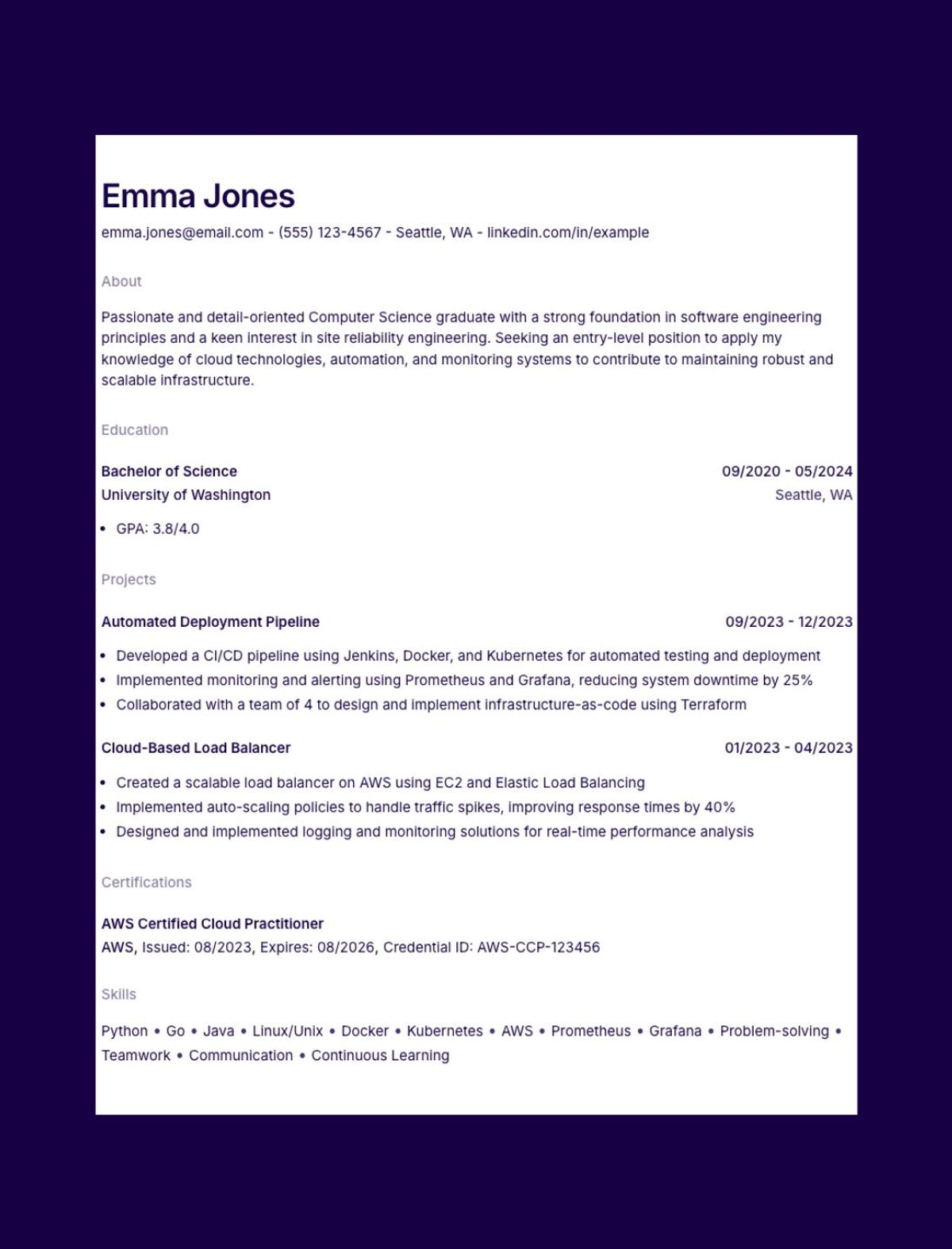
Get More Interviews, Faster
Huntr streamlines your job search. Instantly craft tailored resumes and cover letters, fill out application forms with a single click, effortlessly keep your job hunt organized, and much more...
AI Resume Builder
Beautiful, perfectly job-tailored resumes designed to make you stand out, built 10x faster with the power of AI.
Next-Generation Job Tailored Resumes
Huntr provides the most advanced job <> resume matching system in the world. Helping you match not only keywords, but responsibilities and qualifications from a job, into your resume.
Job Keyword Extractor + Resume AI Integration
Huntr extracts keywords from job descriptions and helps you integrate them into your resume using the power of AI.
Application Autofill
Save hours of mindless form filling. Use our chrome extension to fill application forms with a single click.
Job Tracker
Move beyond basic, bare-bones job trackers. Elevate your search with Huntr's all-in-one, feature-rich management platform.
AI Cover Letters
Perfectly tailored cover letters, in seconds! Our cover letter generator blends your unique background with the job's specific requirements, resulting in unique, standout cover letters.
Resume Checker
Huntr checks your resume for spelling, length, impactful use of metrics, repetition and more, ensuring your resume gets noticed by employers.
Gorgeous Resume Templates
Stand out with one of 7 designer-grade templates. Whether you're a creative spirit or a corporate professional, our range of templates caters to every career aspiration.
Personal Job Search CRM
The ultimate companion for managing your professional job-search contacts and organizing your job search outreach.
Huntr
Blog Product Updates Resume Skill Guides Resume Examples Interview Question Guides Research 2025 Job Search Trends Report Affiliate Program Careers Privacy policy Terms of service Write for us LinkedIn Reddit r/HuntrCo Twitter @TryHuntr Email UsProduct
Job Tracker AI Resume Builder Resume Tailor Resume Checker AI Cover Letters Resume Summary Generator Resume Bullet Generator Resume Skills Generator Resume Headline Generator Resume Keyword Scanner Job Keyword Finder Targeted Resume Contact Tracker Interview Tracker Job Search Metrics Job Application Autofill Resume Storage AI Resume Review Job Clipper Resume Optimization ChatGPT Resume Builder Resume Fixer LinkedIn Resume Builder AI Resume Rewriter Interview Question Generator