
The Conundrum of Soft Skills
Adaptability. Communication. Collaboration. Leadership. Problem solving. Teamwork.
Sound familiar?
Chances are you’ve seen a smattering of these soft skills as requirements for job postings across all industries and job levels.
And I bet you a cup of coffee, or whatever your beverage of choice is, that you faithfully copied these soft skills verbatim on your resume in a skills or professional summary section with the hopes that your resume captures the hearts and minds of the hiring team. That your candidacy is THE one for the talent they seek.
Speak to a recruiter and they will likely scoff at your laundry list of soft skills, because frankly, they will have a hard time believing you. Without the evidence to support your chameleon-like adaptability or problem-solving wizardry, it’s all hogwash. It’s…wait for it…keyword stuffing.
But the job posting lists it as a requirement you say. That it’s the recruiting team’s fault. After all, they are the ones that put it into job posting in the first place.
So, what’s a job seeker to do?
How do you strike the right balance between sounding authentic to the hiring team (humans) while showing up as a relevant, strong match against the job posting that is stored in the applicant tracking system (ATS)?
Evidence Satisfies Both the Human and the Machine
Let’s pretend you are preparing your case as the ideal job candidate before a trial jury of skeptics, AKA the hiring team: hiring manager, talent acquisition team, key internal stakeholders.
Your prima facie evidence that will move you forward in the hiring process is said resume.
If you list soft skills in a summary or skills section, they are not going to believe you.
If you cite that you are a “great communicator” or “strong leader” in your work bullets, they are not going to believe you.
Plus, many modern ATS platforms use artificial intelligence to search for semantic meaning and context. That means a soft skill listed on its own, without context, may weaken your match for the job requirements.
Show Me. Don’t Tell Me.
But if you were to tell them what you did, how you did it, contextualizing the scope and impact of your soft skills, then you give them reason to pause.
Use metrics, like team sizes, budgets or project scope, to support the soft skill.
Showcase how your soft skills led to an outcome or achievement. Tell the story of how you made things better. Bring your leadership skills to life like: “Shepherded organization through multiple reorganizations through calm leadership style, securing strong 360° feedback from executives, managers and direct reports.”
Instead of “using strong communication skills”, say: “Trusted by C-suite leadership to mediate high-conflict employee relations cases, using clear, calm communication that resolved disputes and avoided costly litigations.”
Notice how much more credible the soft skill becomes when you pair third-party evidence with it, as in strong performance metrics, client testimonials, or senior leadership endorsements.
Before you list communication as a stand-alone soft skill, consider:
- Did you negotiate high-stakes client meetings, upselling product offerings by 25% within one quarter? (negotiation and persuasion)
- Delivered company presentation reaching 100+ staff at town hall meeting? (public speaking)
- Published thought leadership article in a peer-reviewed journal with 5K+ subscribers? (technical writing)
How the Machine Reads Your Resume
While traditional ATS relied on rigid keyword search strings, like Boolean searches, (e.g., sales manager AND SaaS), some modern ATS platforms use artificial intelligence and Natural Language Processing (NLP) to understand what a recruiter intends to find (e.g., sales manager that has at least 5 years’ experience selling SaaS in small- to mid-sized companies.)
This is good news for job seekers.
You can stop playing keyword bingo. Many modern ATS platforms look for what your experience means, not whether you parrot every word in the job posting.
That being said, recruiters don’t necessarily use semantic search and many still rely on classic keywords to source candidates.
Interview Rates Spike With Balanced Keyword Coverage
Speaking of evidence, I turned to the data-sleuthing superpowers of Huntr for more answers.
The team at Huntr looked at 119,351 tailored resumes that job seekers used to apply for a specific job between January 2024 and November 2026. They checked where 12 of the usual suspects showed up: communication, leadership, collaboration, teamwork, problem solving, adaptability, critical thinking, time management, attention to detail, interpersonal skills, creativity and emotional intelligence.
Did they appear in the skills section only, in work accomplishment bullets only, in both, or nowhere at all?
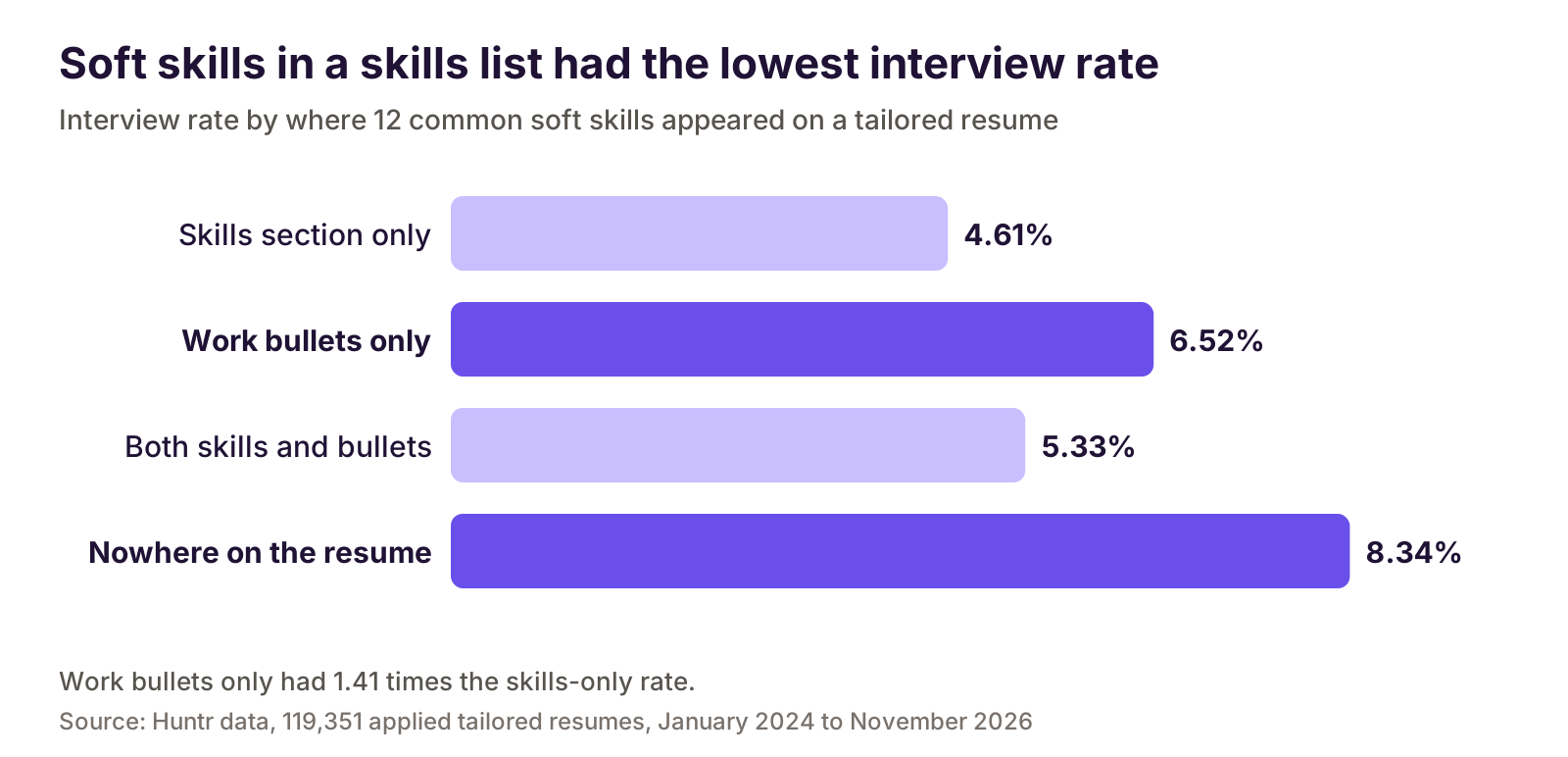
Here’s what nearly three years of data showed. When soft skills were listed in:
- Skills section only: 4.61% landed an interview
- Work bullets only: 6.52% landed an interview, 1.41 times the skills-only rate
- Both the skills section and work bullets: 5.33% landed an interview
- Nowhere on the resume: 8.34% landed an interview
A few surprises emerged.
First, resumes that never named these soft skills at all had the highest interview rate of any group. That doesn’t mean soft skills don’t matter. It suggests the strongest resumes show soft skills through results instead of naming them.
Second, adding a number to a bullet with a soft skill helped only a little: 5.84% with a number vs. 5.51% without. Putting the skill in context seems to matter more than the metric alone.
Third, matching the job posting’s soft skills word for word made almost no difference. Whether a resume covered under 20% or 60 to 79% of the soft skills named in the posting, interview rates stayed between 5.74% and 5.78%. At 80% or more, they dipped to 5.50%.
Keywords as a whole told a different story.
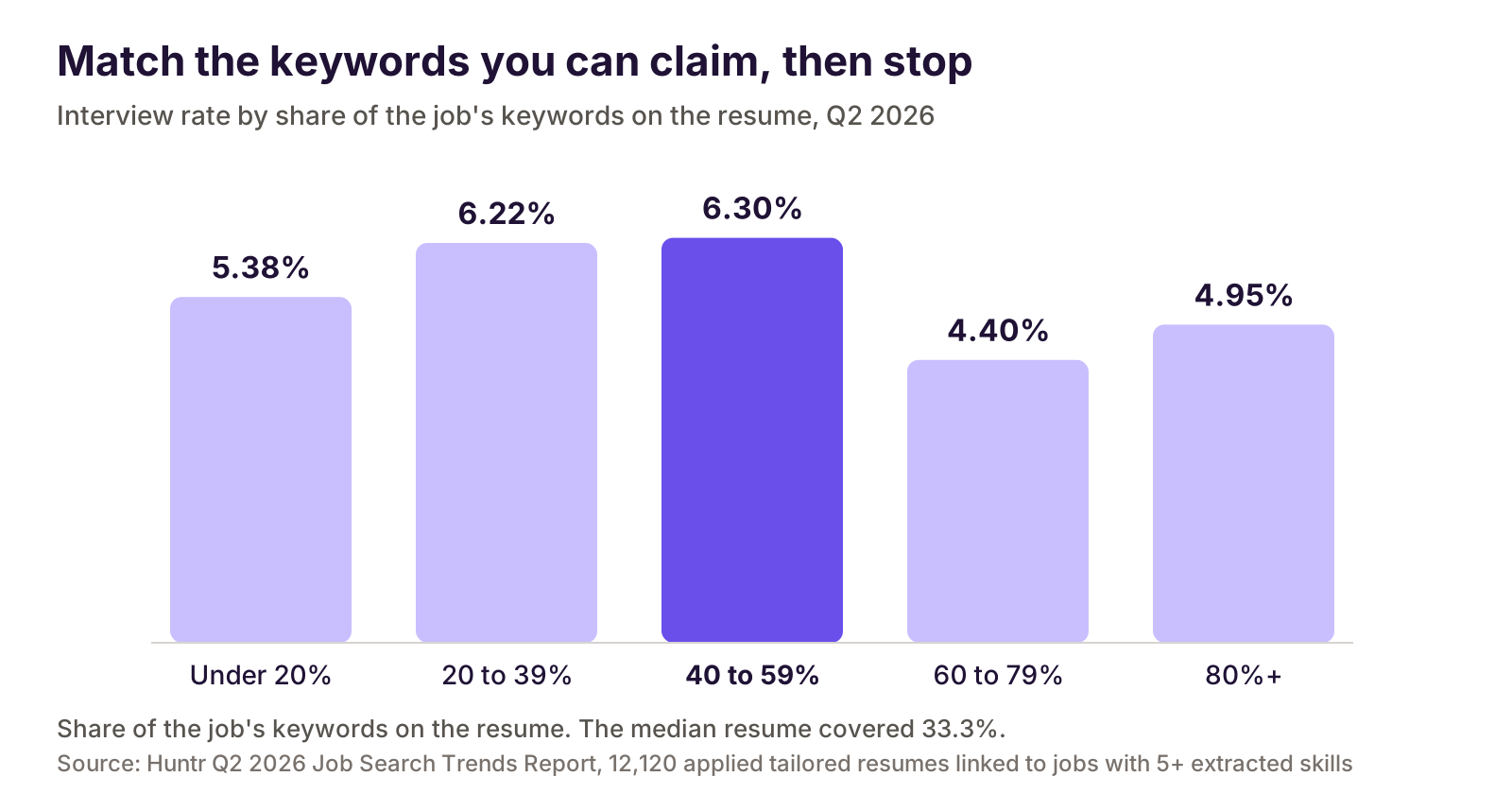
In Huntr’s Q2 2026 Job Search Trends Report, interview rates peaked at 6.30% for resumes that covered 40 to 59% of the keywords extracted from the job posting. Past that point, more keywords didn’t help: rates fell to 4.40% at 60 to 79% coverage and 4.95% at 80% or more. Looking only at the posting’s tools, methods and industry skills from 2024 to 2026, the peak sat in the same place: 5.98% at 40 to 59% coverage. Or to put it another way, overusing keywords is associated with fewer interviews, not more. (These are patterns in Huntr’s data, not proof of cause. The groups also differ in other ways, like job type.)
Present a Compelling Case to Win
- As Cleobulus of Lindos, one of the Seven Sages of ancient Greece, said: “μέτρον ἄριστον,” or “moderation is best.” Huntr’s research showed that the middle of the curve reaped the greatest interview outcomes. Weave in roughly half of the job posting’s keywords, the ones you can honestly claim, across your professional summary, skills section, and bullets, drawing from the job posting as your source of truth.
- For soft skills, let your bullets do the talking. Turn any soft skill into an evidence-backed bullet using defensible scope and impact language. Highlight project numbers, team, or budget sizes. Demonstrate how you raised or saved money, reduced cost/resource utilization, or streamlined workflows.
- Incorporate social proof to make your content believable. Whether that means sharing the size of the applicant pool for the award you snagged (e.g., top 5 out of 200 candidates), leadership or peer recognition, or word-for-word snippets pulled from a performance review or client testimonial, find creative ways to win the hiring team over.
- Here’s an accomplishment bullet framework that works:
Accomplished X by doing Y using soft skill Z.
“Eliminated manual re-entry by redesigning client intake form, saving 20 hours per week for a 3-member team that earned accolades from the IT director for ‘tenacious problem solving.’”
- If you don’t have impressive metrics, don’t fret. Focus on answering how you influenced a hesitant team member, improved team dynamics by introducing weekly check-ins, or were quick on your feet to resolve a sticky client problem.
Show me, don’t tell me and rest your case.

Emily Christakis
Emily Christakis is a Nationally Certified Résumé Writer (NCRW) and career coach based in New York City. A former recruiter, she sourced recent college grads and early career talent for global organizations in telecom and financial services, as well as leading organizational development for a large nonprofit. Today she helps job seekers find their career story through resume writing, LinkedIn profiles, interview coaching and job search strategy. She regularly contracts with college career centers to help students flourish in their professional journeys. Learn more at linkedin.com/in/emilychristakis/.
Get More Interviews, Faster
Huntr streamlines your job search. Instantly craft tailored resumes and cover letters, fill out application forms with a single click, effortlessly keep your job hunt organized, and much more...
AI Resume Builder
Beautiful, perfectly job-tailored resumes designed to make you stand out, built 10x faster with the power of AI.
Next-Generation Job Tailored Resumes
Huntr provides the most advanced job <> resume matching system in the world. Helping you match not only keywords, but responsibilities and qualifications from a job, into your resume.
Job Keyword Extractor + Resume AI Integration
Huntr extracts keywords from job descriptions and helps you integrate them into your resume using the power of AI.
Application Autofill
Save hours of mindless form filling. Use our chrome extension to fill application forms with a single click.
Job Tracker
Move beyond basic, bare-bones job trackers. Elevate your search with Huntr's all-in-one, feature-rich management platform.
AI Cover Letters
Perfectly tailored cover letters, in seconds! Our cover letter generator blends your unique background with the job's specific requirements, resulting in unique, standout cover letters.
Resume Checker
Huntr checks your resume for spelling, length, impactful use of metrics, repetition and more, ensuring your resume gets noticed by employers.
Gorgeous Resume Templates
Stand out with one of 7 designer-grade templates. Whether you're a creative spirit or a corporate professional, our range of templates caters to every career aspiration.
Personal Job Search CRM
The ultimate companion for managing your professional job-search contacts and organizing your job search outreach.
Huntr
Blog Product Updates Resume Skill Guides Resume Examples Interview Question Guides Research 2025 Job Search Trends Report Affiliate Program Careers Privacy policy Terms of service Write for us LinkedIn Reddit r/HuntrCo Twitter @TryHuntr Email UsProduct
Job Tracker AI Resume Builder Resume Tailor Resume Checker AI Cover Letters Resume Summary Generator Resume Bullet Generator Resume Skills Generator Resume Headline Generator Resume Keyword Scanner Job Keyword Finder Targeted Resume Contact Tracker Interview Tracker Job Search Metrics Job Application Autofill Resume Storage AI Resume Review Job Clipper Resume Optimization ChatGPT Resume Builder Resume Fixer LinkedIn Resume Builder AI Resume Rewriter Interview Question Generator