

AI resume builders are everywhere, but most job seekers are still trying to solve the same two problems: getting past applicant tracking systems and staying consistent through a fast-moving job search process. Huntr and Rezi are two of the most popular options because they take different approaches. One leans into structure and ATS optimization, while the other focuses on workflow, speed, and managing applications at scale. This guide breaks down Huntr vs. Rezi based on hands-on testing so you can pick the resume builder that matches how you actually apply.
Quick Verdict
Huntr vs. Rezi comes down to how you apply. Rezi can be a solid choice if you are perfecting one ATS-optimized resume for a specific role. But for most job seekers applying across multiple roles, Huntr is the better system because it combines resume tailoring with job tracking, autofill, and repeatable execution in one place.
Rezi gives structured ATS guidance through resume scoring and keyword targeting, which helps when you are tightening a single resume against a specific job description. Huntr performs better when the job application process becomes repetitive and fast-paced, because it supports the full loop from tailoring to applying to tracking pipeline stages, contacts, and notes without forcing you into a stop-and-start workflow.
Best for ATS scoring signals on one resume: Rezi. Best for executing a real search at scale: Huntr. If you are managing multiple resumes across different job titles and want a workflow that keeps you moving, Huntr is the safer default.
How We’re Comparing Huntr and Rezi (40+ Tools Tested)
This comparison is grounded in a broader dataset created by signing up for and testing over 40 AI resume builders. Each tool was tested end-to-end with the same approach: import an existing resume, generate or rewrite content, run a job description match, then export PDF and DOCX to check formatting and editability. We also logged friction points such as confusing navigation, time delays, and editing constraints.
Every tool was scored using a weighted rubric that reflects how real job seekers use resume software. The rubric covered editor usability, AI writing quality, tailoring and matching, access and trust factors like free plan limits and exports, and job search tools like trackers and browser extensions. Within that dataset, Huntr outperformed Rezi, scoring 90.77 out of 100, while Rezi scored 78.8 out of 100, largely because it supports the full application workflow instead of stopping at resume optimization.
What Is Huntr?
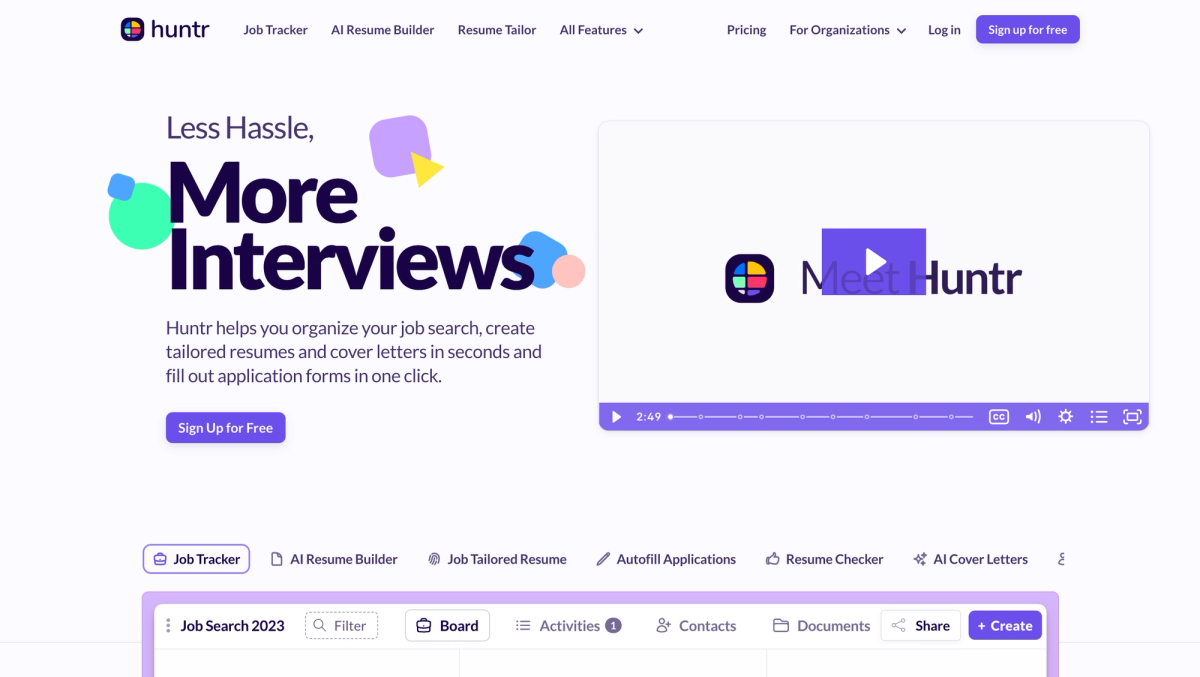
Huntr is a job search management platform that includes an AI resume builder plus tools to track and streamline applications. At the resume level, it supports the reality of active job searches: creating a strong base resume and then tailoring it repeatedly for different roles, including cover letters tied to specific job descriptions. The editor offers deeper customization than most builders, and exports are accessible, which matters when final edits need to happen outside the platform.
Huntr’s strengths are practical: strong resume imports, modern templates, flexible formatting controls, and contextual AI rewriting that often preserves intent while improving clarity. The AI can still overshoot with overly specific brand names or metrics, and generation speed can be slower than some tools, but the workflow benefits are clear. Huntr is not just a resume builder. It is closer to an application operating system for job seekers, which is why it holds up better when you need consistency across multiple resumes and job applications.
What Is Rezi?
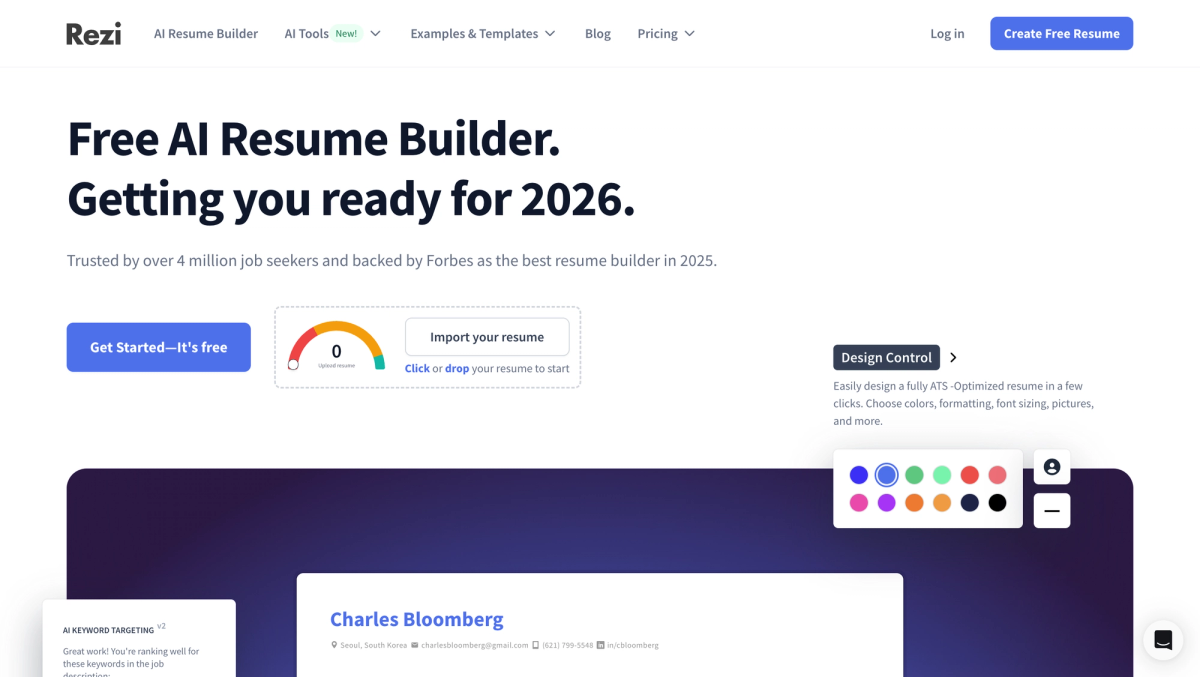
Rezi is an AI-powered resume and career document builder that helps job seekers generate ATS-optimized resumes and related materials, including cover letters. In practice, it is built around ATS compliance: structured resume templates, keyword targeting, and a scoring system that flags gaps against specific job descriptions. It provides clear guardrails, which can be useful when you are refining one resume for a narrow target and want your formatting and keyword coverage to stay consistent.
The tradeoffs show up once you move beyond that use case. The interface can feel rigid, and the workflow has friction around navigation and inputs. The AI is helpful for summaries, skills exploration, and rewrites, but bullet generation can drift into generic phrasing or assumptions if the user does not provide enough detail. Pricing is also a differentiator, including a lifetime option for users who mainly want long-term access to resume tools rather than a broader job search workflow.
Resume Writing Quality
AI Bullet Point Generation Compared
Rezi’s bullet point generation is primarily keyword-driven. It pulls language directly from job descriptions and reshapes resume bullet points to reflect those terms. This works well for matching a specific job title, but the output can feel rigid and occasionally disconnected from the actual scope of work. It can also push users toward coverage-first writing, where the resume sounds aligned but reads less like the person who did the work.
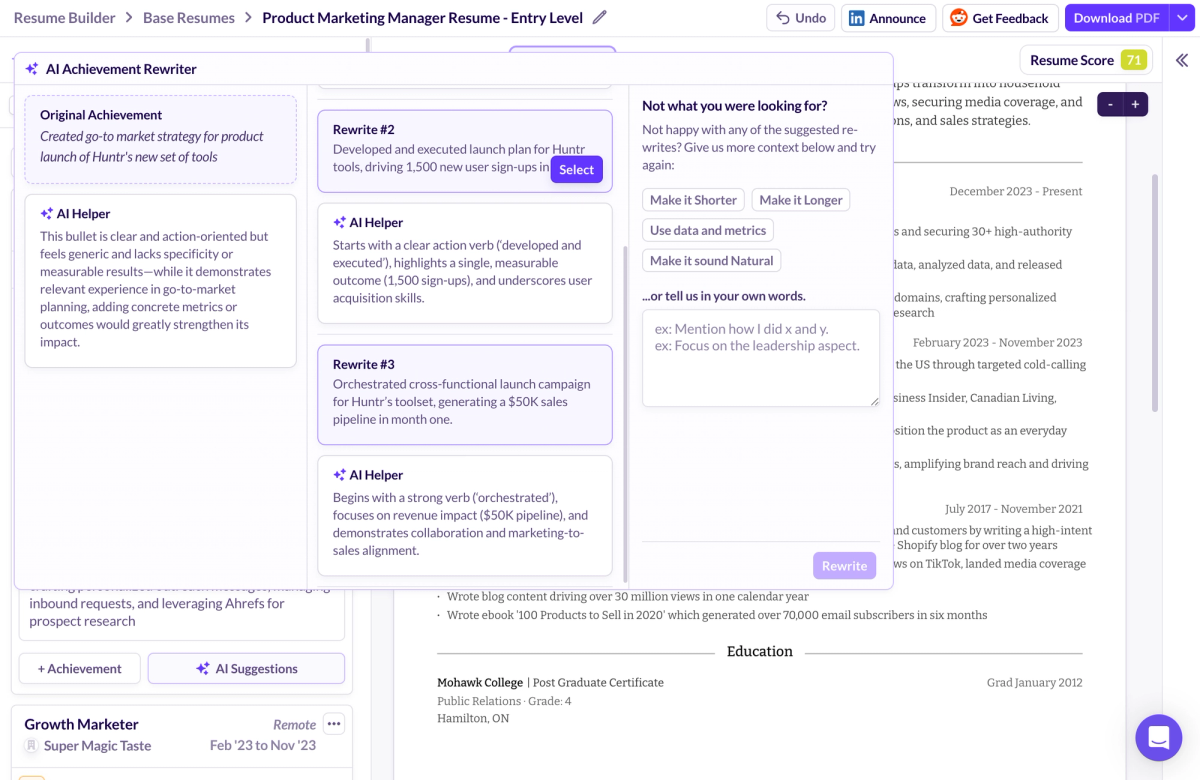
Huntr’s approach focuses more on translating transferable skills across different job titles. The AI assistance rewrites existing bullet points with contextual framing rather than replacing them outright. This tends to preserve meaning better, and it is easier to iterate without turning the resume into a keyword list. It can still introduce overly specific claims or metrics, but the editing is usually about tightening and verifying details rather than rebuilding the entire bullet.
Resume Summaries and Role Context
Rezi produces structured summaries that align well with common ATS expectations. The tone is consistent, which helps when you want something clean and conventional. The downside is that the summaries can start to feel templated across versions, especially when you are trying to reposition yourself across roles.
Huntr offers more flexibility in how summaries are written. The AI-generated summaries can adapt to role context, and they are easier to tweak across job titles without rewriting from scratch. That flexibility matters for career switchers and high-volume applicants because summaries become a versioning problem, not a one-time writing task.
Output Snapshot: What Each Tool Got Wrong and Right
In practice, both tools make mistakes that matter. Rezi occasionally introduces tools, platforms, or experiences that were never part of the user’s resume, especially when it is trying to satisfy keyword alignment. Huntr’s errors tend to show up in specificity, where it can suggest a metric or branded tool that needs verification. The difference is what happens next: Huntr generally makes it easier to correct and reuse content across versions, while Rezi’s structure can make iterative editing feel slower.
ATS Optimization: Which Tool Actually Helps You Pass?
Keyword Targeting and Job Description Matching
Rezi is built around matching job descriptions. It actively surfaces missing keywords from specific job descriptions and encourages users to add them to the resume. That helps when your main goal is improving ATS-facing signals for a single posting, but it can also push resumes toward repetitive language if the keyword layer takes over the writing, making resumes read less naturally and increasing factual risk if you accept suggestions without heavy editing.
Huntr also supports job description matching, but it places more emphasis on context. Keywords are suggested within role-relevant rewrites rather than inserted as isolated terms, which makes it easier to keep the resume readable. If you care about passing screening and still sounding credible to a recruiter, that balance is the more sustainable approach.
Keyword Match vs Qualification Match
Matching keywords is different from matching requirements. Rezi’s resume score and match experience tend to reward keyword coverage, which can be useful, but it can also mislead users into chasing terms that do not reflect their actual background.
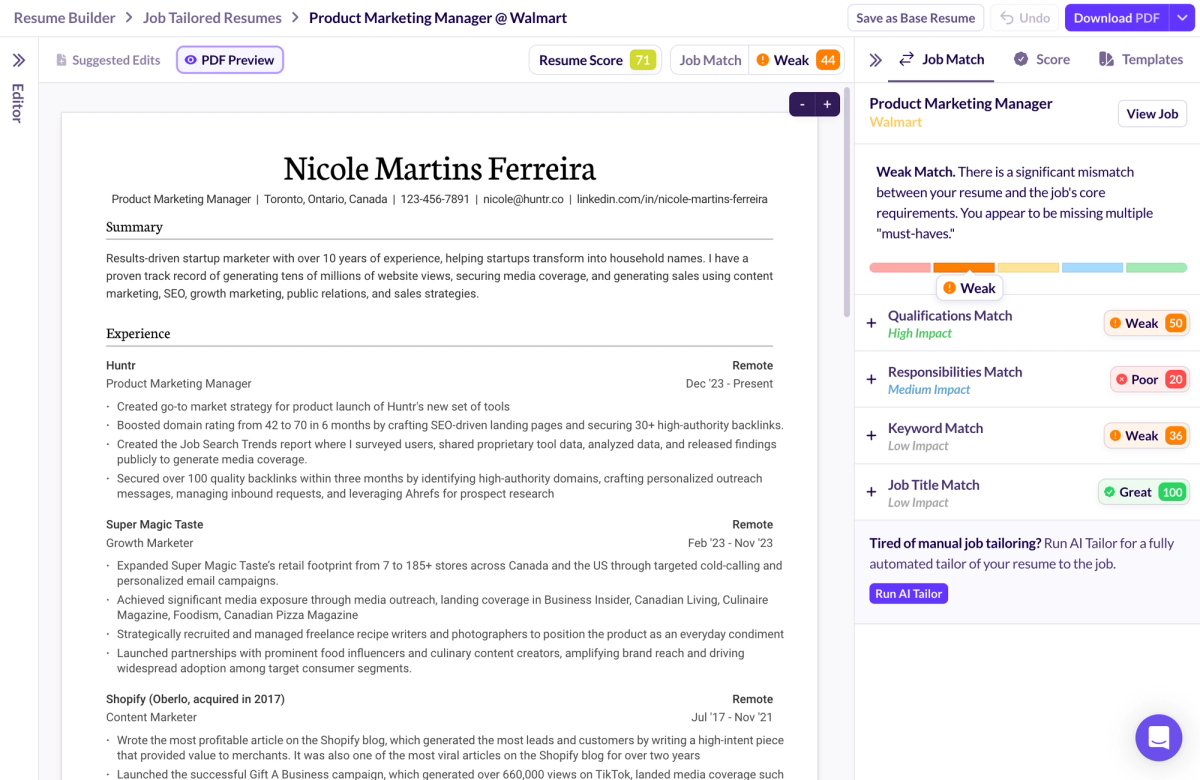
Huntr’s matching is closer to a qualification check because it looks at responsibilities and role fit alongside keywords. That is the smarter signal to follow because it reduces the risk of a resume that passes filters but collapses under human review.
Formatting and Parsing Reliability
Formatting plays a quiet but critical role in ATS performance. Rezi uses structured templates with limited design customization, which helps keep resumes clean and consistent. Huntr offers ATS-friendly templates with more control over spacing, sections, and formatting, and exports generally hold up well in PDF and DOCX formats. The practical difference is that Huntr gives you more room to tailor without breaking the layout, while Rezi keeps you inside a narrower lane.
Workflow: Resume → Apply → Track
Importing and Setup
Rezi supports imports from LinkedIn, PDF, and DOCX, but the process can feel rigid. Import accuracy is generally acceptable, though users often need to clean up spacing, dates, and role ordering after import. Adding multiple roles requires moving through defined steps, which slows the resume-building process for job seekers with longer work histories.
Huntr also allows imports from LinkedIn, PDF, and Microsoft Word formats, with a smoother initial setup. Importing an existing resume usually preserves structure and reduces cleanup time. That difference shows up fast when you are trying to tailor quickly, because the baseline is cleaner and easier to iterate on.
Customization and Iteration
Rezi keeps formatting consistent, but editing can feel constrained when you want to reorder sections or adjust layout decisions. Huntr offers broader customization across templates, with more control over spacing and structure. That flexibility supports tailoring without turning each version into a separate formatting project.
The Execution Gap (Where Most Tools Break)
Finishing a resume is only part of the job application process.
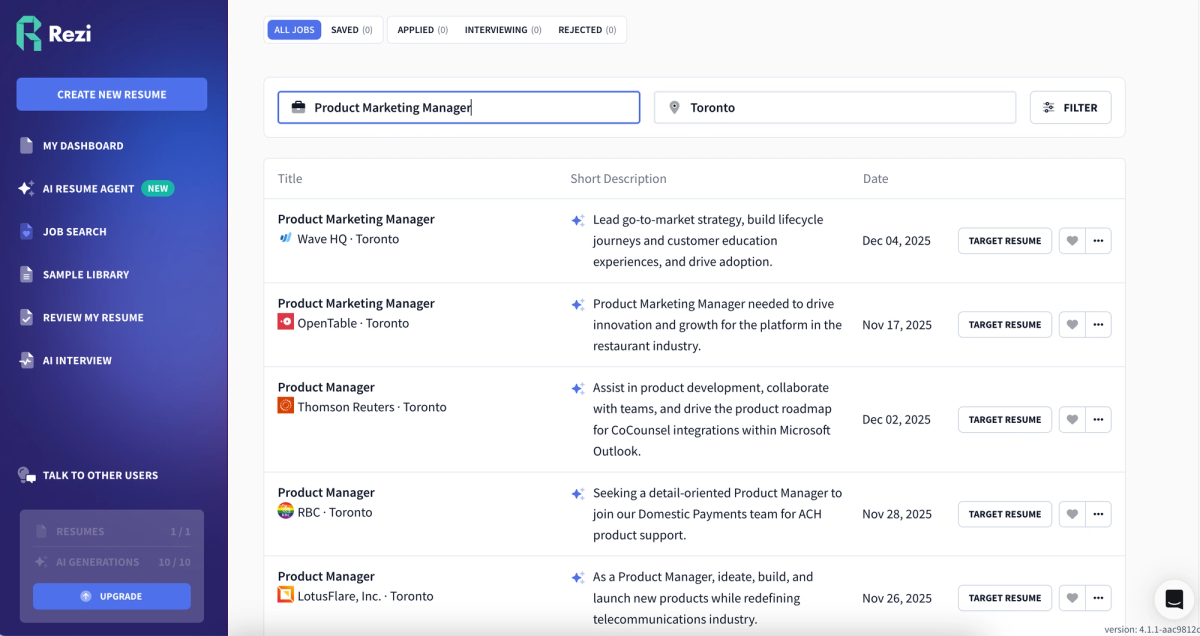
Rezi does offer supporting job search tools, including a job tracker, a Chrome extension, and a job match score. In practice, those features feel secondary to the resume editor, and the match experience leans heavily toward keyword alignment. For a smaller number of applications, that may be enough, but it does not reduce coordination work when you are juggling multiple roles.
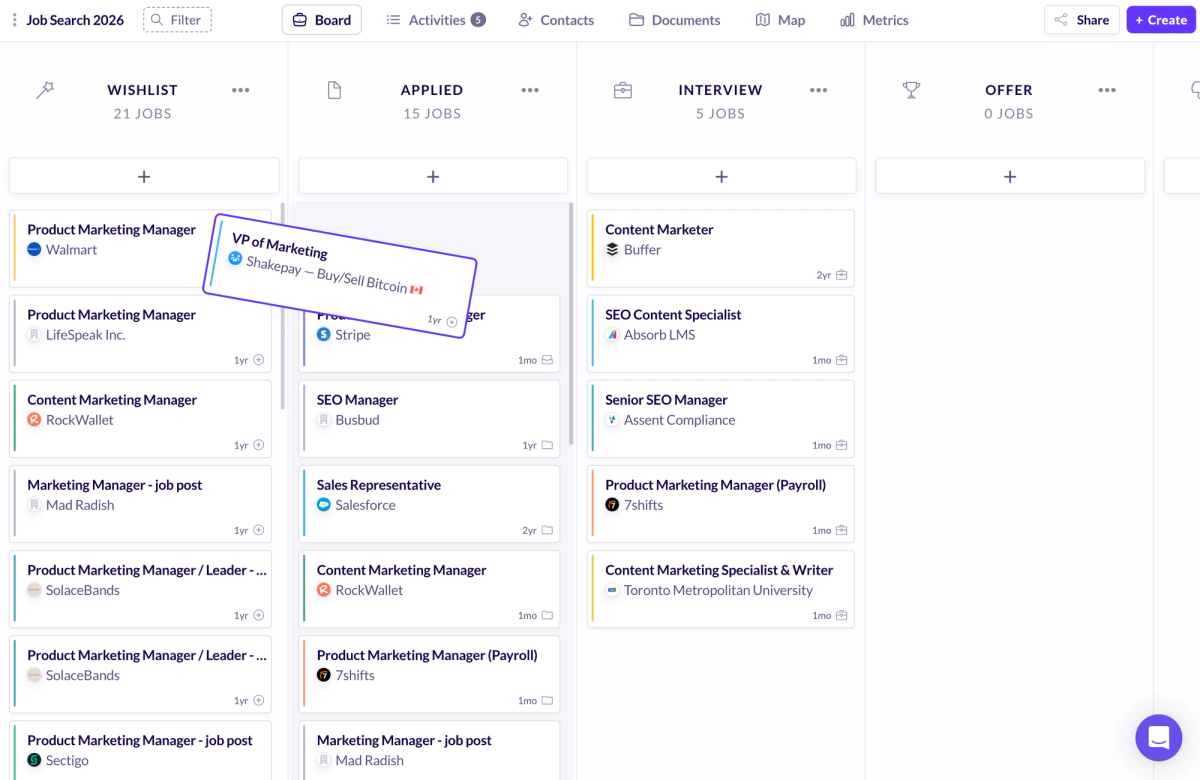
Huntr is built around execution. It combines tailored resumes, job tracking, autofill, and pipeline management (including notes and contacts) in one workflow, so the resume stays connected to the application it was written for. That reduces versioning mistakes and makes it easier to sustain volume without losing control.
Pricing and Value for Money
Rezi Pricing Breakdown
Rezi has a free plan plus two main paid options: a Pro subscription and a one-time Lifetime plan, both covered by a 30-day money-back guarantee. The free plan is $0 per month and lets you create one resume with limited AI access, plus up to three PDF downloads. It also includes unlimited cover and resignation letters, which is useful if you mainly want to test the platform.
The constraints show up quickly once you start tailoring. Keyword targeting depth, higher-value scoring feedback, and unlimited exports sit behind the paywall, which can make active job searches feel stop-and-start. Rezi’s Pro plan is $29 per month and unlocks unlimited resumes, AI tools, and downloads, plus access to a human resume review option. The Lifetime plan is $149 one-time and provides ongoing access to most core Pro features, though subscription perks can differ.
Huntr Pricing Breakdown
Huntr uses a freemium model with a free Basic plan and a paid Pro subscription. The free plan is $0 per month and includes unlimited base resumes, basic resume and job matching, basic resume scoring, a job tracker with limits, contact management, application autofill, and up to around 100 document uploads. It is one of the few options where the free version can support a real job search, because you can build, export, and track without hitting immediate walls.
Huntr’s Pro plan expands those tools into a true scale workflow. It unlocks unlimited AI resume generations, AI-tailored resumes, unlimited AI cover letters, advanced job matching and resume scoring, deeper job insights, unlimited job tracking, unlimited document uploads, and unlimited AI review and tailor actions. Month-to-month pricing is commonly listed at around $40 per month, with discounted multi-month options reducing the effective monthly cost.
Quick Trust Checks To Consider Before You Pay
Before entering payment details, confirm download limits, whether files remain accessible after cancellation, and what renewal terms look like. In our testing, Rezi’s pricing is relatively clear and includes a lifetime option. Huntr’s free plan avoids most download traps by allowing exports upfront.
Also, note that some resume builders operate multiple sites that share the same underlying product, Rezi being one of them. This can confuse comparisons, since clones often differ mainly in branding and pricing.
Pros and Cons of Using Huntr vs Rezi
Rezi Pros and Cons
Rezi’s strongest advantage is structured ATS guidance when you are tightening one resume for one target. Resume scoring and keyword checks can help you spot gaps quickly. Pricing options also stand out, especially the lifetime plan for users who mainly want ongoing access to resume tools.
The tradeoffs appear in speed and flexibility. AI suggestions can drift into generic or assumption-heavy content, particularly when chasing keywords. The workflow can also feel slower once you start tailoring across roles, which is where many job seekers lose momentum.
Huntr Pros and Cons
Huntr excels in customization and execution. It supports fast iteration across applications, keeps tailored resumes organized, and reduces the overhead of tracking and workflow management. The system approach is what makes it stronger in real-world searches, where volume and consistency usually matter more than perfecting a single document.
The limitations are mainly about refinement. AI suggestions can be overly specific and need verification, and some generation steps can take longer than instant-output tools. Those issues are manageable, and they tend to be outweighed by the time saved across applications.
Huntr vs. Rezi: Which One Is Right for You?
Choose Huntr If…
Huntr is the better fit for most job seekers because most job searches are messy. If you are applying to many roles, managing multiple tailored resumes, and trying to stay consistent across applications, Huntr gives you the workflow to keep moving. It is also the stronger option if you want job tracking, autofill, and organization built in rather than stitched together with spreadsheets.
Choose Rezi If…
Rezi fits best when you are optimizing one primary resume for a narrow target and you want structured scoring and keyword checks to guide edits. If your search is small, focused, and you mainly want resume polish inside a guided editor, Rezi can be a practical choice.
Conclusion
If you are optimizing a single resume for a single job, Rezi can be a solid fit. But for most job seekers, Huntr vs. Rezi is less about polish and more about execution. Huntr is the stronger pick because it combines ATS-friendly resumes with job tracking, autofill, and repeatable tailoring across multiple job titles without losing organization. If you want the best resume builder for applying at scale, create a free Huntr account and run your next few applications through it.
FAQs: Huntr vs Rezi
Is Huntr better than Rezi for ATS?
Rezi provides structured ATS scoring and keyword checks, which can be useful when optimizing a resume for a specific job description. Huntr supports ATS-friendly resumes too, but it is often the better long-term strategy because it balances keywords with qualification match signals and keeps the resume readable for human review.
Can Huntr replace spreadsheets for job tracking?
Yes. Huntr includes built-in job tracking that can replace manual spreadsheets and keeps applications, notes, contacts, and pipeline stages in one place. That matters most when you are applying at volume and want the resume tied to the application record.
Which tool is better for career switchers?
Huntr tends to work better for career switchers because it supports tailoring across different roles and job titles without forcing you to rebuild each version. Rezi works best when you are targeting a narrow role and want structured keyword guidance.
Can you use Huntr or Rezi for free?
Both tools offer free plans. Huntr’s free plan is more usable for real job searches because it supports exports, basic matching, and job tracking. Rezi’s free plan is better for testing the editor and polishing one resume, but it hits limits faster once you start tailoring.
Do recruiters detect AI-written resumes?
Recruiters do not detect AI usage directly, but they notice generic language, inaccuracies, and over-optimized content. The safest approach is to treat AI as a drafting tool, then edit until the resume reads like a credible human wrote it.
Which tool helps you get more interviews?
That depends on how you apply. Rezi can help tighten a single resume for ATS scoring signals. Huntr tends to win in real searches because it supports higher-quality iteration across more applications, and volume plus consistency usually drives more interview opportunities.

Ashliana Spence
Ashliana is a freelance marketing and growth operations consultant who works with lean teams to improve where and how they show up, communicate, and operate. With a background in integrated marketing communications, she focuses on messaging, content, systems, and processes, turning complex ideas and values into clear narratives and building workflows that help teams move with consistency and intent to support long-term trust-driven growth.
Get More Interviews, Faster
Huntr streamlines your job search. Instantly craft tailored resumes and cover letters, fill out application forms with a single click, effortlessly keep your job hunt organized, and much more...
AI Resume Builder
Beautiful, perfectly job-tailored resumes designed to make you stand out, built 10x faster with the power of AI.
Next-Generation Job Tailored Resumes
Huntr provides the most advanced job <> resume matching system in the world. Helping you match not only keywords, but responsibilities and qualifications from a job, into your resume.
Job Keyword Extractor + Resume AI Integration
Huntr extracts keywords from job descriptions and helps you integrate them into your resume using the power of AI.
Application Autofill
Save hours of mindless form filling. Use our chrome extension to fill application forms with a single click.
Job Tracker
Move beyond basic, bare-bones job trackers. Elevate your search with Huntr's all-in-one, feature-rich management platform.
AI Cover Letters
Perfectly tailored cover letters, in seconds! Our cover letter generator blends your unique background with the job's specific requirements, resulting in unique, standout cover letters.
Resume Checker
Huntr checks your resume for spelling, length, impactful use of metrics, repetition and more, ensuring your resume gets noticed by employers.
Gorgeous Resume Templates
Stand out with one of 7 designer-grade templates. Whether you're a creative spirit or a corporate professional, our range of templates caters to every career aspiration.
Personal Job Search CRM
The ultimate companion for managing your professional job-search contacts and organizing your job search outreach.
Huntr
Blog Product Updates Resume Skill Guides Resume Examples Interview Question Guides Research 2025 Job Search Trends Report Affiliate Program Careers Privacy policy Terms of service Write for us LinkedIn Reddit r/HuntrCo Twitter @TryHuntr Email UsProduct
Job Tracker AI Resume Builder Resume Tailor Resume Checker AI Cover Letters Resume Summary Generator Resume Bullet Generator Resume Skills Generator Resume Headline Generator Resume Keyword Scanner Job Keyword Finder Targeted Resume Contact Tracker Interview Tracker Job Search Metrics Job Application Autofill Resume Storage AI Resume Review Job Clipper Resume Optimization ChatGPT Resume Builder Resume Fixer LinkedIn Resume Builder AI Resume Rewriter Interview Question Generator