
The empty page. It's every job seeker's nightmare.
You've sat down to write your resume. Maybe you were just laid off or let go. Maybe you are looking for something new. Either way, the blank page is scary and makes most people want to do literally anything else.
Regardless of who is doing the actual writing, you or AI, you're aware of the need to be really strategic, right? A make-or-break moment on your resume you might not be thinking about is: How many bullet points should each job on a resume have? I'm going to break down how I make that decision for each and every one of my resume-writing clients. (I'm a certified resume writer and career coach and have helped over 3,000 clients tell their stories.)
The short answer
Aim for 3 to 5 bullet points per job, with the most going to your most recent role. Older roles need fewer bullets, and anything older than 15 years doesn't belong.
Do more bullet points per job get more interviews?
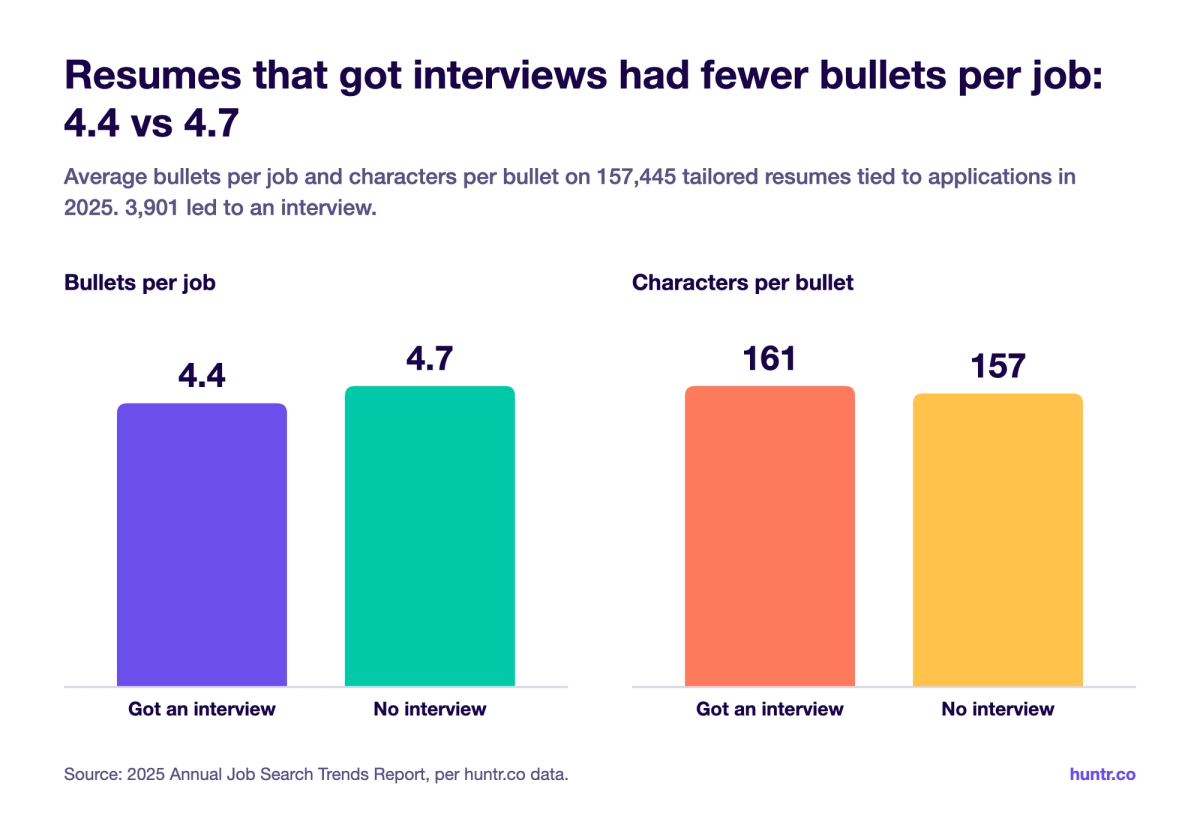
According to Huntr's 2025 Annual Job Search Trends Report, resumes that led to interviews averaged 4.4 bullets per job. Resumes that didn't averaged 4.7. Huntr found the same pattern in Q1, Q2 and Q3 2025: more bullets per job did not mean more interviews.
In other words, there's a sweet spot. Too few bullets and you haven't shown enough depth. Too many, and the recruiter or hiring manager is overwhelmed and their eyes glaze over.
Plus, if you want the numbers: the bullets on those resumes also ran a little longer, 161 characters against 157. Huntr's own writing guidance lands in the same place: 3 to 5 bullets per role, at about 150 to 200 characters each.
Fewer, fuller bullets
In Huntr's 2025 data, resumes that led to interviews averaged 4.4 bullets per job, against 4.7 for resumes that didn't. Their bullets ran a bit longer too: 161 characters against 157.
The question then evolves from "How many bullets should my resume have?" to "How do I choose which bullets earn their place?"
Why you should outline your resume before you write it
The biggest mistake I see people make when writing their own resumes is (by far) going straight to the writing. It's like building IKEA furniture without opening the instructions. Sure, you'll end up with something that vaguely resembles a bookcase, but you'll also have a pile of leftover noodlehagens or a shelf that collapses the first time someone breathes on it.
We've got to outline first.
Skipping this step, the outline, is how people end up with 8+ bullets. Instead, we want to be strategic and intentional with the content.
I was working with a Director of Engineering, and he came to me with over 10 bullets per job. Each was short and described a single facet of his role. But honestly, who cares what he was responsible for?! Putting on my recruiter hat, I explained that none of his bullets showed value. Nothing showed how he aligned with his job target.
How do you choose which resume bullet points to keep?
So we started over and began with his target, not the resume. Here's the process:
- Analyze 3 to 5 job descriptions. Pull postings for the target role and look for what is repeated. This includes both keywords and high-level proficiencies employers keep asking for. For a Director of Engineering, these are things like leading large teams, owning budgets, and product development.
- List the biggest accomplishments from each role. Go position by position, and outline the wins, including challenge, action, and resolution. This is 100% focused away from job duties.
- Map the two. Match each accomplishment to a proficiency from the job descriptions. This map becomes the outline.
Then, we cut. If an accomplishment doesn't relate to the target, cut it. It's out. Recency matters, too. Typically, we'll want to emphasize the most recent role and give it the most bullets, as the freshest demonstration of value. Older roles need fewer bullets, simply to highlight where the alignment is. Anything older than 15 years simply doesn't belong.
Now's where I get to show you my workaround, and break the rule I just laid out. Sub-bullets are a fun way to get around the 3 to 5 bullet limit. Keep the "big bullet" for the accomplishment, then add 1 to 2 sub-bullets only when you need to show extra technical depth. It's an easy pattern to follow: the big bullet is the what (the result), and the sub-bullets are the how (the tools, scope, etc.).
Here's an example:
Before:
- Responsible for managing the engineering team and overseeing releases.
After:
- Led a 40-person engineering organization through a cloud migration, cutting infrastructure costs 30% and shortening release cycles from monthly to weekly.
- Migrated 120 services with zero customer-facing downtime.
- Tech: AWS, Kubernetes, Terraform.
The "before" tells you what he was responsible for. The "after" tells you what he delivered, and it speaks directly to what employers were asking for. Over 10 bullets became 5, and every single one earned its place.
Match your bullets to the job description
Applications with a tailored resume had a 5.71% interview rate in Huntr's Q2 2026 data, vs 3.09% without. Huntr's Resume Tailor rewrites your resume to match each job description, so your bullets line up with what the employer asks for.
How do you know if a resume bullet point is worth keeping?
Once you have your outline, ask yourself the following 4 questions about each potential bullet. If it fails any one of these, cut it or go back to the drawing board.
- Does it show value, not a duty? If the bullet only says what you were responsible for, it isn't done yet. Ask yourself, "So what?" The answer is your bullet.
- Does it connect to the job descriptions? Go back to the keywords and proficiencies you pulled. If a bullet doesn't support at least one of them, it doesn't belong on this resume. (It might belong on a different one, and that's okay.)
- Does it tell a mini story? The strongest bullets show a challenge, the action you took, and the resolution. You don't need all 3 spelled out, but a reader should be able to see them. (I wrote more about why career storytelling works in resumes here.)
- Would a hiring manager miss it? Imagine it's gone. If the resume reads the same without it, you have your answer.
Remember my Director of Engineering? "Responsible for managing the engineering team" fails #1 immediately. The cloud migration bullet passes all 4.
When this test costs you a bullet you love or something you're really proud of, cut it anyway. You aren't losing the actual experience. You're simply choosing to present yourself in the most aligned way possible.
A strong resume is a focused resume.
How many bullet points should each job have, by role?
Another cheat sheet: since 3 to 5 bullets per job is the sweet spot, where you land inside each position depends on the role.
- Your most recent role: Up to 5 bullets. It's your most recent experience and earns the most space.
- Other recent roles: 3 to 5 bullets, depending on how closely they match your target.
- Older roles: Fewer bullets, just enough to show where the alignment is.
- Anything older than 15 years: Cut it.
- Sub-bullets: 1 to 2 under a big bullet, only when you need to show extra technical depth.
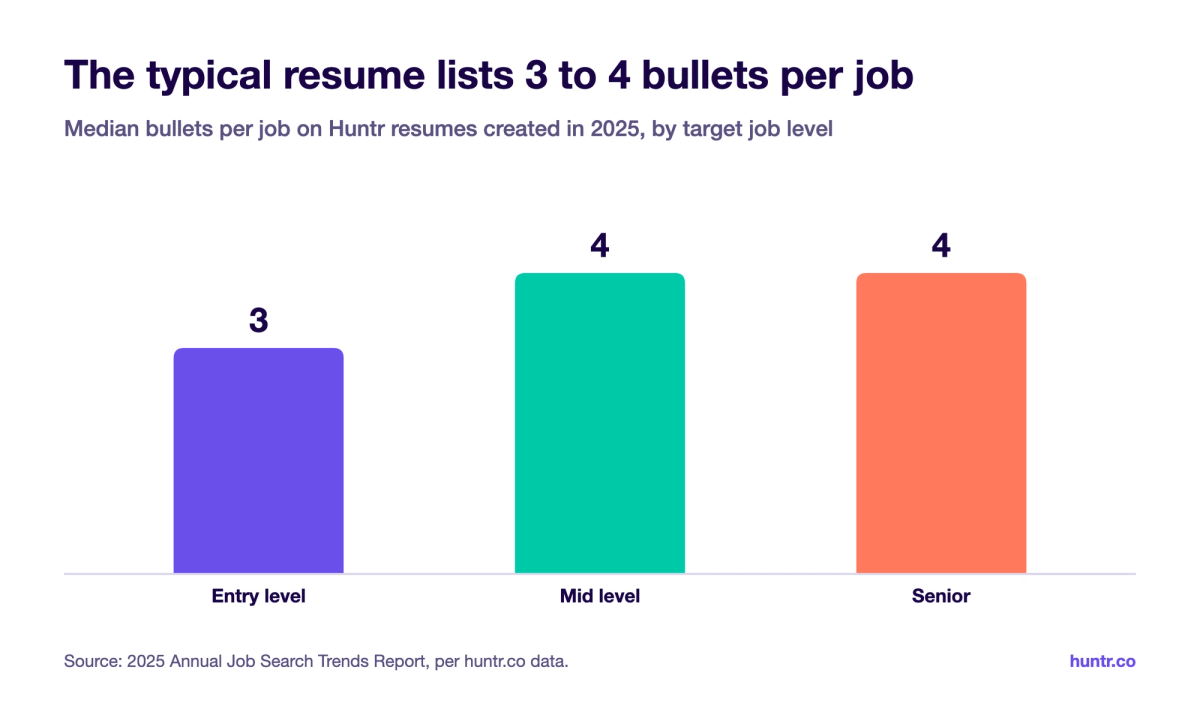
Most Huntr resumes already land in this range. See the full breakdown by level in Huntr's 2025 Annual Job Search Trends Report.
And, above all, remember these are just guidelines. The goal is to make sure every bullet earns its spot.
Resume bullet points per job: FAQ
How many bullet points should your most recent job have?
Up to 5. It's your most recent experience and earns the most space. If you need to show extra technical depth, add 1 to 2 sub-bullets under a big bullet.
How many bullet points should older jobs have?
Fewer bullets, just enough to show where the alignment is with your target. Anything older than 15 years doesn't belong.
Are 6 or more bullet points per job too many?
For most jobs, yes. Even your most recent role tops out at about 5. If you have more, run each bullet through the 4 questions above and cut the ones that fail.
How long should each resume bullet point be?
Huntr's writing guidance is about 150 to 200 characters per bullet. In Huntr's 2025 data, resumes that got interviews averaged 161 characters per bullet. If you're stuck on wording, Huntr's Resume Bullet Point Generator can draft options for you to edit.
So, how many bullet points should each job have?
Aim for 3 to 5 bullet points per job, with the most going to your most recent role. In Huntr's data, resumes that got interviews had slightly fewer bullets per job than resumes that didn't. More bullets didn't mean more interviews.
But the number is only half the story. Outline first, map your biggest wins to what employers are asking for, and cut everything else. Do that, and you won't be staring at the blank page for long.
Want help telling your career story? Find Krista at Virtuoso Resumes & Recruiting or connect with her on LinkedIn.

Krista Morris
Krista Morris, CARW, CCSC, is the founder of Virtuoso Resumes & Recruiting in Gilbert, Arizona, and a 2x TORI award-winning resume writer. She launched Virtuoso Resumes in 2011 after nearly a decade in workforce development, running job centers and teaching job search skills. She has helped over 3,000 professionals, from new grads to C-suite executives, tell their career stories, and her work has been featured on ABC News. Learn more at virtuosoresumes.com or connect at linkedin.com/in/kristamorris.
Get More Interviews, Faster
Huntr streamlines your job search. Instantly craft tailored resumes and cover letters, fill out application forms with a single click, effortlessly keep your job hunt organized, and much more...
AI Resume Builder
Beautiful, perfectly job-tailored resumes designed to make you stand out, built 10x faster with the power of AI.
Next-Generation Job Tailored Resumes
Huntr provides the most advanced job <> resume matching system in the world. Helping you match not only keywords, but responsibilities and qualifications from a job, into your resume.
Job Keyword Extractor + Resume AI Integration
Huntr extracts keywords from job descriptions and helps you integrate them into your resume using the power of AI.
Application Autofill
Save hours of mindless form filling. Use our chrome extension to fill application forms with a single click.
Job Tracker
Move beyond basic, bare-bones job trackers. Elevate your search with Huntr's all-in-one, feature-rich management platform.
AI Cover Letters
Perfectly tailored cover letters, in seconds! Our cover letter generator blends your unique background with the job's specific requirements, resulting in unique, standout cover letters.
Resume Checker
Huntr checks your resume for spelling, length, impactful use of metrics, repetition and more, ensuring your resume gets noticed by employers.
Gorgeous Resume Templates
Stand out with one of 7 designer-grade templates. Whether you're a creative spirit or a corporate professional, our range of templates caters to every career aspiration.
Personal Job Search CRM
The ultimate companion for managing your professional job-search contacts and organizing your job search outreach.
Huntr
Blog Product Updates Resume Skill Guides Resume Examples Interview Question Guides Research 2025 Job Search Trends Report Affiliate Program Careers Privacy policy Terms of service Write for us LinkedIn Reddit r/HuntrCo Twitter @TryHuntr Email UsProduct
Job Tracker AI Resume Builder Resume Tailor Resume Checker AI Cover Letters Resume Summary Generator Resume Bullet Generator Resume Skills Generator Resume Headline Generator Resume Keyword Scanner Job Keyword Finder Targeted Resume Contact Tracker Interview Tracker Job Search Metrics Job Application Autofill Resume Storage AI Resume Review Job Clipper Resume Optimization ChatGPT Resume Builder Resume Fixer LinkedIn Resume Builder AI Resume Rewriter Interview Question Generator