
If you're a senior leader, you've probably heard conflicting advice about resume length.
- The resume should be 1 page.
- The first 10 to 15 years go on the first page, and the rest go on the second page.
- Decades of leadership can't be squeezed onto 1 or 2 pages.
How do you reconcile this?
The short answer
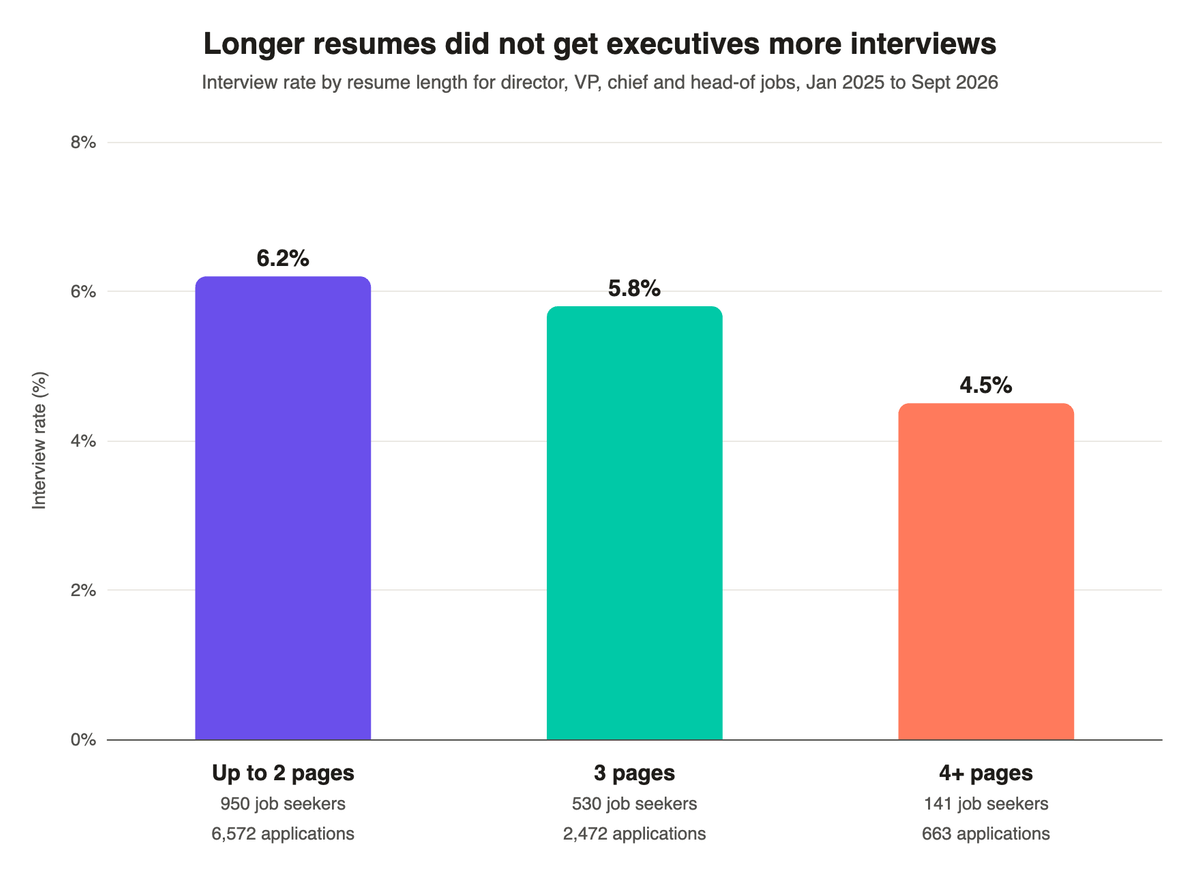
Aim for 2 pages. In Huntr's data on 9,707 applications for director, VP, chief and head-of roles, resumes of up to 2 pages got interviews on 6.2% of applications. Resumes of 4 or more pages got 4.5%.
First, consider where you're getting your information. If you're listening to influencers on social media and in journalism who have strong opinions and clear instructions but don't know anything about hiring, stop. I call them false prophets. Start talking to people who have actually worked in hiring.
Look at the false prophets' bios. They are usually frustrated job seekers who have never sat on the hiring side of the desk. They have zero experience in what they're advising.
What the Data Shows
Next, let's look at the facts.
Huntr looked at 9,707 applications that 1,354 job seekers sent for director, VP, chief and head-of roles between January 2025 and September 2026. Resumes of up to 2 pages earned interviews on 6.2% of applications. Resumes of 4 or more pages earned interviews on 4.5%.
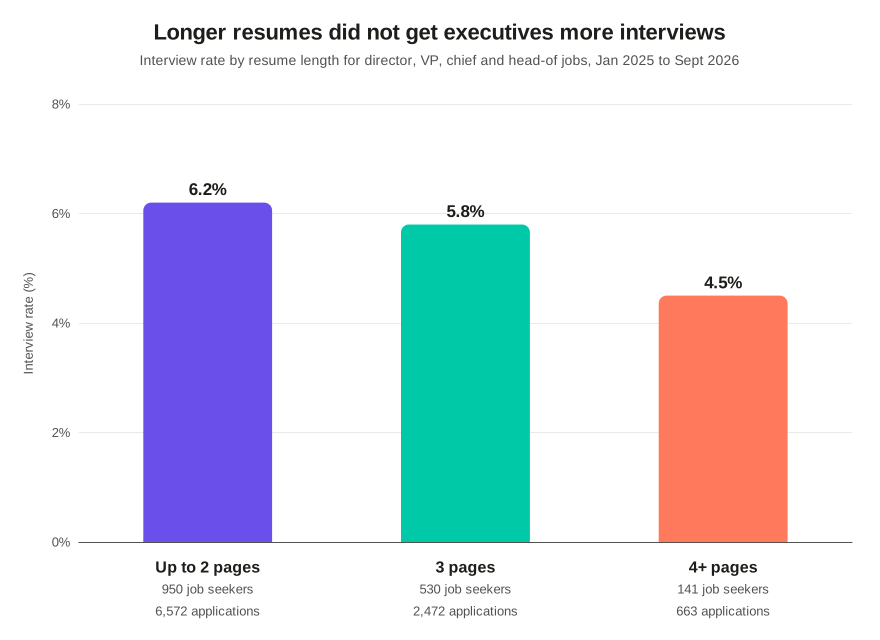
That gap may look small, but it adds up. Per application, resumes of up to 2 pages got about 38% more interviews than resumes of 4 or more pages.
The data shows a pattern, not proof that cutting pages causes more interviews. But the extra pages did not help. At the executive level, where every opportunity is high stakes and openings are scarce, one lost conversation can mean a missed role.
For resume length at every career level, see How Long Should a Resume Be?
Brevity & Focus Win
It's tempting to think a senior hire deserves a longer read. But executive decision makers aren't looking for a complete career history. They want clear proof, as fast as possible, that you can deliver results at the scale they need.
A 2-page resume forces you to make choices. Leaders are paid to gather information, prioritize it, and then communicate what matters. You would think leaders would see how this applies to the job search, but a lot of people miss it.
Length also dilutes impact. When your most impressive accomplishment, say, growing a division from $40 million to $200 million, is hidden among lists of routine duties, it gets lost. Your accomplishments are what you need to get across, even if it means deleting less important responsibilities.
One Page Isn't Enough
It's also tempting to follow the 1-page rule. It seems neat and clean to have everything in one place. But executives have so much experience that squeezing it all in leads to tiny, hard-to-read type and far more information than a tight space can hold.
Or executives leave out important information that could have won them the job. They guess what the company needs to know about them. This usually doesn't go well, because they feel everything they've done is equally important.
How to Find Your Optimal Length
Your optimal resume length depends entirely on how well you address the company's needs and prove your leadership with impact and results. It may differ for each company you're considering. Every company, division, department and team has different needs, so what you tell each one may differ.
Here are some general guidelines:
Focus on the last 10 to 15 years
Recent roles carry the most weight. Condense older positions and board terms into a Related Experience section that lists company, title and any impact. There is no set amount of space for any of this.
Lead with outcomes, not duties
Replace “Responsible for overseeing sales operations” with “Grew revenue 42% in 2 years by restructuring the sales organization,” if that's what the company is looking for right now. Quantified results that address the company's needs prove your point.
Write a sharp executive summary
Use 2 or 3 statements that prove to the reader you have solved their problems before. For ideas, see these resume summary examples.
Cut what doesn't serve the target role
Every bullet should make the case for the job you want next. You don't need to document every job you've had.
Huntr's data points the same way for bullets. For the same kinds of executive jobs, resumes with an average of 3 to 4 bullets per job got interviews on 6.4% of applications. Resumes with 7 or more bullets per job got 4.6%. Again, this is a pattern, not proof. But more bullets did not mean more interviews.
To trim a long resume for each role, see how to tailor a resume to a job description, or try the Huntr resume tailor.
Longer does not mean more helpful, and shorter does not mean more concise.

Soozy G. Miller
Soozy G. Miller, CPRW, CDCC, CDP, is an executive career coach with 30 years of experience in professional business writing. As a certified behavior analyst, Master Resume Writer and recruiter, she brings deep expertise in executive leadership behavior, hiring software and the full hiring process. She has helped hundreds of executives around the world land their dream jobs. Yahoo Finance named her a Top 10 Communications Coach, and her insights have been featured in Bloomberg, Yahoo News, MarketWatch, Street Insider and on multiple radio shows. Her bestselling book, Control Your Career: 5 Steps to Stand Out and Get the Job You Want, has been an Amazon #1 in 3 categories since its release. Learn more at linkedin.com/in/soozymiller.
Get More Interviews, Faster
Huntr streamlines your job search. Instantly craft tailored resumes and cover letters, fill out application forms with a single click, effortlessly keep your job hunt organized, and much more...
AI Resume Builder
Beautiful, perfectly job-tailored resumes designed to make you stand out, built 10x faster with the power of AI.
Next-Generation Job Tailored Resumes
Huntr provides the most advanced job <> resume matching system in the world. Helping you match not only keywords, but responsibilities and qualifications from a job, into your resume.
Job Keyword Extractor + Resume AI Integration
Huntr extracts keywords from job descriptions and helps you integrate them into your resume using the power of AI.
Application Autofill
Save hours of mindless form filling. Use our chrome extension to fill application forms with a single click.
Job Tracker
Move beyond basic, bare-bones job trackers. Elevate your search with Huntr's all-in-one, feature-rich management platform.
AI Cover Letters
Perfectly tailored cover letters, in seconds! Our cover letter generator blends your unique background with the job's specific requirements, resulting in unique, standout cover letters.
Resume Checker
Huntr checks your resume for spelling, length, impactful use of metrics, repetition and more, ensuring your resume gets noticed by employers.
Gorgeous Resume Templates
Stand out with one of 7 designer-grade templates. Whether you're a creative spirit or a corporate professional, our range of templates caters to every career aspiration.
Personal Job Search CRM
The ultimate companion for managing your professional job-search contacts and organizing your job search outreach.
Huntr
Blog Product Updates Resume Skill Guides Resume Examples Interview Question Guides Research 2025 Job Search Trends Report Affiliate Program Careers Privacy policy Terms of service Write for us LinkedIn Reddit r/HuntrCo Twitter @TryHuntr Email UsProduct
Job Tracker AI Resume Builder Resume Tailor Resume Checker AI Cover Letters Resume Summary Generator Resume Bullet Generator Resume Skills Generator Resume Headline Generator Resume Keyword Scanner Job Keyword Finder Targeted Resume Contact Tracker Interview Tracker Job Search Metrics Job Application Autofill Resume Storage AI Resume Review Job Clipper Resume Optimization ChatGPT Resume Builder Resume Fixer LinkedIn Resume Builder AI Resume Rewriter Interview Question Generator