
Huntr Blog
How Long Should a Resume Be? Data From 100,644 Applications
November 21, 2026
“Does my resume have to fit on 1 page?” I hear this on my 1,000+ free one-on-one Huntr job search support calls more than almost any other question. It comes mostly from people with a few years of experience. Many have spent hours cutting real results to hit an old rule.
So I checked how resume length related to interview rates in Huntr’s data: 100,644 job applications that 8,955 job seekers sent with a tailored resume from January 2024 to September 2026.
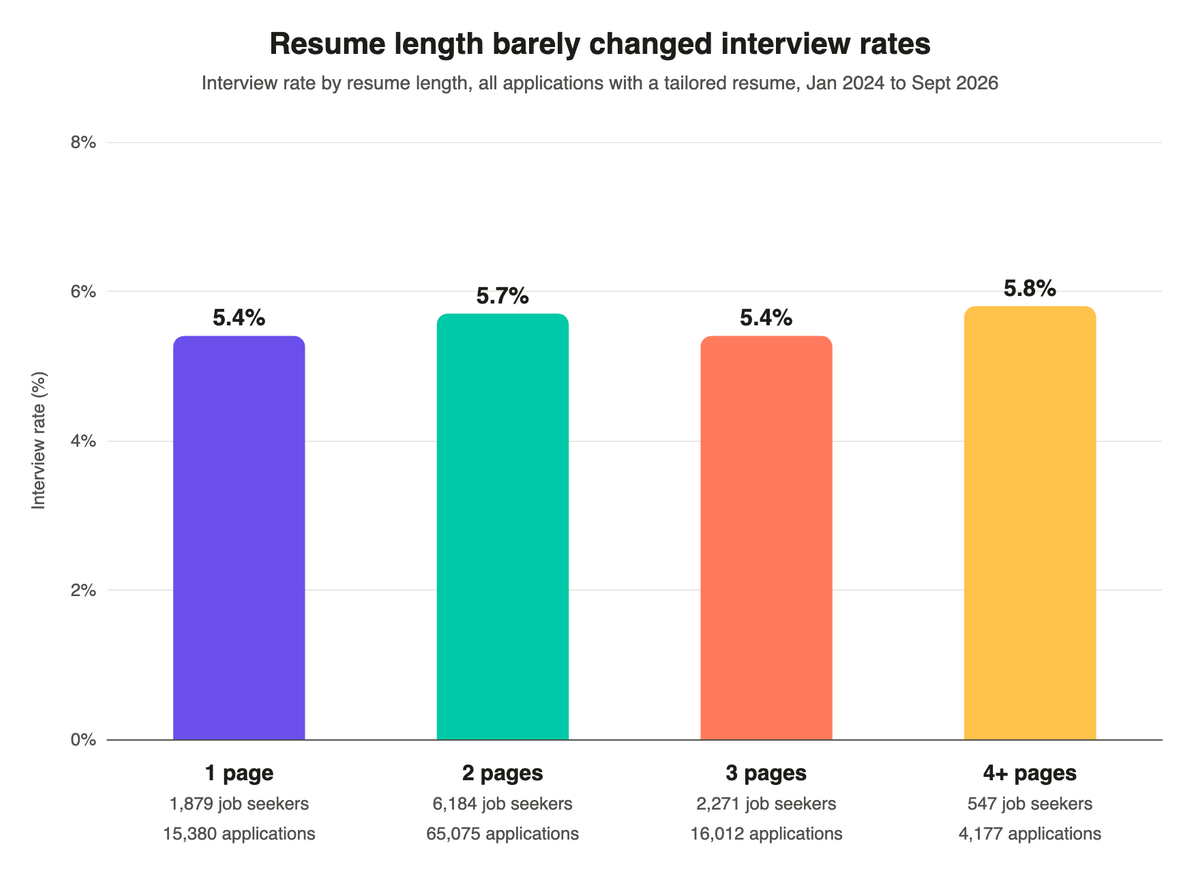
Most resumes should be 1 or 2 pages. In that data, 1-page resumes got interviews on 5.4% of applications and 2-page resumes on 5.7%, so use the length your relevant results need. The lowest rate came from 3+ page resumes sent by people with 3 to 5 years of experience: 3.8%. US federal jobs cap resumes at 2 pages, and academic and medical CVs can run longer.
How many pages should a resume be?
The right length depends mostly on how much relevant experience you have.
| Your situation | Best length (interview rate) |
| Student or 0 to 2 years | 1 page, or 2 with real work or projects (1 page: 5.9%, 2 pages: 5.8%) |
| 3 to 5 years | 1 or 2 pages. Avoid 3 (3+ pages: 3.8%, the lowest) |
| 6 to 9 years | 1 or 2 pages (all lengths: 6.1% to 7.1%) |
| 10 to 19 years | 2 pages, the most common choice (2 pages: 7.8% to 7.9%) |
| 20+ years | 2 pages, or 3 if the role needs it (2 pages: 7.3%, 3+ pages: 8.1%) |
| Director, VP or chief | 1 or 2 pages. Avoid 4+ (4+ pages: 5.3%, the lowest) |
| US federal jobs | 2 pages at most (required since 2025) |
| Academic or medical CV | As long as the format requires |
Table rates count at most 25 applications per job seeker, so a few very active users can’t swing them.
Does resume length affect interview rates?
Across 100,644 applications, page count barely moved interview rates. 1-page resumes got interviews on 5.4% of applications, 2-page resumes on 5.7%, 3-page resumes on 5.4% and 4+ page resumes on 5.8%.
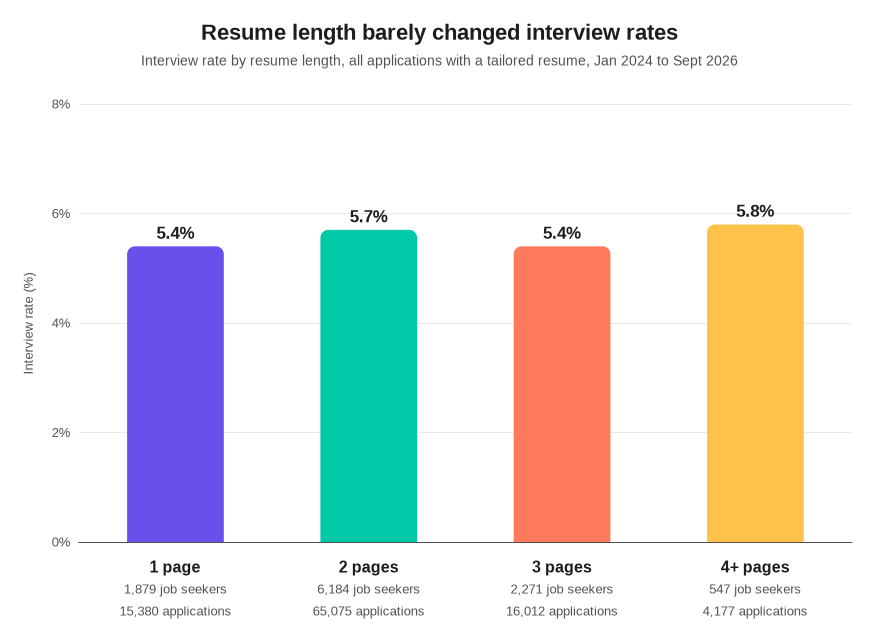
2 pages was the most common length by far, at 65% of applications. The median resume ran 1.8 pages.
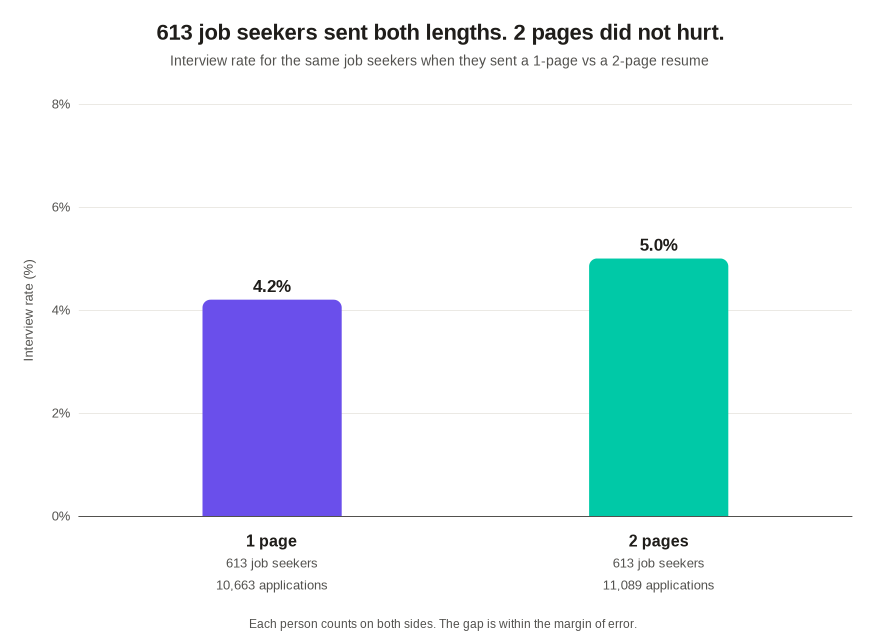
Averages can hide who sends which length. So I also looked at the 613 job seekers who sent both a 1-page and a 2-page resume. They got interviews on 4.2% of applications with 1 page and 5.0% with 2 pages.
That gap sits within the margin of error, so the 2nd page did not hurt them. For the 1,085 people who sent both 2 pages and 3 or more, there was no clear difference either.
My read: recruiters care far more about whether your resume fits the job than how many pages it runs. In our Q2 2026 Job Search Trends Report, applications with a resume tailored to the job got interviews 5.7% of the time, vs 3.1% for untailored ones. That gap is far bigger than any gap from length. The Huntr Resume Tailor matches your resume to each job description.
How long should a resume be by years of experience?
Length made little difference at most career stages.
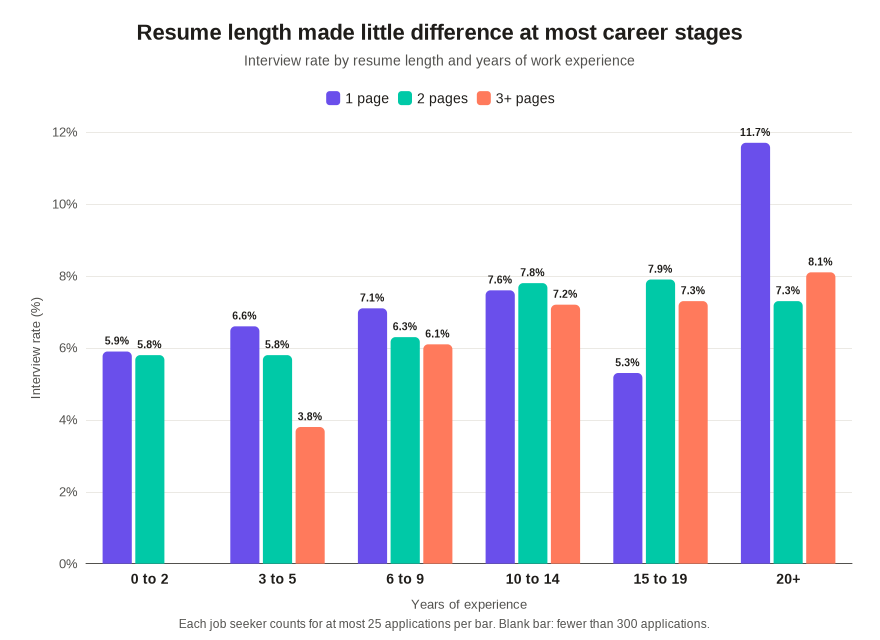
- 0 to 2 years: 1 page and 2 pages did about the same, 5.9% vs 5.8%. A full 2nd page of internships, research or projects did not hurt.
- 3 to 5 years: 3+ page resumes had the lowest rate of any experience group, 3.8%, vs 6.6% for 1 page and 5.8% for 2 pages. My read: at this stage a 3rd page is usually padding.
- 6 to 19 years: No length clearly won. Rates ran from 6.1% to 7.9%. The one dip, 5.3% for 1 page at 15 to 19 years, came from just 98 job seekers.
- 20+ years: 1-page resumes did best, at 11.7%, but only 149 job seekers sent one. Most people at this stage sent 2 pages (7.3%) or 3+ (8.1%).
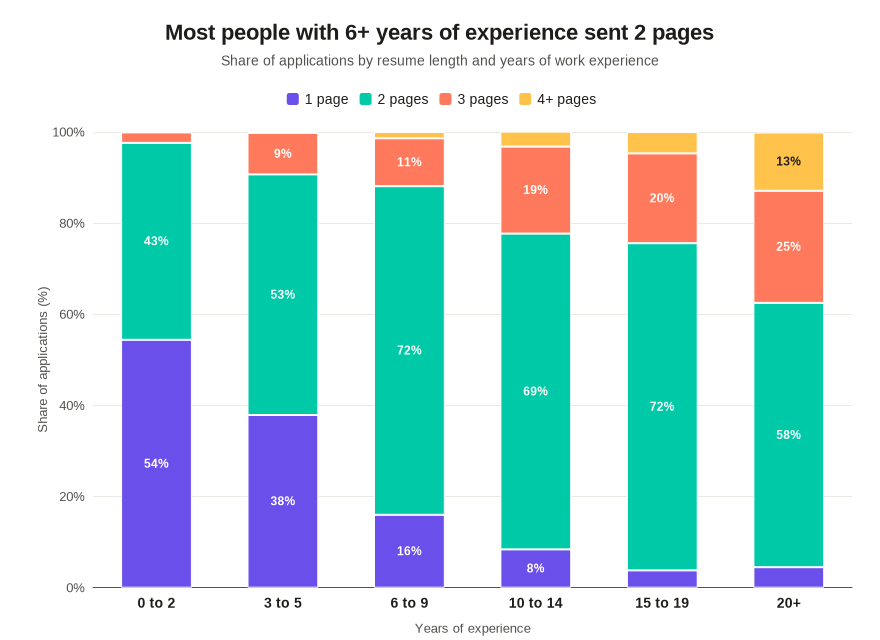
Most people with 0 to 2 years of experience sent 1 page (54%). From 6 to 19 years, about 7 in 10 sent 2 pages, and at 20+ years, 37% sent 3 or more.
For a single-quarter view, see resume page count by experience in our Q3 2026 Job Search Trends Report.
Resume length by job level
Job level here comes from words in the job title, like “junior,” “senior,” “manager” or “director.”
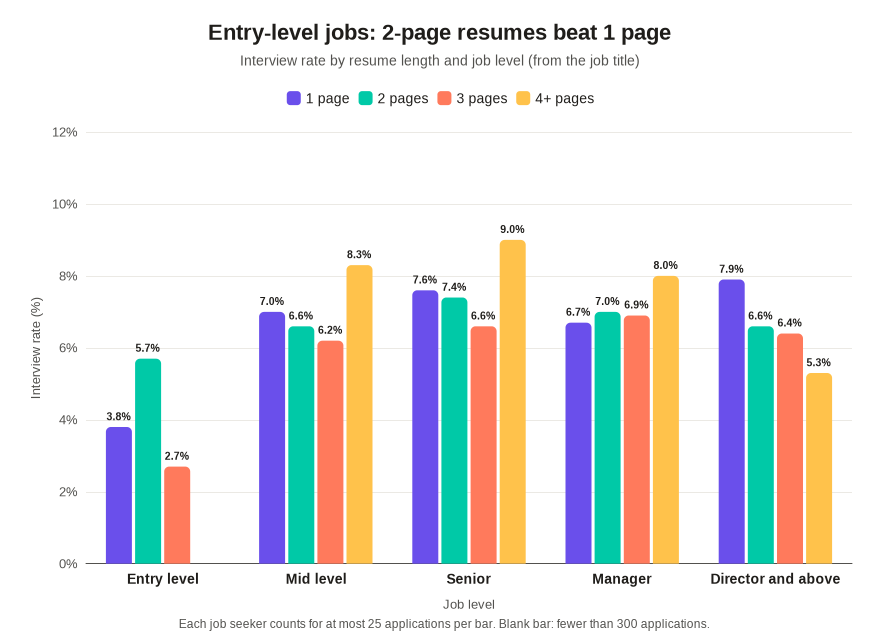
- Entry-level jobs: 2-page resumes got interviews on 5.7% of applications, vs 3.8% for 1 page. Part of that gap may come from people with more experience applying to entry-level roles.
- Mid-level, senior and manager jobs: 1 and 2 pages landed within 0.4 points of each other at each level. 4+ page resumes did well here too, at 8.0% to 9.0%, from smaller groups of 165 to 284 job seekers.
- Director and above: 4+ page resumes had the lowest rate, 5.3%, vs 6.6% for 2 pages. 1 page did best, at 7.9%, from 104 job seekers. Executive career coach Soozy G. Miller explains how long an executive resume should be.
Resume length by industry
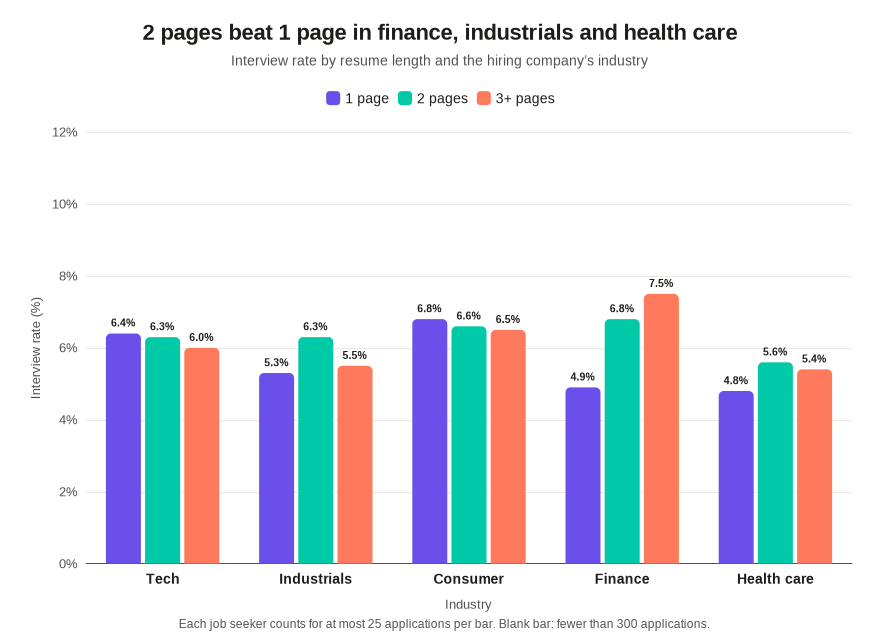
In finance, industrials and health care, 2-page resumes beat 1 page. Finance showed the widest spread: 4.9% for 1 page, 6.8% for 2 pages and 7.5% for 3 or more. At tech and consumer companies, every length landed within 0.4 points.
1-page vs 2-page resume: which should you use?
If you match both lists, pick 2 pages.
When to use a 1-page resume
- You have under about 5 years of experience and your best results fit on 1 page.
- Your 2nd page is mostly old jobs, duties or filler.
When to use a 2-page resume
- You have 5+ years of relevant results.
- You are senior and the job calls for a record of leading teams, budgets or programs.
- Cutting to 1 page would mean dropping results the job asks for.
- You are applying for a US federal job. The Office of Personnel Management limits federal resumes to 2 pages.
How to make your resume more concise
- Lead with your best numbers. Open your summary with your most impressive results, like revenue, savings, growth or team size. These resume summary examples show how.
- Keep 3 to 5 bullets per job. Use fewer for older roles.
- Write results. “Cut onboarding time from 3 weeks to 1” beats “Responsible for onboarding.”
- Drop what nobody needs. References, your full street address, a photo, and high school once you have a degree.
- Keep it readable. Do not shrink fonts or margins to force a fit. In our data, 28% of job seekers who sent a 1-page resume shrank the font to fit. Our best resume format research found tiny text is not worth it.
- Tailor each version to the job. The Huntr Resume Tailor keeps what the job asks for. Starting from scratch? Try the Huntr AI Resume Builder.
Check your resume in minutes
Huntr flags weak bullets and filler so every page earns its place. Free to start.
How I got these numbers
I pulled every job saved in the Huntr job tracker from January 2024 to September 2026 that the job seeker marked as applied and that had a resume tailored for that job in Huntr. That gave 100,644 applications from 8,955 job seekers. The interview rate is the share of those applications the job seeker marked as an interview.
- Page count is the tailored resume’s measured length, rounded up. Up to 1.0 page counts as 1 page, over 1.0 to 2.0 as 2 pages, and so on.
- Years of experience run from the earliest start date in the resume’s work history to the date the resume was made.
- Job level comes from the job title: intern, junior or entry for entry level; senior, lead, principal or staff for senior; manager; and director, VP, chief or head of for director and above. All other titles count as mid level.
- Industry is the hiring company’s sector. We know it for 65% of applications.
- A few job seekers logged hundreds of applications. In the charts by experience, job level and industry, each job seeker counts for at most 25 applications per bar, and groups with fewer than 300 applications are left out. The overall chart counts every application.
- I left out applications sent through an auto-apply service.
What these numbers can and can’t tell you
These numbers come from Huntr users who tailored their resume, and they chose their own length. This was no controlled test, so the data can’t show cause. Some job seekers don’t log every interview, so true interview rates run higher. No length guarantees an interview.
Resume length FAQ
How long should a resume be?
1 or 2 pages for most people. In Huntr’s data from 100,644 applications, 1-page resumes got interviews on 5.4% of applications and 2-page resumes on 5.7%. Use the length your relevant results need.
Is a 2-page resume OK?
Yes. 2 pages was the most common length, at 65% of applications, and it did about as well as 1 page at most career stages. It beat 1 page for entry-level jobs.
Should a resume be 1 page?
Only if your best, most relevant results fit on 1 page. For most people early in their career, they will. For many experienced people, they won’t, and that is fine.
Can a resume be 3 pages?
For most jobs, avoid it. At 3 to 5 years of experience, 3+ page resumes had a 3.8% interview rate, the lowest of any experience group. Academic and medical CVs, which list publications, grants and licenses, and some senior roles are the exceptions. Even then, put your best results on page 1.
How long should a resume be with 10 years of experience?
2 pages. At 10 to 14 years of experience, 1-page and 2-page resumes did about the same, 7.6% vs 7.8%. 2 pages was by far the most common choice, at 69% of applications.
How long should a federal resume be?
No more than 2 pages. The US Office of Personnel Management set a 2-page limit for federal resumes in 2025.
Does resume length matter for ATS?
No. Applicant tracking systems read every page. Length matters for the person reading it, so make page 1 count. More on this in how applicant tracking systems actually work.
Should I shrink my font to fit 1 page?
No. Cut words instead. Tiny text makes a resume harder to read, and our best resume format research found it is not worth it.

Sam Wright
Sam Wright is the Head of Career Strategy at Huntr. Drawing on proprietary data from 1.7 million applications, 1 million job postings, 243,000 résumés, and a 1,049-respondent survey, Sam provides actionable, data-driven blueprints to help professionals navigate today's fractured hiring landscape. He has conducted over 900+ free support calls with job seekers, giving him frontline insight into today's job market. His work and insights have been featured in Business Insider, The Wall Street Journal, Forbes, and The Seattle Times.
Outside the tech world, Sam is a part-time farmer from a five-generation legacy of organic vegetable farming. He is a passionate advocate for farmland preservation.
Get More Interviews, Faster
Huntr streamlines your job search. Instantly craft tailored resumes and cover letters, fill out application forms with a single click, effortlessly keep your job hunt organized, and much more...
AI Resume Builder
Beautiful, perfectly job-tailored resumes designed to make you stand out, built 10x faster with the power of AI.
Next-Generation Job Tailored Resumes
Huntr provides the most advanced job <> resume matching system in the world. Helping you match not only keywords, but responsibilities and qualifications from a job, into your resume.
Job Keyword Extractor + Resume AI Integration
Huntr extracts keywords from job descriptions and helps you integrate them into your resume using the power of AI.
Application Autofill
Save hours of mindless form filling. Use our chrome extension to fill application forms with a single click.
Job Tracker
Move beyond basic, bare-bones job trackers. Elevate your search with Huntr's all-in-one, feature-rich management platform.
AI Cover Letters
Perfectly tailored cover letters, in seconds! Our cover letter generator blends your unique background with the job's specific requirements, resulting in unique, standout cover letters.
Resume Checker
Huntr checks your resume for spelling, length, impactful use of metrics, repetition and more, ensuring your resume gets noticed by employers.
Gorgeous Resume Templates
Stand out with one of 7 designer-grade templates. Whether you're a creative spirit or a corporate professional, our range of templates caters to every career aspiration.
Personal Job Search CRM
The ultimate companion for managing your professional job-search contacts and organizing your job search outreach.
Huntr
Blog Product Updates Resume Skill Guides Resume Examples Interview Question Guides Research 2025 Job Search Trends Report Affiliate Program Careers Privacy policy Terms of service Write for us LinkedIn Reddit r/HuntrCo Twitter @TryHuntr Email UsProduct
Job Tracker AI Resume Builder Resume Tailor Resume Checker AI Cover Letters Resume Summary Generator Resume Bullet Generator Resume Skills Generator Resume Headline Generator Resume Keyword Scanner Job Keyword Finder Targeted Resume Contact Tracker Interview Tracker Job Search Metrics Job Application Autofill Resume Storage AI Resume Review Job Clipper Resume Optimization ChatGPT Resume Builder Resume Fixer LinkedIn Resume Builder AI Resume Rewriter Interview Question Generator